Bringing family members to Australia requires meeting strict eligibility criteria. The process involves multiple visa categories, each with different requirements around relationships, finances, and personal circumstances.
At Jameson Law, we help families navigate family visa Australia eligibility requirements every day. Understanding what the Department of Home Affairs expects from your application is the first step toward a successful outcome.
What Family Visa Options Match Your Situation
Australia’s family visa system offers distinct pathways depending on your relationship to the person sponsoring you and whether you’re seeking temporary or permanent residency. The Department of Home Affairs manages multiple visa subclasses, each designed for different family circumstances. Your specific family relationship category determines which visa subclass suits your circumstances and what documentation you’ll need to prepare.
Partner and Spouse Visas
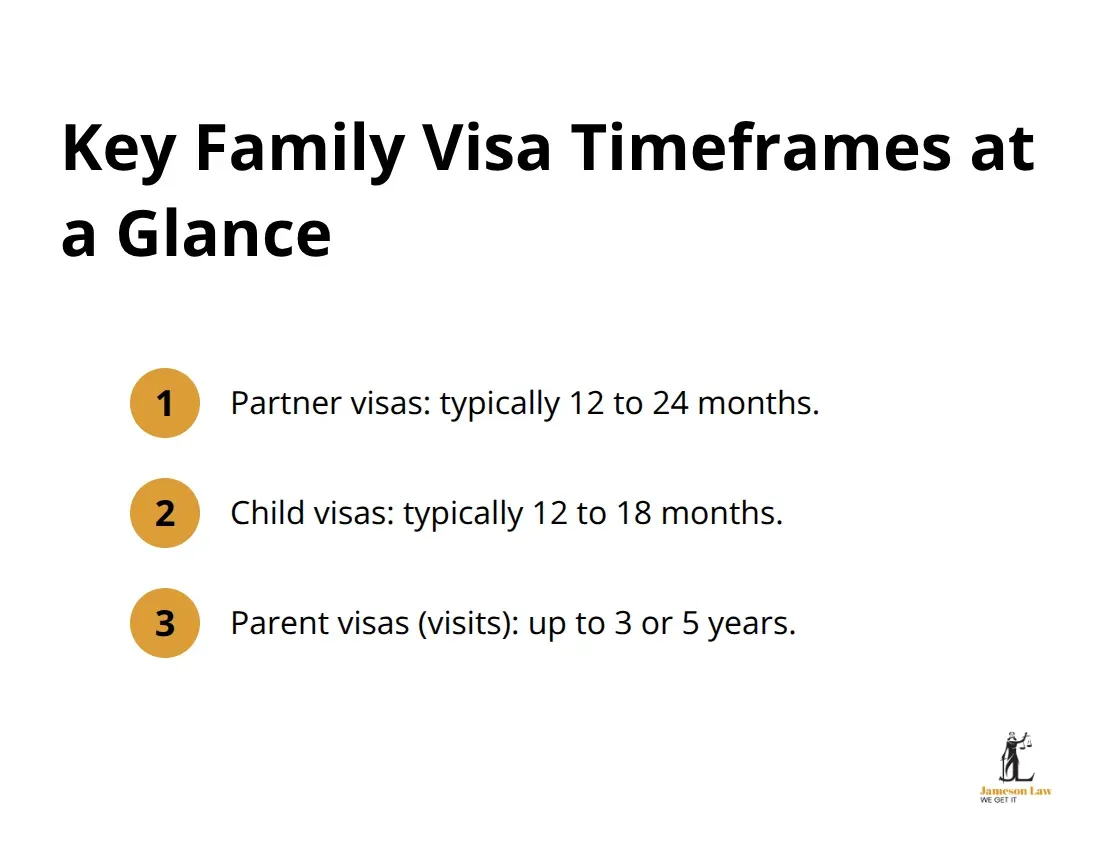
Partner and spouse visas represent the largest family visa stream in Australia. Australian citizens and permanent residents can sponsor their overseas partners for permanent residency through these visas. The partner visa process typically takes 12 to 24 months, though some applications exceed this timeline.
Financial requirements for partner visas are substantial. Sponsors must demonstrate they can support their partner and meet annual income thresholds set by the Department of Home Affairs. The genuine relationship requirement is strict; the Department examines evidence of cohabitation, joint financial commitments, and family support. Many applications fail because applicants provide insufficient evidence of genuine commitment rather than formal marriage alone.
Parent Visas
Parent visas let a parent of an Australian citizen, Australian permanent resident or eligible New Zealand citizen visit Australia for up to 3 or 5 years. Australian citizens and permanent residents can sponsor their parents for permanent residency, but parent visa sponsorship requires meeting strict financial and health requirements.
The sponsor must demonstrate the capacity to support their parents financially. The Department assesses whether parents are likely to become dependent on government services. This assessment directly influences whether your application will succeed or face refusal.
Child and Dependent Visas
Child visas apply when Australian citizens or permanent residents sponsor dependent children, including adopted children and stepchildren. Processing for child visas typically takes 12 to 18 months.
Dependent child visas have more flexible financial requirements than partner visas, but the relationship must be clearly established through birth certificates, adoption orders, or other official documentation. The Department requires clear proof of your connection to the child before it will approve your application.
Health and Character Requirements
Each visa category requires health assessments through approved civil surgeons and character checks through the Australian Federal Police. These assessments apply regardless of which family visa category you pursue.
Applications submitted through ImmiAccount (the Department of Home Affairs’ official portal) allow you to track progress and respond to requests for additional information. Understanding which visa category applies to your family situation is the foundation for a successful application-and knowing your specific requirements helps you gather the right documentation before you submit.
What You Must Prove for Your Application
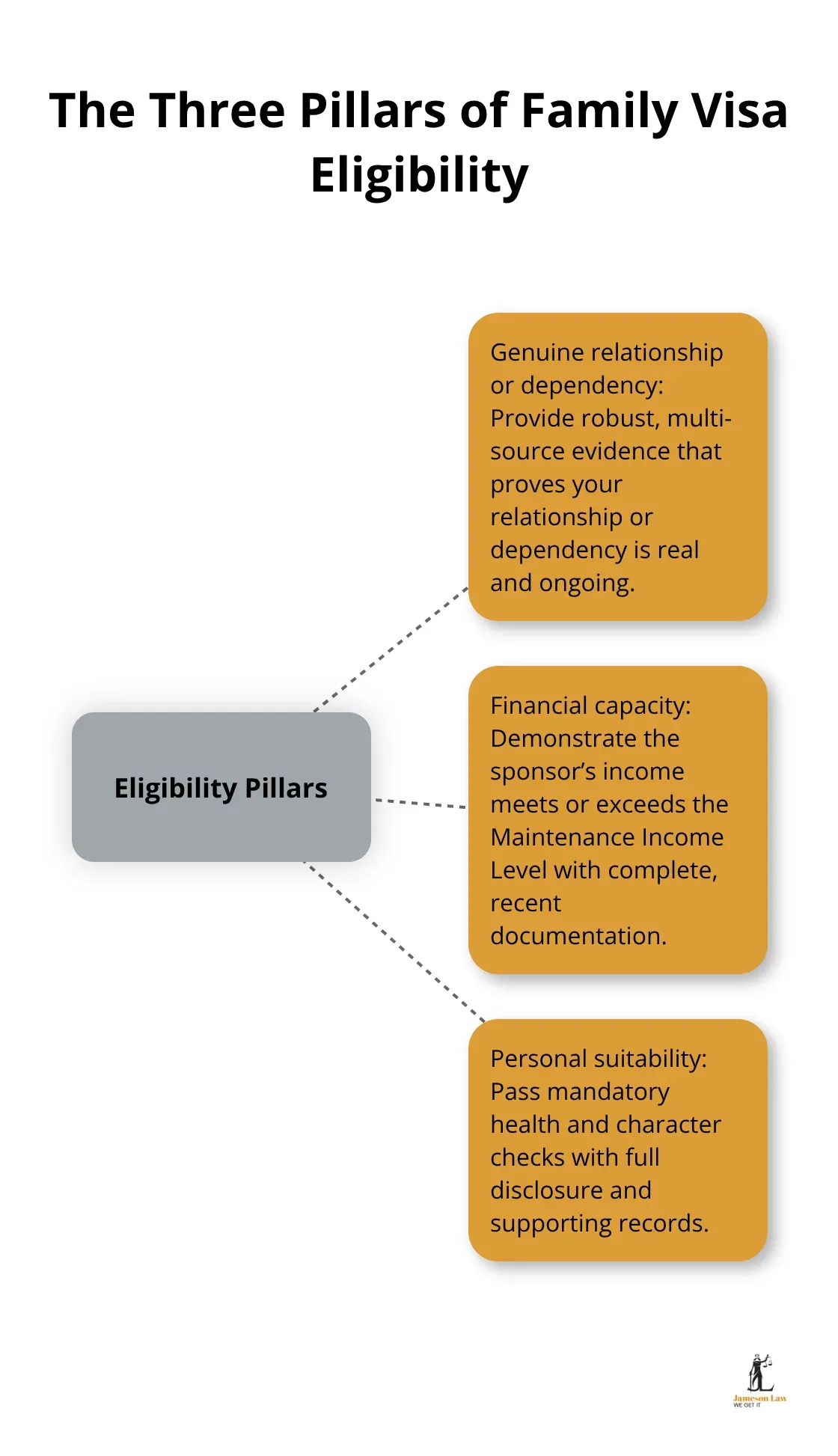
The Department of Home Affairs assesses family visa applications against three interconnected eligibility pillars: genuine relationship or dependency, financial capacity, and personal suitability. Applicants often focus on one area while neglecting others, which leads to refusal. The Department examines all three simultaneously, and weakness in any single area can sink an otherwise strong application.
Demonstrating Genuine Relationship and Dependency
Genuine relationship or dependency sit at the heart of every family visa decision. For partner visas, the Department requires concrete evidence of cohabitation, shared financial arrangements, joint property ownership, and mutual family recognition. Many applicants submit marriage certificates alone and expect approval; this approach fails consistently. The Department wants evidence spanning at least two years of the relationship, including joint bank statements, lease agreements, utility bills in both names, and statutory declarations from friends or family members who can attest to the relationship’s authenticity.
Child visas demand proof of legal guardianship through birth certificates or adoption orders, plus evidence that the child genuinely depends on the sponsoring parent for financial and emotional support. Parent visas require the opposite: proof that the Australian citizen or permanent resident genuinely depends on their parent for care or support, which is rarely met and explains why parent visa refusals run high. The Department scrutinises applications where relationships appear transactional or where dependency claims lack supporting evidence.
Meeting Financial Thresholds
Financial requirements operate as a hard threshold that eliminates applications immediately if unmet. Sponsors must demonstrate annual income exceeding the Maintenance Income Level, which the Department of Home Affairs updates annually. For partner visas, this threshold typically sits around AUD 90,000 gross annual income, though it varies based on family size and dependants. Applicants often misunderstand this requirement, believing their partner’s income counts toward the threshold; it does not. Only the sponsor’s income matters.
The Department verifies income through tax returns covering the previous two financial years, payslips, and employment letters. If you are self-employed, the Department demands profit and loss statements plus accountant’s reports. Many applications fail because applicants submit incomplete financial documentation or because their income falls marginally below the threshold. If your income sits close to the limit, strengthening other application areas-particularly relationship evidence-becomes critical to offset financial weakness.
Passing Health and Character Assessments
Health and character assessments operate as non-negotiable gates rather than flexible criteria. All family visa applicants must obtain medical examinations from Department-approved civil surgeons and undergo character checks through the Australian Federal Police. Health assessments screen for serious infectious diseases and conditions likely to significantly cost the Australian healthcare system. Character assessments examine criminal history, driving offences, and conduct that suggests the applicant poses a risk to Australian community safety.
Neither assessment is negotiable; if you fail either, your application receives refusal regardless of relationship strength or financial capacity. Applicants sometimes attempt to hide criminal history, hoping the character check misses it; this strategy guarantees refusal and may result in a permanent visa bar. Honesty throughout the application process, including disclosure of any character or health concerns, gives you the best chance of a fair assessment. Once you understand what the Department expects across these three pillars, the next step involves preparing your specific documentation package-and knowing exactly which documents matter most for your visa category will determine whether your application succeeds or faces unnecessary delays.
Why Family Visa Applications Fail
Financial Shortfalls Eliminate Applications Immediately
Financial inadequacy ranks as the single most common refusal reason across all family visa categories. Sponsors underestimate the income threshold or submit incomplete documentation that fails to prove their capacity. The Maintenance Income Level for partner visas sits around AUD 90,000 gross annual income, yet applicants regularly submit payslips showing income marginally below this figure and expect approval. The Department of Home Affairs does not exercise discretion here; if your income falls short, your application receives refusal.
Self-employed applicants face particular difficulty because the Department demands two years of tax returns plus accountant verification, and many sole traders cannot demonstrate consistent income across that period. Partners working part-time or on casual contracts struggle similarly because the Department counts only reliable, ongoing income. Applicants attempting to strengthen weak finances by including their partner’s income in the calculation discover this strategy fails; only the sponsor’s income counts toward the threshold.
If your income sits close to the limit, the Department scrutinises relationship evidence more intensely, searching for reasons to refuse. Reapplying without increasing your income simply invites another refusal.
Inadequate Relationship Evidence Creates Doubt
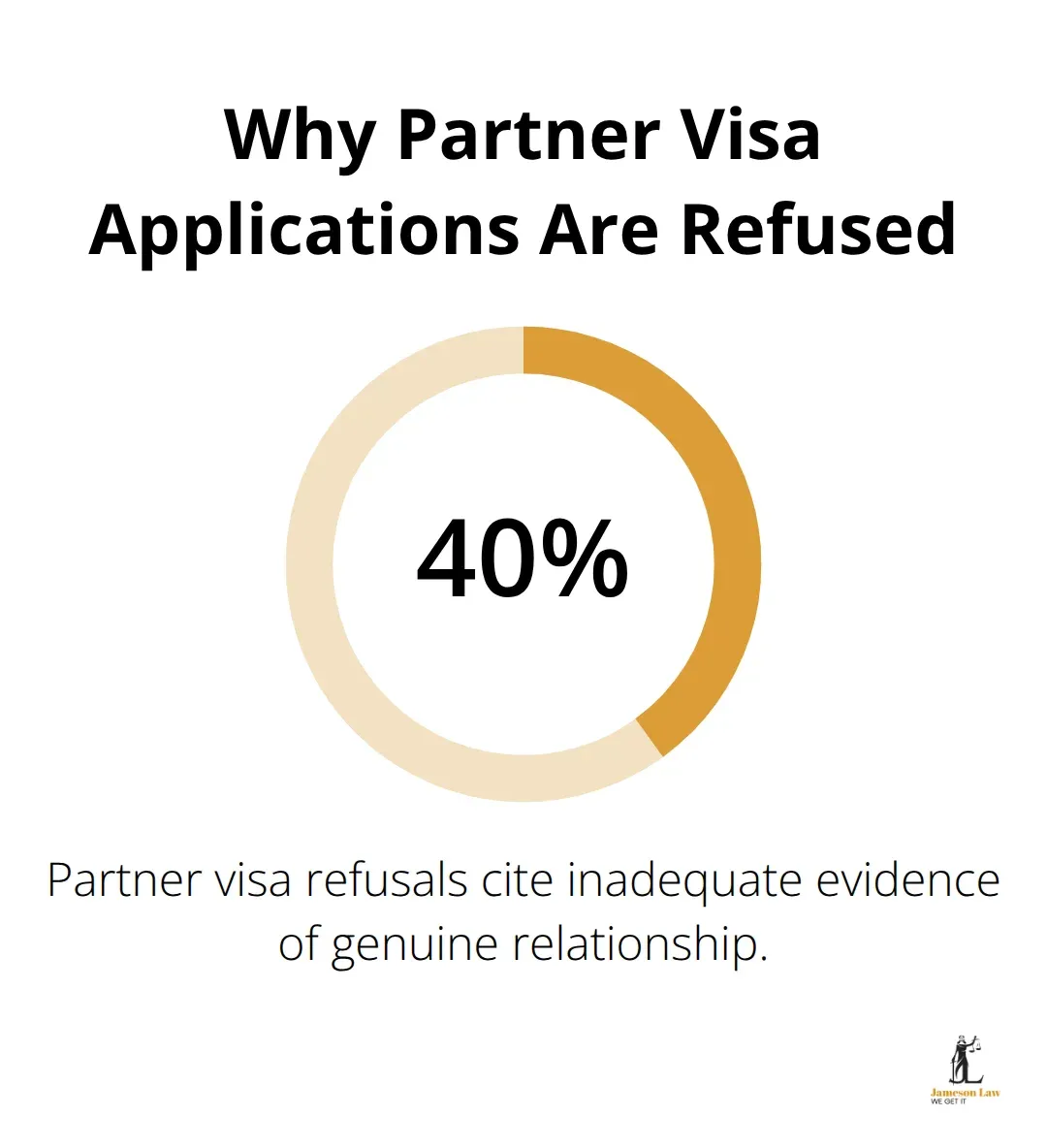
Genuine relationship failures reflect inadequate evidence rather than relationship weakness itself. Applicants submit marriage certificates, a few photographs, and statutory declarations expecting approval; the Department views this as insufficient. Partner visa refusals cite inadequate evidence of genuine relationship in approximately 40 per cent of cases according to Department reporting.
The Department demands documentary evidence spanning at least two years covering cohabitation, financial interdependence, and family integration. Joint bank statements showing regular transfers between partners, lease agreements or mortgage documents in both names, utility bills addressed to both parties, and joint tax returns all strengthen applications significantly. Statutory declarations from friends, family members, employers, or community figures who can attest to the relationship’s authenticity carry substantial weight.
Many applicants fail to gather this evidence before submitting, assuming the relationship speaks for itself. This assumption costs them their application.
Health and Character Issues Function as Absolute Bars
Character and health refusals operate as absolute bars rather than negotiable issues. Any criminal conviction, regardless of how minor or how long ago, triggers character concerns that require formal assessment. Driving offences (including drink-driving convictions, traffic violations resulting in licence suspension, or accumulated demerit points) all appear in character checks and create barriers.
Health assessments screen for serious infectious diseases and medical conditions likely to cost the Australian healthcare system significantly. Applicants occasionally attempt to withhold information about criminal history or medical conditions, believing the Department will not discover it; this approach guarantees refusal and creates a permanent visa bar that prevents future applications.
Applicants with character or health concerns must disclose these issues upfront and provide comprehensive supporting documentation explaining circumstances and demonstrating rehabilitation or treatment compliance. Honesty at the application stage, though difficult, produces better outcomes than concealment discovered during assessment.
Final Thoughts
Family visa Australia eligibility rests on three interconnected factors: demonstrating genuine relationship or dependency, meeting strict financial thresholds, and passing health and character assessments. Each pillar carries equal weight, and weakness in any single area creates refusal risk. Successful applicants address all three requirements simultaneously rather than focusing on one area while neglecting others.
The Department of Home Affairs applies consistent standards across all family visa categories without exception. Your relationship must be genuine and thoroughly documented through joint financial records, lease agreements, and statutory declarations from people who know you. Your income must meet the Maintenance Income Level, and your health and character must satisfy absolute requirements with no discretion available.
Many applicants underestimate the documentation burden before submission, which leads to costly delays and rejection. If you are uncertain about your eligibility or need guidance preparing your application, we at Jameson Law provide immigration law assistance to help families navigate these requirements and prepare applications that meet Department standards. Seeking professional legal advice early prevents mistakes that result in refusal.