Partner visa eligibility in Australia depends on meeting several specific requirements set by the Department of Home Affairs. Whether you’re in a de facto relationship or married, understanding these criteria is the first step toward a successful application.
At Jameson Law, we’ve helped countless clients navigate the partner visa process. This guide breaks down the key eligibility factors, visa types, and what to expect during assessment.
What You Actually Need to Meet Partner Visa Requirements
Demonstrating a Genuine Relationship
To qualify for a partner visa in Australia, you must satisfy the Department of Home Affairs that your relationship is genuine and that you meet specific personal and financial criteria. The relationship itself forms the foundation-whether you’re married or in a de facto partnership, you must provide substantial evidence of commitment, shared finances, joint living arrangements, and social recognition from friends and family. For de facto couples, the Department typically requires 12 months of continuous cohabitation, though this requirement can be waived if you register your relationship in a state or territory that offers relationship registration. Married couples do not face this waiting period. Your sponsor (the Australian citizen, permanent resident, or eligible New Zealand citizen) must obtain separate approval and meet character requirements, including obtaining an Australian Federal Police clearance. Without an approved sponsor, your application cannot proceed.
Health and Character Assessments
Health and character assessments run parallel to relationship verification. You must undergo a medical examination when the Department requests it, and you must obtain police certificates from every country where you lived for 12 months or longer since turning 16. The 8503 No Further Stay condition presents a significant barrier if your current visa carries it-this condition typically prevents you from applying for a partner visa unless the Department grants a waiver, which is difficult to obtain in practice.
Financial Requirements and Sponsorship Obligations
Your sponsor must demonstrate they can support you without relying on government assistance, though the Department does not impose a strict income threshold. Instead, they assess whether your sponsor’s income, assets, and any co-sponsors’ contributions are sufficient for your household size. If you apply onshore (subclass 820), you can lodge your application while in Australia and receive a bridging visa during processing, but work rights on that bridging visa are not automatic-you may need to request a waiver to gain permission to work.
Documentation and Processing Considerations
The application itself requires scanned, properly translated documents uploaded through ImmiAccount, and visa fees apply based on your circumstances. Processing times vary significantly depending on whether you apply onshore or offshore and the complexity of your case, with no guaranteed timeframe despite the Department publishing processing time estimates based on recently decided applications. Understanding these requirements positions you to prepare a stronger application, and the next section outlines the specific visa types available and how they differ in their pathways and conditions.
Your Partner Visa Options in Australia
Onshore and Offshore Pathways
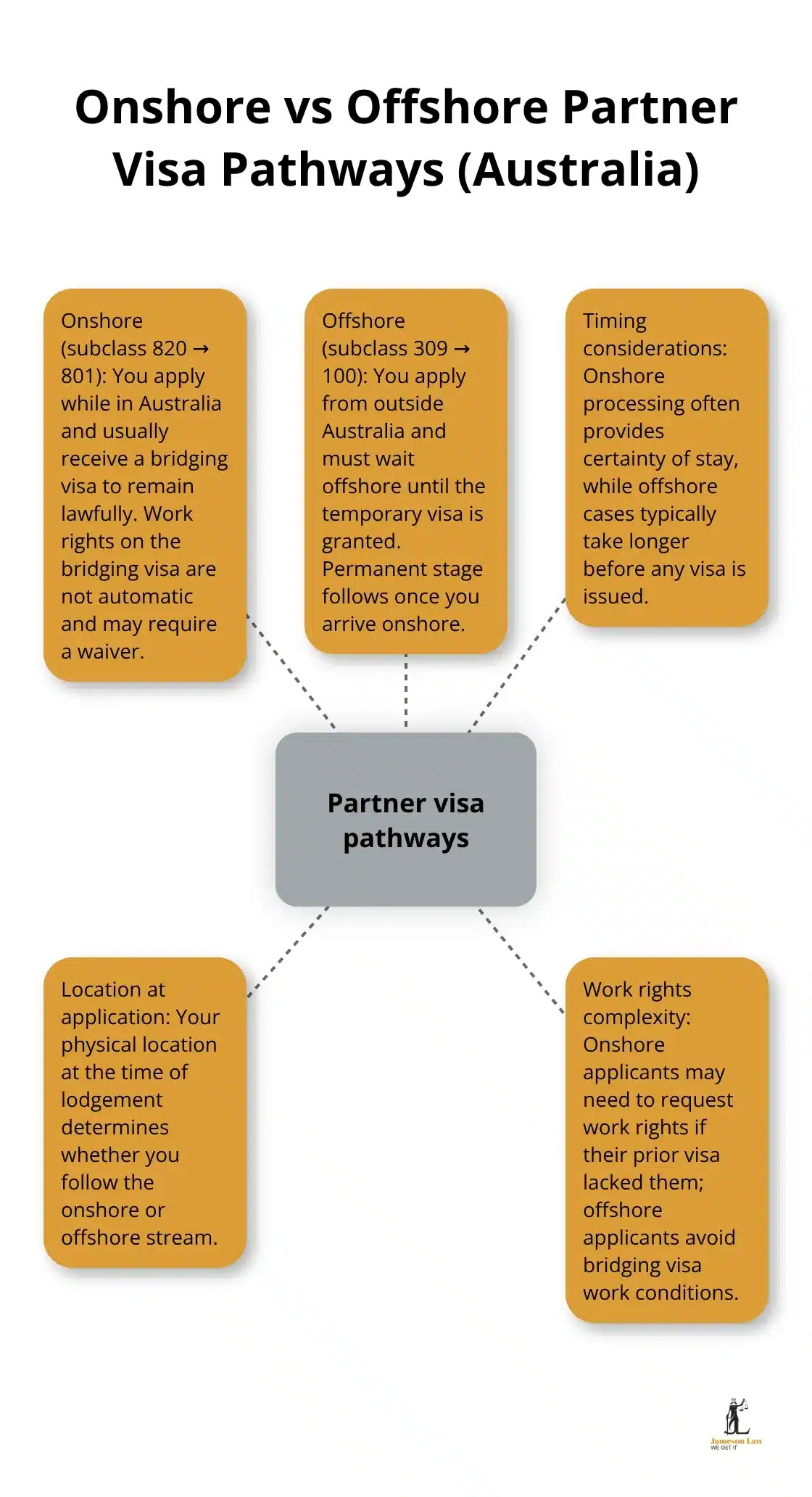
Australia offers two primary pathways for partner visas, each suited to different circumstances. The temporary partner visa (subclass 820) allows you to live in Australia while your permanent visa application is assessed, whereas the permanent partner visa (subclass 801) grants ongoing residency once approved. The key distinction lies in timing and your location at application. If you’re already in Australia, you’ll typically lodge the subclass 820 first, then transition to the 801 once the Department of Home Affairs approves your permanent status. The Department of Home Affairs data shows that onshore applications via this pathway provide certainty during processing because you can remain lawfully in Australia on a bridging visa. However, work rights on that bridging visa aren’t guaranteed-you may need to request a waiver if your original visa doesn’t permit employment. If you’re outside Australia, the offshore pathway (subclass 309 temporary, then subclass 100 permanent) applies instead, and you cannot enter Australia until your temporary visa is granted. This offshore route typically takes longer because the Department processes your application before any visa is issued, though it avoids the complexity of managing work rights during assessment.
De Facto Relationships and the 12-Month Requirement
De facto relationships follow the same visa pathways as married couples but carry an additional requirement: the Department of Home Affairs typically demands 12 months of continuous cohabitation as evidence of genuine commitment. This requirement can be waived if you register your relationship in a state or territory offering relationship registration, though availability varies significantly. Some states like New South Wales allow relationship registration, which effectively removes the 12-month waiting period, whereas other territories may not offer this option or may have different eligibility rules. Married couples bypass this requirement entirely.
Financial and Character Assessments for De Facto Couples
For de facto applicants, the financial and character assessments remain identical to married applicants-your sponsor must still obtain police clearance and demonstrate capacity to support you, and you must still provide health assessments and police certificates from countries where you’ve lived 12 months or longer since age 16. The practical advantage of relationship registration is speed; if your state permits it and you qualify, registering before you lodge your visa application removes a significant processing barrier and strengthens your evidence of genuine commitment simultaneously.
Understanding which pathway suits your circumstances-and whether relationship registration applies to you-shapes how you prepare your application. The next section outlines the specific documentation and evidence the Department requires, along with what to expect during the assessment process itself.
What Documentation and Evidence the Department Actually Reviews
Financial Evidence That Demonstrates Shared Commitment
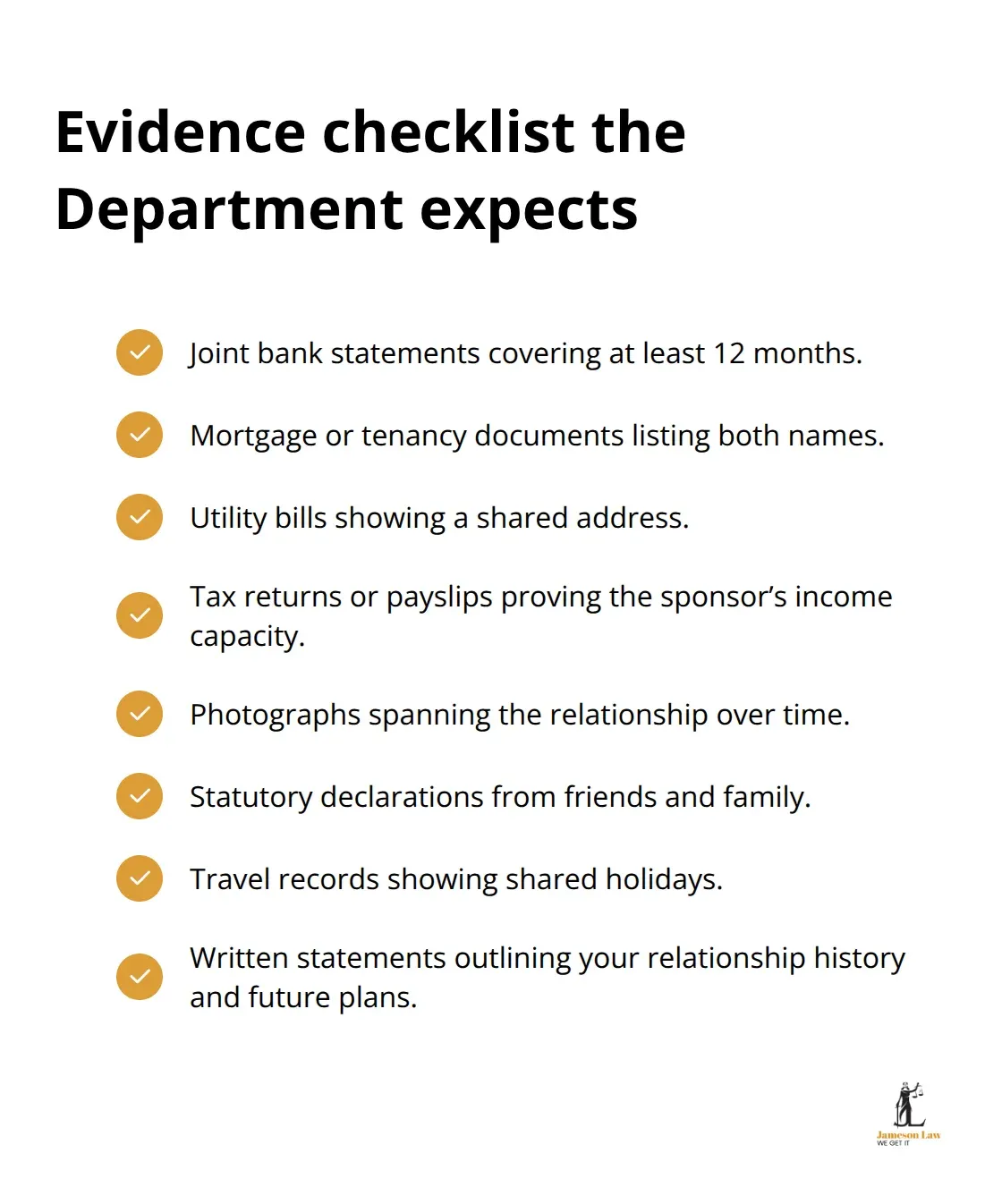
The Department of Home Affairs assesses partner visa applications in stages, and understanding what they scrutinise makes the difference between approval and delay. The Department requires financial evidence that demonstrates shared commitment, which typically includes joint bank account statements covering at least the past 12 months, mortgage or rental documents showing both names, utility bills, and tax returns or payslips proving your sponsor’s income capacity. Relationship evidence extends beyond these financial documents-you must provide photographs spanning your relationship, statutory declarations from friends and family confirming they know you as a couple, travel records showing shared holidays, and written statements explaining your relationship history, how you met, and your future plans together. The Department of Home Affairs website emphasises that evidence quality matters more than quantity; three well-organised documents proving genuine commitment outweigh 20 scattered pages that lack coherence.
Establishing Cohabitation for De Facto Couples
For de facto couples, the 12-month cohabitation requirement demands evidence of continuous living together-tenancy agreements, utility accounts, and correspondence all dated within the relevant period establish this timeline. Relationship registration in states like New South Wales removes this requirement entirely, so check whether your state offers this option before you lodge your application. The Department accepts official documents only; unofficial evidence wastes time and invites requests for resubmission.
Health and Character Documentation Requirements
Health assessments occur only when the Department requests them, typically after initial assessment of your relationship and character evidence, so do not obtain medical examinations unprompted. Character assessments require police certificates from every country where you have lived for 12 months or longer since turning 16, obtained directly from those countries’ authorities. The Department accepts nothing less than official certificates, and using unofficial documents invites requests for resubmission that extend your timeline significantly.
Processing Timelines and Assessment Stages
Processing timelines vary dramatically between onshore and offshore applications. Onshore subclass 820 applications currently process faster than offshore subclass 309 applications because you remain in Australia on a bridging visa during assessment. The Department does not guarantee processing within published timeframes-these estimates reflect recently decided applications rather than forecasts for your specific case. Onshore applicants typically lodge the subclass 820 first and, once approved, transition to the subclass 801 permanent visa application within approximately 24 months, though this timeline is not fixed. Offshore applications follow a different pathway: the Department assesses your temporary subclass 309 visa first, and only after approval do you receive permission to travel to Australia; the subclass 100 permanent visa application follows once you arrive onshore.
Interview Preparation and Assessment Focus
Interviews form part of the assessment for some applicants, though the Department does not interview all partner visa applicants-they conduct interviews when relationship evidence appears unclear or inconsistent, or when financial circumstances require clarification. If invited to an interview, you typically receive notice via ImmiAccount with a specified date and location. Interviews focus on relationship authenticity, so prepare to answer detailed questions about your relationship history, daily routines together, and future plans; inconsistent answers between you and your sponsor raise concerns and can lead to refusal. The Department assesses character and health separately from relationship assessment, meaning delays in obtaining police certificates or medical results can slow your overall processing time even if your relationship evidence is strong.
Final Thoughts
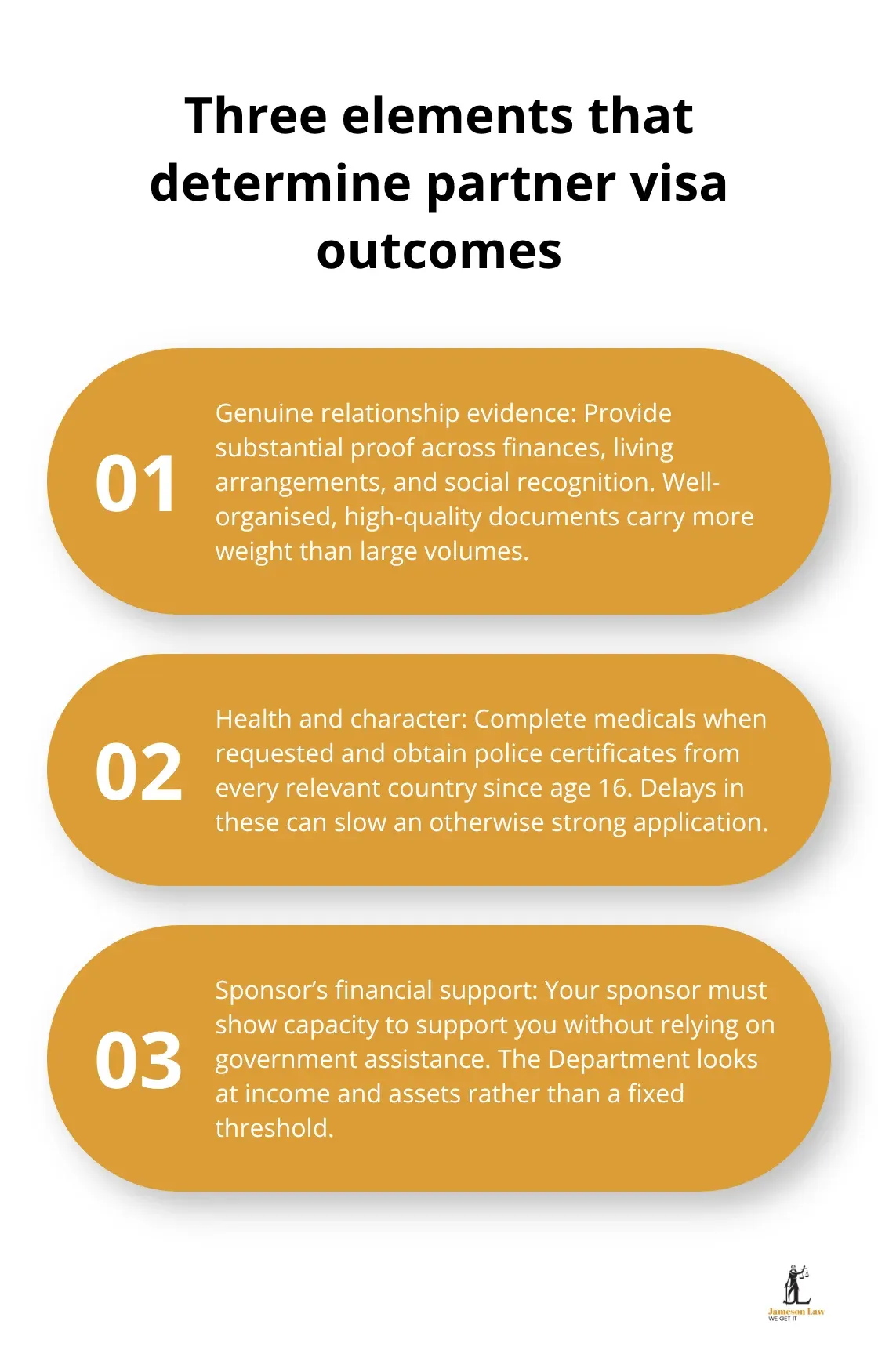
Partner visa eligibility Australia applications succeed when you prepare methodically and understand what the Department of Home Affairs actually assesses. Three core elements determine your outcome: demonstrating a genuine relationship through substantial evidence, meeting health and character requirements, and ensuring your sponsor can support you financially. The pathway you choose-onshore or offshore-shapes your timeline and processing experience, but the underlying eligibility criteria remain consistent across both streams.
Before you lodge your application, verify that your sponsor meets character requirements and obtain police certificates from all relevant countries. Confirm whether the 8503 No Further Stay condition applies to your current visa, as this can block your application unless the Department grants a waiver. Check the Department of Home Affairs website for current visa fees and processing time estimates based on your visa type and stream (onshore applications typically move faster than offshore ones).
Immigration law involves complex requirements and tight deadlines, and complications such as the 8503 condition, previous visa refusals, or unclear relationship evidence warrant professional legal advice before you submit. We at Jameson Law provide immigration law assistance tailored to your situation and help you meet all eligibility requirements before submission. Contact us to discuss your partner visa application and protect your investment in this important process.