Personal injury NSW claims can be complex, but understanding the process makes it manageable. Whether you’ve suffered a workplace injury, been in a car accident, or experienced medical negligence, knowing your rights is the first step toward fair compensation.
At Jameson Law, we’ve guided countless clients through this journey. This guide walks you through each stage, from your initial consultation to settlement, so you know exactly what to expect.
Understanding Personal Injury Claims in NSW
The Four Legal Elements You Must Prove
A valid personal injury claim in NSW rests on four legal elements under the Civil Liability Act 2002 (NSW). You must prove that someone owed you a duty of care, they breached that duty, their breach caused your injury, and you suffered measurable damages. This framework applies across all claim types-workplace accidents, motor vehicle crashes, slip-and-fall incidents, and medical negligence. The duty of care is straightforward: drivers owe it to road users, property owners to visitors, and medical professionals to their patients. A breach occurs when someone fails to meet that standard-running a red light, leaving a wet floor unmarked, or prescribing incorrect medication. Causation means the breach directly caused your injury, not some unrelated factor. Damages are the financial and non-financial losses you’ve incurred. Without all four elements, your claim will fail. Many people assume an accident alone is enough to recover compensation, but it isn’t. The accident must result from someone’s negligence, and you must prove it.
The Three-Year Deadline Under NSW Law
The Limitation Act 1969 (NSW) imposes a three-year deadline to start court proceedings from the date of your injury. This is not a soft guideline-it’s a hard legal boundary with serious consequences. If you miss this deadline, you lose your right to sue, regardless of the strength of your claim. One critical exception exists: if you were under 18 when injured, the three-year period begins on your 18th birthday, giving you until age 21 to file. For latent injuries (conditions that develop slowly and aren’t immediately obvious), the clock starts when you became aware of the injury or reasonably should have. Medical negligence and institutional abuse claims sometimes have different timelines, so early legal advice is essential to confirm your exact deadline. Acting within the first year is strategically smarter than waiting until year two or three. Early action preserves your negotiating position with insurers, allows time to gather evidence while memories are fresh, and creates space for medical treatment to stabilise before damages are finalised.
How Workplace Injuries, Car Accidents, and Medical Negligence Differ
Workplace injuries in NSW follow a separate no-fault pathway through icare or WorkCover, where you receive statutory benefits without proving negligence. However, if your employer was grossly negligent, you may also pursue a common law claim for additional compensation. Motor vehicle accidents are handled differently: you lodge a claim with the at-fault driver’s insurer within 28 days under the Motor Accident Injuries Act 2017. Missing this deadline can affect your entitlement to statutory benefits, though late claims aren’t automatically barred. Medical negligence claims typically yield higher compensation because proving a healthcare provider breached their duty of care is often clearer than establishing fault in other scenarios. Settlements for medical negligence commonly range from 40 to 60 per cent of the initial claim value, depending on the evidence and injury severity. Public liability claims (slips at a supermarket, dog bites, or injuries at a business) require you to report the incident to the property owner or business and preserve evidence like photos and witness details. Each claim type has different insurers, timeframes, and procedural requirements, which is why understanding which category your injury falls into matters from day one. The next stage of your journey involves taking action-starting with an initial consultation where a lawyer assesses whether your claim has merit and what compensation you might recover.
Moving Through Your Claim: What Actually Happens
Your Initial Consultation Sets the Direction
Your first meeting with a personal injury lawyer establishes the foundation for everything that follows. During this consultation, a lawyer will ask detailed questions about how your injury occurred, what medical treatment you’ve received, and whether you’ve already reported the incident to relevant authorities. They’ll review your medical records, any police or incident reports, and witness statements you’ve collected. Within this meeting, the lawyer makes a critical assessment: does your claim have legal merit under the four-element negligence framework, and is it financially viable to pursue? This viability assessment is brutally honest. A lawyer won’t move forward with your case if liability is too weak or damages too low to justify the legal costs. If your claim passes this gate, the lawyer will provide a realistic estimate of potential compensation and outline the timeline ahead. Many personal injury firms offer No Win No Fee arrangements for plaintiff claims, meaning you pay nothing unless your claim succeeds. This removes financial risk from your decision to proceed.
Gathering Evidence: Your Shared Responsibility
Once your claim is accepted, evidence collection becomes a shared responsibility between you and your lawyer. You must obtain comprehensive medical records from every treating provider within 14 days of your first appointment; responses typically arrive within 10 business days. These records form the backbone of your claim because insurers rely heavily on documented medical findings to calculate compensation. Simultaneously, collect photographs of the injury site if possible, witness statements from anyone who saw the incident, and receipts for all medical costs, travel expenses, and recovery equipment. If your injury is workplace-related, lodge a formal report with your employer and SafeWork NSW to create an official record. For motor vehicle accidents, notify the at-fault driver’s insurer within 28 days under the Motor Accident Injuries Act 2017 to protect your statutory benefits entitlements.
The Medico-Legal Examination and Its Impact
Your lawyer will coordinate evidence collection and typically arrange a medico-legal examination, an independent medical assessment that isn’t treatment but rather a detailed report outlining your injuries, prognosis, and future treatment needs. This report heavily informs the insurer’s compensation calculation. The examination involves a discussion of your medical history, a physical assessment, and a description of your ongoing symptoms. The resulting report becomes critical evidence in your claim because it provides an objective, expert perspective on your condition and recovery trajectory.
Settlement Negotiations: Don’t Accept the First Offer
Once evidence is compiled, your lawyer engages the insurer in settlement negotiations. Most NSW personal injury claims settle without court involvement; the strength of your evidence and how quickly you engage the insurer significantly influence the outcome. Do not accept the first settlement offer. Insurers typically open low, knowing many claimants lack legal representation and will settle early. A skilled lawyer negotiates multiple rounds, leveraging your medical evidence and documented losses to push toward fair value. If the insurer’s offer remains inadequate or liability is genuinely disputed, your claim progresses to court. This path involves discovery of documents, expert reports, and possibly mediation before trial. Court timelines in the District Court of NSW typically run 2 to 4 years or longer, making litigation a last resort when settlement is genuinely impossible. Understanding what compensation you can actually recover requires knowledge of how damages are calculated and what factors influence the final amount your insurer will offer.
What You’ll Actually Recover in Compensation
Economic and Non-Economic Damages Explained
NSW personal injury compensation splits into two distinct categories, and understanding the difference matters because it affects how much you’ll receive. Economic damages cover your concrete financial losses: medical treatment costs, rehabilitation, travel to appointments, lost wages, and future care expenses. Non-economic damages compensate for pain and suffering, loss of enjoyment of life, and psychological distress. Insurers calculate economic damages by adding up receipts, medical invoices, and wage loss documentation, then project future costs based on your medical prognosis. Non-economic damages follow standardised impairment guidelines published by SIRA to ensure consistency across claims.
How Impairment Ratings Determine Your Payout
For a workplace injury with permanent impairment, SIRA’s guidelines translate your medical condition into a percentage rating, which directly determines your pain and suffering payout. A 20 per cent whole person impairment rating generates a different compensation figure than a 10 per cent rating. Medical negligence claims typically command higher non-economic damages because proving a healthcare provider breached their duty is often clearer than establishing fault in motor vehicle or workplace incidents. Your medico-legal report plays the deciding role here because insurers rely entirely on the independent medical assessor’s findings about your prognosis and future treatment needs to calculate what they’ll offer.
Why Early Settlement Offers Fall Short
The insurer’s opening offer arrives after liability is admitted but before your claim is fully assessed, and it’s almost always too low. This early offer reflects incomplete information and serves the insurer’s cash flow interests, not your recovery needs. Accepting it permanently bars you from pursuing additional compensation for the same injury, even if your condition worsens or future medical costs exceed the initial estimate. A skilled lawyer negotiates multiple rounds, using your documented losses and medical evidence to push toward fair value.
Factors That Increase or Decrease Your Settlement
Factors that increase your settlement include clear liability with no dispute, comprehensive medical records showing ongoing treatment, strong witness statements, substantial lost wages, and a medical prognosis indicating long-term impairment. Factors that decrease your offer include contributory negligence (you partly caused the accident), gaps in medical treatment suggesting your injury wasn’t serious, pre-existing conditions unrelated to the incident, and delayed reporting to authorities.
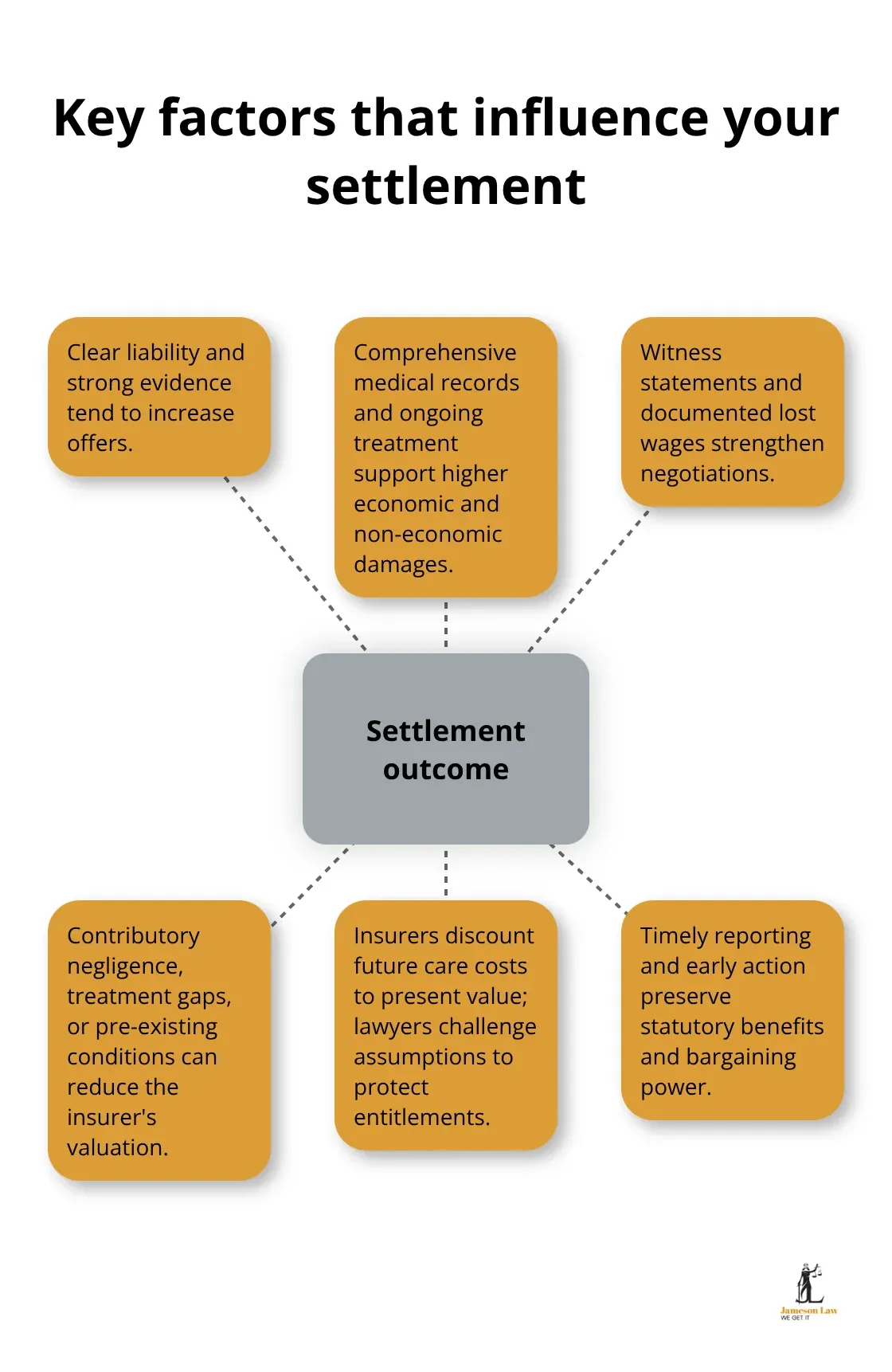
The insurer discounts future medical costs to present value, meaning a treatment plan costing $50,000 over ten years might be calculated at a lower amount in today’s money depending on interest rates and inflation assumptions. Your lawyer challenges these discount calculations because small percentage differences compound significantly over decades.
Timeline to Settlement Based on Claim Complexity
If your injuries have stabilised and your prognosis is clear, settlement typically follows within 6 to 12 months for straightforward claims with admitted liability. Complex claims involving disputed liability or severe injuries stretch to 12 to 24 months or longer because the insurer won’t finalise damages until your medical condition reaches maximum improvement, the point where further recovery is unlikely.
Final Thoughts
Personal injury NSW claims follow a structured path from your first consultation through to settlement, but the journey only succeeds when you act early and with proper guidance. The four-element negligence framework, the three-year limitation deadline, and the distinction between claim types create a legal landscape that rewards preparation and penalises delay. Insurers open low and expect you to accept their first offer, yet without a lawyer pushing back with documented losses and medical evidence, you recover far less than your claim is worth.
Professional legal representation removes the guesswork and protects your rights at every stage. A lawyer assesses claim viability, manages strict procedural deadlines, coordinates evidence collection, negotiates with insurers, and handles court proceedings if settlement fails. We at Jameson Law offer No Win No Fee arrangements for plaintiff claims, meaning you pay nothing unless your claim succeeds.
Contact a personal injury lawyer to discuss your injury, confirm your deadline, and begin building your case. The sooner you act, the stronger your position becomes.