PUBLICATION

Workers Compensation NSW Claims: How to Lodge a Claim

"Learn how to lodge workers compensation NSW claims with our step-by-step guide. Get expert advice on eligibility, documentation, and the claims process."
Workers Compensation NSW Claims: How to Lodge a Claim

A workplace injury can turn your life upside down, especially when you’re unsure about your rights and next steps. Workers compensation NSW claims exist to protect you during this difficult time, covering medical costs and lost wages while you recover.

At Jameson Law, we’ve helped countless NSW workers navigate the claims process successfully. This guide walks you through everything you need to know, from filing your claim to understanding your entitlements.

Understanding Workers Compensation in NSW

Workers compensation in NSW is a no-fault insurance scheme that supports employees who suffer work-related injuries or illnesses. Unlike other legal claims, you don’t need to prove your employer was negligent to receive benefits. If you’re injured at work or develop an illness because of your job, the scheme covers medical treatment, rehabilitation, and income support while you’re unable to work. This protection applies regardless of who caused the injury, making it fundamentally different from personal injury litigation. The scheme operates under the Workers Compensation Act 1987 and is administered by icare, which manages claims and coordinates with licensed Claims Service Providers (CSPs) to deliver support. Most NSW employers are required by law to hold workers compensation insurance, with limited exceptions for exempt employers. Your coverage becomes active the moment you start work, without needing to register or apply beforehand.

Who qualifies for coverage

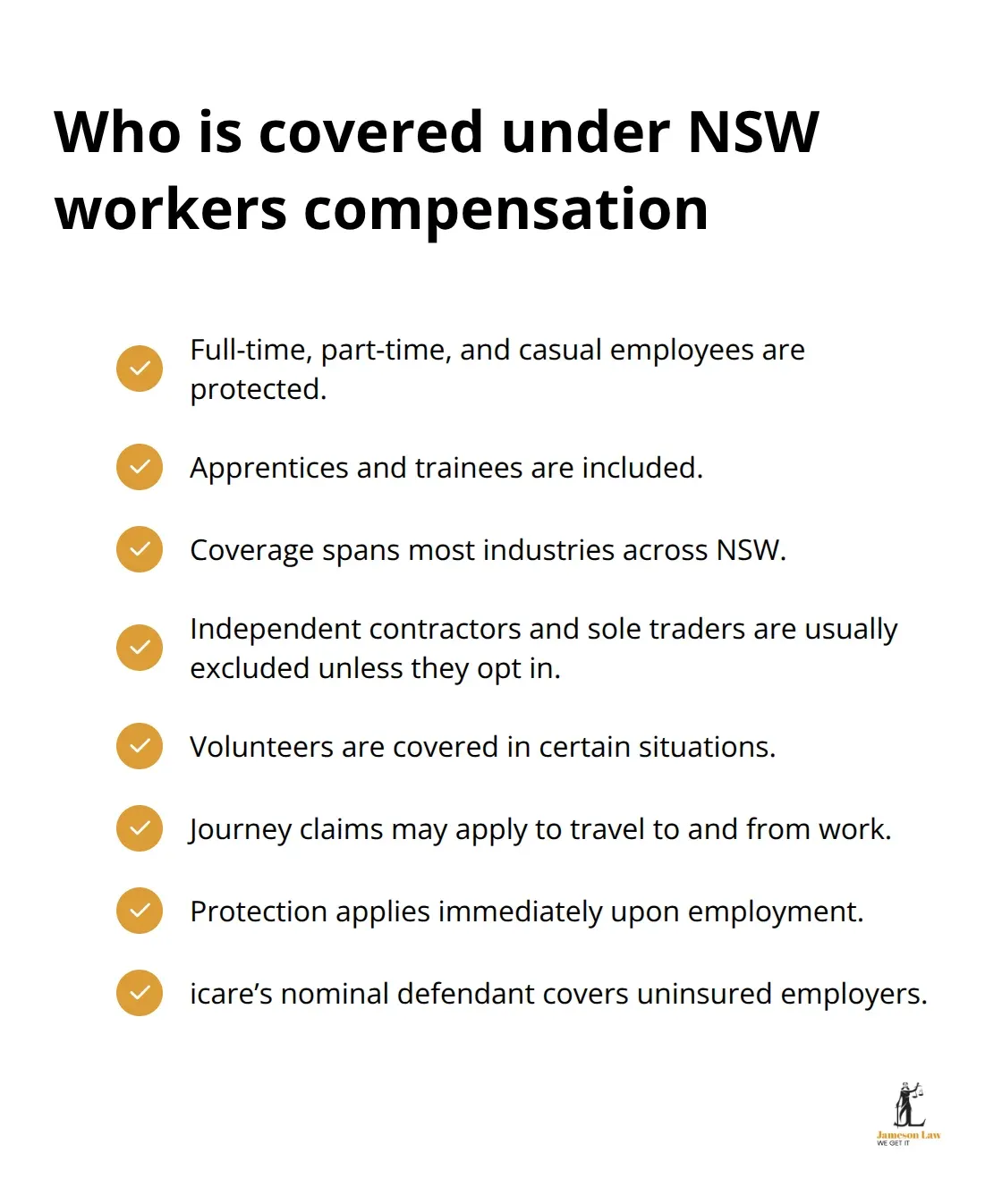
NSW workers compensation covers employees across virtually all industries, from construction and manufacturing to hospitality and office-based roles. The scheme protects full-time, part-time, and casual workers, including apprentices and trainees. However, independent contractors, sole traders, and business owners are generally excluded unless they’ve specifically chosen to be covered.

Eligibility highlights for NSW workers compensation coverage in Australia - Workers compensation NSW claims

If you’re unsure about your employment status, this distinction matters significantly because it determines your eligibility. Workers aged 16 to 67 are covered, though workers over 65 may have different benefit entitlements depending on their circumstances. The scheme also extends to volunteers in certain situations and to workers injured while travelling to or from work. Your coverage applies immediately upon employment, so you don’t need to wait for paperwork or formal notification. If your employer hasn’t obtained the required insurance, you’re still protected because icare operates a nominal defendant scheme that covers uninsured employers. This safety net means you won’t be left without support if your employer has failed to meet their legal obligations.

What injuries and illnesses are covered

Workers compensation covers a broad range of work-related injuries and illnesses, from acute trauma like broken bones and lacerations to gradual conditions like repetitive strain injuries and occupational diseases. Mental health conditions caused by work are now recognised and covered, reflecting a significant shift in how the scheme operates. Psychological injuries resulting from workplace incidents, harassment, or excessive workload pressures can attract benefits if they meet the legislative requirements. Physical illnesses caused by workplace exposure, such as occupational diseases from workplace exposure, are covered under the scheme. The critical factor is that the injury or illness must have a direct connection to your work. Injuries sustained during work-related travel, including commuting to and from your workplace, are generally covered. Pre-existing conditions aren’t automatically excluded, but the injury must have been aggravated or materially contributed to by your work. icare assesses each claim individually to determine whether the connection to work is sufficiently established. Once you lodge a claim, a CSP typically contacts you within three business days and completes a full assessment within seven days to determine your eligibility and the level of support available.

How the assessment process works

After you lodge your claim, the CSP assigned to your case takes the lead in gathering information and making decisions about your entitlements. The CSP contacts you within three business days to discuss your injury and collect additional details about what happened. Within seven days, the CSP completes a full assessment and communicates the liability outcome to you and your employer. This timeframe applies to most straightforward claims, though more complex cases may take longer. The CSP uses the information you provide (along with medical reports and employer details) to determine whether your injury qualifies for support under the scheme. You’ll receive clear notification about what level of support you’re eligible for, whether that’s medical treatment, weekly payments, or rehabilitation services. Understanding this timeline helps you plan ahead and know when to expect decisions about your claim.

Lodging Your Claim: What Happens Next

Notification and timing requirements

You must notify your employer of your injury as soon as possible. Your employer then has a legal obligation to notify their Claims Service Provider within 48 hours of becoming aware of the injury. This 48-hour window is not negotiable-if your employer delays, you should contact your CSP or icare directly. The sooner you report the injury, the sooner the assessment process begins and you can access support.

How to lodge your claim online

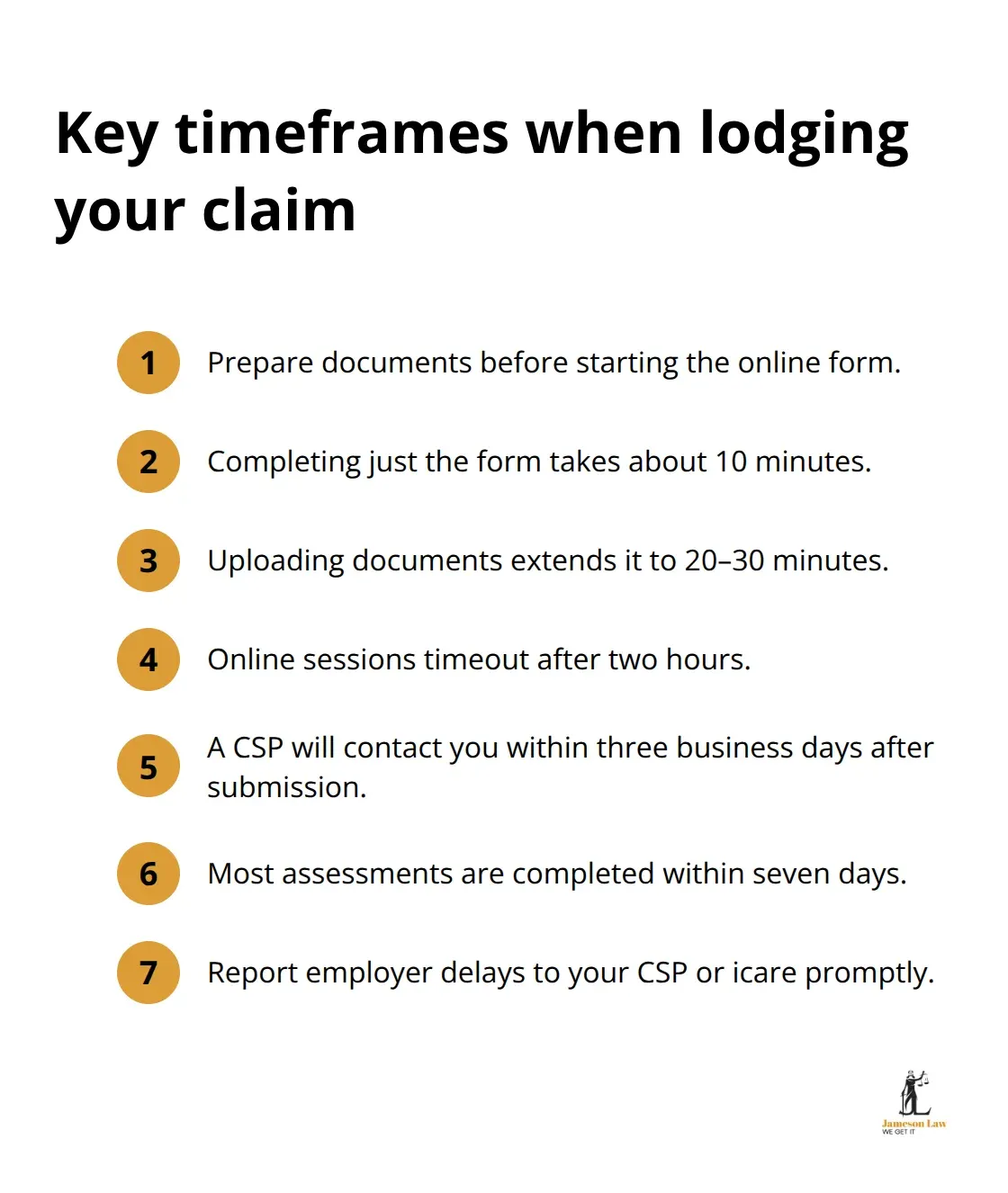
You can lodge your claim online via the injury notification form, by phone, email, or post. The online process takes approximately 10 minutes if you complete just the form, though uploading supporting documents extends this to 20–30 minutes. Online sessions timeout after two hours, so gather your documents beforehand to avoid losing your progress.

Important online lodgement and assessment timeframes for NSW workers compensation claims - Workers compensation NSW claims

You’ll need to provide your worker’s name, address, age, occupation, industry, the exact date and time of injury, and a clear description of what happened. If you’re unsure about any details, provide what you know and update the claim later-incomplete information won’t prevent you from lodging. After you submit, the assigned CSP will contact you within three business days to verify details and request any additional information. Within seven days, they’ll complete a full assessment and notify you of the liability decision and what support you qualify for.

Documentation that strengthens your claim

Documentation serves as your evidence that the injury happened and connects to your work. Gather medical reports from your treating doctor, including details of your condition and how it relates to the injury. Include incident reports, witness statements from colleagues who saw what happened, and photographs of the injury or hazardous conditions. Your employer’s records-duty rosters, safety logs, or incident reports-strengthen your claim considerably.

If you received wages before the injury, provide payslips to establish your pre-injury income (this determines your weekly payment rate). You can update your claim online if it was lodged on or after 1 July 2026 by adding documents later. For claims lodged before this date with Allianz, email mfclaim@allianz.com.au; for GIO claims from before 1 August 2020, use wcclaims@gio.com.au.

What happens after you lodge

The CSP uses all submitted information to determine liability-whether your injury genuinely arose from work. Lodging the notification does not automatically mean liability is accepted. The assessment period typically takes seven days, though complex cases involving disputed liability or unclear injury circumstances may take longer. Keep copies of everything you submit and note the dates of all communications with the CSP and your employer.

If your claim is rejected, you’ll receive written reasons explaining the decision and information about how to dispute it. Understanding your rights at this stage prepares you for the next phase: accessing the medical treatment, rehabilitation, and income support you may be entitled to.

Your Rights and Entitlements After Lodging a Claim

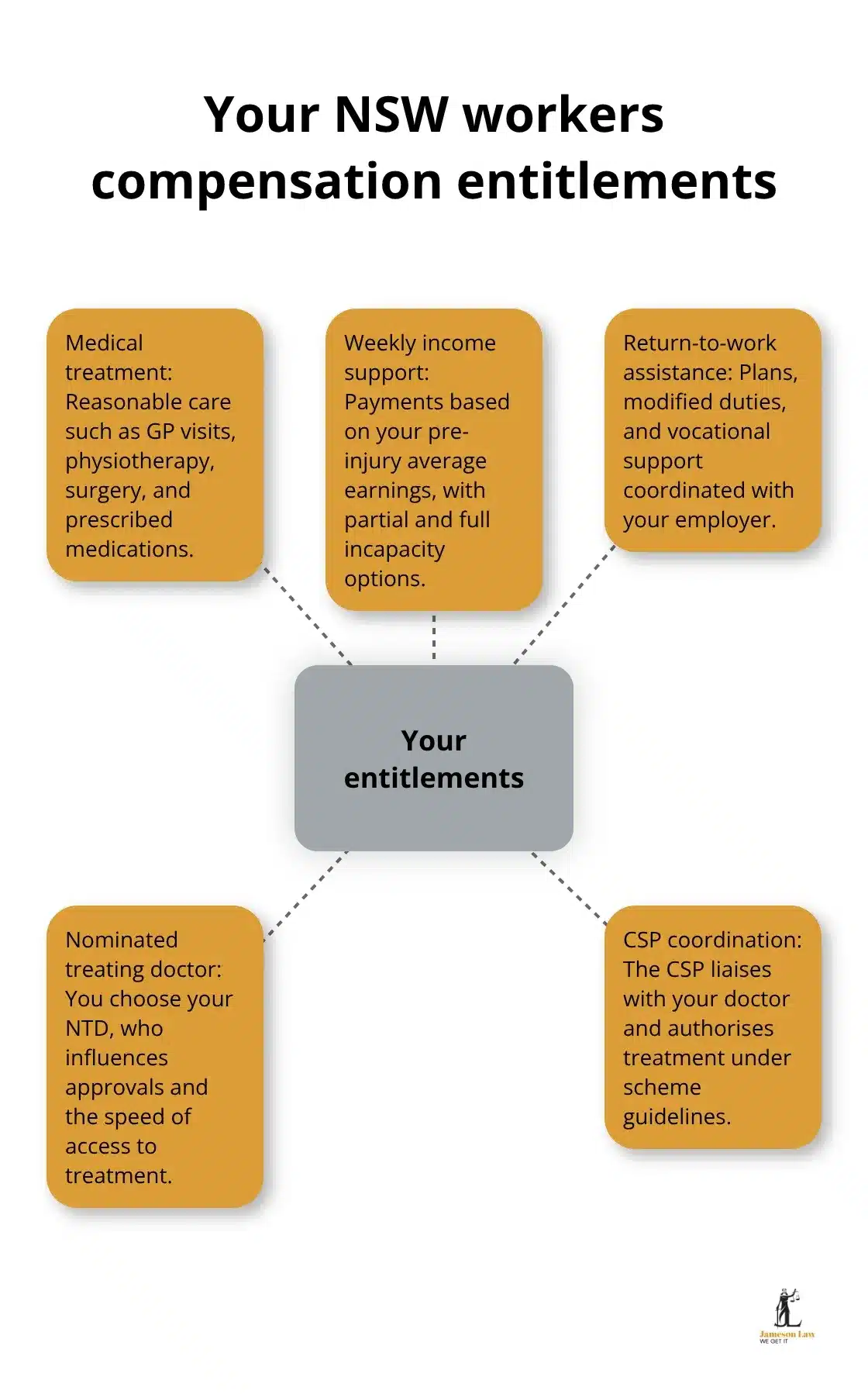
Once your claim is accepted, the CSP coordinates your entitlements across three main areas: medical treatment, weekly income support, and return-to-work assistance. Medical benefits cover all reasonable treatment related to your injury, including doctor visits, physiotherapy, surgery, and medications prescribed by your treating doctor. You choose your own nominated treating doctor (NTD), and this choice matters because your doctor influences what medical treatment the scheme will fund and how quickly you access it.

Overview of medical, income, and return-to-work entitlements under NSW workers compensation

Contact your treating doctor early after the injury and discuss your recovery plan with them. The CSP will liaise directly with your doctor to authorise treatment, so don’t delay in establishing this relationship.

Medical treatment and rehabilitation benefits

Your treating doctor plays a central role in your recovery and your access to funded treatment. Early contact with your doctor after the injury allows them to assess your condition and recommend appropriate treatment. Discuss your recovery plan with your doctor and provide them with information about your workplace duties and recovery timeline. The CSP will liaise directly with your doctor to authorise treatment, so your doctor knows which services the scheme will fund. Treatment covers physiotherapy, surgery, medications, specialist consultations, and rehabilitation services that support your return to work. If your doctor recommends treatment, the CSP typically approves it unless it falls outside scheme guidelines. The CSP also coordinates rehabilitation services if needed, which might include vocational training or workplace adjustments to support your return.

Weekly payments and income support

Weekly payments replace your lost wages while you’re unable to work, calculated based on your average pre-injury earnings. icare provides a PIAWE fact sheet that explains how weekly payment rates are calculated, which you should review to understand your exact entitlement. These payments continue for as long as you’re unable to work due to the injury, subject to scheme limitations that vary depending on the type of injury and your age. Partial incapacity payments apply when you can work but earn less than your pre-injury wage, with the scheme making up the difference. Full incapacity payments apply when you cannot work at all due to your injury.

Return-to-work support and obligations

Return-to-work support is where many workers miss opportunities to recover successfully and maintain their employment. Your employer must develop a return-to-work plan with you and your supervisor, based on medical advice from your treating doctor. This plan identifies duties you can perform during recovery, allowing you to return gradually rather than all at once. Early contact with your employer about modified duties prevents your role from disappearing and keeps you engaged with your workplace during recovery. Discuss your recovery timeline and available duties with your employer before you’re medically cleared to return full-time. Many workers find that working part-time or on modified duties during recovery accelerates their healing and reduces the psychological impact of extended absence. If your employer refuses to accommodate modified duties or retaliates against you for making a claim, contact your CSP immediately because these actions breach your statutory protections. Your entitlements continue unchanged if your employer fails to cooperate with return-to-work planning.

Final Thoughts

Lodging a workers compensation NSW claim requires you to notify your employer promptly, submit your claim within the required timeframe, and provide documentation that supports your case. The CSP assigned to your claim will contact you within three business days and complete a full assessment within seven days, giving you certainty about your entitlements. Once accepted, your claim provides access to medical treatment, weekly income support, and return-to-work assistance coordinated by your CSP.

You don’t need to prove negligence to receive benefits under the scheme-your focus should be on reporting the injury promptly, gathering strong documentation, and maintaining regular contact with your treating doctor and employer. Early engagement with your doctor and employer significantly improves both your recovery outcomes and your chances of returning to work successfully. If your claim is rejected, you have the right to dispute the decision and request written reasons for the rejection.

Many rejected workers compensation NSW claims are overturned on review when additional evidence is provided or when the CSP’s initial assessment is challenged. At this point, seeking legal advice becomes valuable because the dispute process involves formal procedures and deadlines that require careful navigation. Contact Jameson Law for practical legal guidance tailored to your situation if your claim has been rejected or you’re uncertain about your entitlements.

Speak to an Expert Lawyer today

Laywers-Jameson-Law-The-best-law-firm-in-Sydney- Sydney Lawyers - Sydney
BOOK NOW

WE'RE IN IT TO WIN IT

Book your consultation

Book Now
Book Now Mobile 06 02 2025

This form submission is encrypted and secured to ensure your information remains confidential.

What our Clients

Related Publications:

What our clients say

.

Jameson Law - Voted the Best Law firm in Sydney Award

Legal Answers ... In Short

We're here to help

Our mission is to ensure our client matters are resolved successfully every time. Success to us does not simply involve winning, but moreover ensuring we take the most feasible, economic and stress-free path to help our clients achieve their goals. We fight hard for our clients, and always go by the motto: we’re in it to win it.

Jameson Law - Best Law Firm in Sydney

WE'RE IN IT TO WIN IT

Book your consultation

Call us now on (02) 8806 0866 or fill out the form below

Book Now Mobile

This form submission is encrypted and secured to ensure your information remains confidential.

WE'RE IN IT TO WIN IT

Book your consultation

Book Now Mobile 06 02 2025
lock

This form submission is encrypted and secured to ensure your information remains confidential.

Our Sydney Offices

Offices Parramatta and Sydney Jameson Law
Parramatta CBD - Head Office
jameson Law - Blacktown
jameson Law - Liverpool Office
Jameson Law - Bankstown
Court Houses We Frequent Jameson Law

Court Houses We Frequent

Balmain Local Court

Registry: Monday to Friday, 9:00am to 4:30pm

Bankstown Local Court

Court Operating Hours: 9:30am-4:30pm

Blacktown Local Court

Registry Hours: 9:00 – 4:30
Telephone Hours: 8:30 -4:30
Days open: Mon-Fri

Burwood Local Court

Registry Hours: 9:00 – 4:30
Telephone Hours: 8:30 – 4:30
Days open: Mon – Fri

Campbell Local Court

Registry Hours: 9:00 – 4:30
Telephone Hours: 8:30 – 4:30
Days open: Mon – Fri

Central Local Court

Registry Hours: 9:00 – 1:00 and 2:00 – 4:30
Telephone Hours: 8:30 – 4:30

Downing Local Court

Registry Hours: 9:00 – 1:00 and 2:00 – 4:30
Telephone Hours: 8:30 – 4:30

Wollongong Local Court

Registry Hours: 9:00 – 1:00 and 2:00 – 4:30
Telephone Hours: 8:30 – 4:30

Fairfield Local Court

Registry Hours: 9:00 – 1:00 and 2:00 – 4:30
Telephone Hours: 8:30 – 4:30

Hornsby Local Court

Registry Hours: 9:00 – 1:00 and 2:00 – 4:30
Telephone Hours: 8:30 – 4:30

Liverpool Local Court

Registry Hours: 9:00 – 1:00 and 2:00 – 4:30
Telephone Hours: 8:30 – 4:30

Manly Local Court

Registry Hours: 9:00 – 1:00 and 2:00 – 4:30
Telephone Hours: 8:30 – 4:30

Newtown Local Court

Registry Hours: 9:00 – 1:00 and 2:00 – 4:30
Telephone Hours: 8:30 – 4:30

Parramatta Local Court

Registry Hours: 9:00 – 1:00 and 2:00 – 4:30
Telephone Hours: 8:30 – 4:30

Penrith Local Court

Registry Hours: 9:00 – 1:00 and 2:00 – 4:30
Telephone Hours: 8:30 – 4:30

Sutherland Local Court

Registry Hours: 9:00 – 1:00 and 2:00 – 4:30
Telephone Hours: 8:30 – 4:30

Waverley Local Court

Registry Hours: 9:00 – 1:00 and 2:00 – 4:30
Telephone Hours: 8:30 – 4:30

Windsor Local Court

Registry Hours: 9:00 – 1:00 and 2:00 – 4:30
Telephone Hours: 8:30 – 4:30

Wollongong Local Court

Registry Hours: 9:00 – 1:00 and 2:00 – 4:30
Telephone Hours: 8:30 – 4:30

Downing Centre District Court

Registry Hours: 9:00 – 4:30
Telephone Hours: 8:30 – 4:30
Days open: Mon – Fri

Parramatta District Court

Registry Hours: 9:00 – 4:30
Days open: Mon-Fri

Penrith District Court

Registry Hours: 9:00 – 4:30
Days open: Mon-Fri

Campbelltown District Court

Registry Hours: 9:00 – 4:30
Days open: Mon – Fri

Liverpool District Court

Registry Hours: 9:00 – 4:30
Days open: Mon – Fri

Wollongong District Court

Registry Hours: 9:00 – 1:00 and 2:00 – 4:30
Telephone Hours: 8:30 – 4:30

Supreme Court New South Wales

Registry Hours: 9:00 AM – 4:30 PM
Telephone Hours: 8:30 AM – 4:30 PM
Days Open: Monday to Friday

Federal Circuit and Family Court of Australia

Registry Hours: 9:00 AM – 4:30 PM
Telephone Hours: 8:30 AM – 5:00 PM
Days Open: Monday to Friday

Federal Court

Monday to Friday, 8:30 AM – 4:30 PM

High Court

Monday to Friday, 8:30 AM – 5:00 PM

Children’s Court of New South Wales

Registry Hours: 9:00 AM – 4:30 PM
Telephone Hours: 8:30 AM – 4:30 PM
Days Open: Monday to Friday

Coroner’s Court New South Wales

Registry Hours: 9:00 AM – 4:30 PM
Telephone Hours: 8:30 AM – 4:30 PM
Days Open: Monday to Friday

Industrial Relations Commission of New South Wales

Registry Hours: 9:00 AM – 4:30 PM
Telephone Hours: 8:30 AM – 4:30 PM
Days Open: Monday to Friday

Land and Environment Court of New South Wales

Registry Hours: 9:00 AM – 4:30 PM
Telephone Hours: 8:30 AM – 4:30 PM
Days Open: Monday to Friday

WE'RE IN IT TO WIN IT

Book your consultation

Book Now
Book Now Mobile 06 02 2025
lock

This form submission is encrypted and secured to ensure your information remains confidential.