PUBLICATION

Temporary visa Australia requirements: Key Criteria and Timelines

"Discover Australia's temporary visa requirements, key criteria, and timelines to guide your application process successfully."
Temporary visa Australia requirements: Key Criteria and Timelines

Australia’s temporary visa system offers multiple pathways for skilled workers, students, and visitors. Understanding the temporary visa Australia requirements is essential before you apply, as missing key criteria can delay or reject your application.

At Jameson Law, we’ve helped countless people navigate these requirements successfully. Getting your documentation and eligibility sorted early gives you the best chance of approval.

Your Temporary Visa Options in Australia

Skilled Migration Visas

Australia’s temporary visa system splits into four main categories, each with distinct purposes and requirements. Skilled migration visas target workers with occupations listed on Australia’s skilled occupation lists. As of March 2018, Australia had around 2.2 million temporary residents, with skilled visas representing a significant portion of that number according to data from data.gov.au. The Temporary Skill Shortage visa (subclass 482) requires employer sponsorship and serves as the primary pathway for skilled workers. The key difference between older 457 visas and the current 482 program lies in stricter salary benchmarks and more rigorous labour market testing requirements. If you’re a skilled worker, an Australian employer must nominate you for a specific role-you cannot apply without this sponsorship.

Student Visas and Work Rights

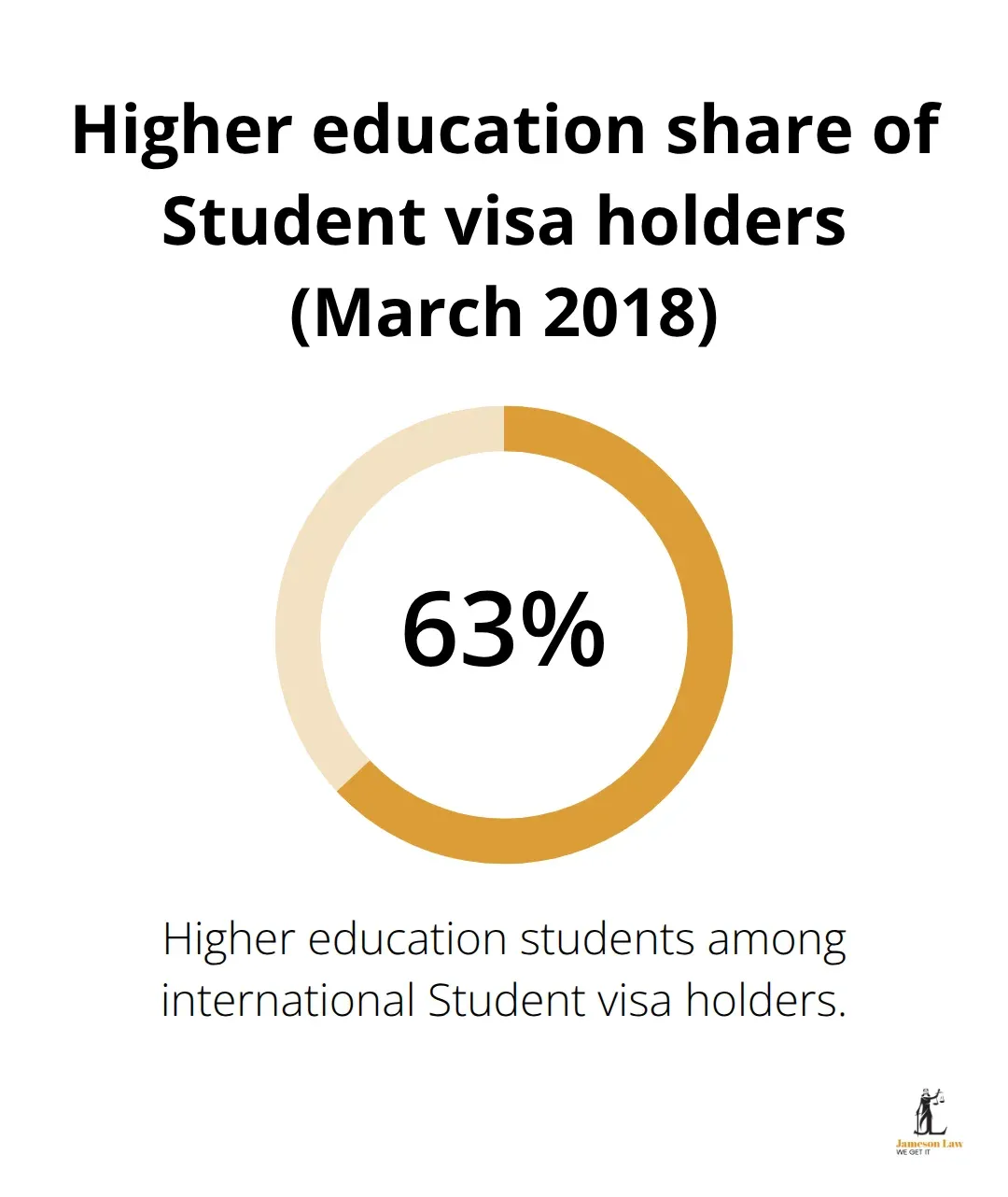
Student visas represent the second major category and have grown substantially over the past decade. As of March 2018, more than 530,000 international students held valid visas in Australia, with higher education students accounting for approximately 63% of that cohort according to data.gov.au.

Share of international students in higher education among Student visa holders in Australia as of March 2018.

The consolidated Subclass 500 student visa replaced seven earlier subclasses in 2017, which means employers must now verify work rights more carefully since the single subclass can mask different work entitlements. Most student visa holders can work up to 40 hours per fortnight during semester, though student visa holders can work unlimited hours when their course is not in session. This distinction matters significantly if you employ students-exceeding permitted hours creates compliance risks for both you and the visa holder.

Working Holiday Maker Visas

Working Holiday Maker visas (subclasses 417 and 462) offer younger people the chance to work and travel simultaneously. Subclass 417 numbers declined slightly between 2012 and 2018, while Subclass 462 Work and Holiday visas grew from approximately 4,668 to 16,031 holders during the same period, reflecting expanding source countries including China. These visas typically last one to three years depending on the subclass and whether the holder completes specified work in regional Australia.

Visitor and Tourist Visas

Visitor and tourist visas (subclasses 600, 601, and 651) operate under fundamentally different rules because they prohibit work entirely. As of March 2018, approximately 384,487 tourist and business visitors were in Australia, and they cannot engage in paid employment under any circumstances-business visitors have extremely limited permitted activities. If you’re considering hiring someone, confirming their visa subclass through the Visa Entitlement Verification Online system proves essential, as work rights vary dramatically between categories and even within the same visa type depending on conditions imposed at grant. Understanding which visa category applies to your potential employee determines whether they can legally work for you and under what restrictions.

What You Must Prove Before Your Visa Gets Approved

Health and Character Assessments

Health and character assessments form the foundation of every temporary visa application in Australia, and these checks happen outside your control once you submit. The Department of Home Affairs conducts health and character assessments through panel doctors and character assessments through police records, court history, and international databases. Delays in these external checks represent the largest variable in processing times according to the Department’s May 2026 data.

If you have any health condition requiring ongoing treatment, obtain your medical records from your home country now rather than waiting for the application stage. Panel doctors in Australia often need historical documentation to process your assessment efficiently. Character issues extend beyond criminal convictions; undisclosed visa cancellations, immigration fraud, or outstanding debts can trigger refusals.

Demonstrating Financial Capacity

Financial capacity proves equally important but often misunderstood by applicants. You must demonstrate sufficient funds to support yourself during your visa period without relying on government assistance, and the amount varies by visa type and duration. For student visas, you typically need to prove around AUD $29,710 per year plus tuition fees, though this varies by institution and state. Skilled migration applicants face different financial thresholds based on the nominated position’s salary and location.

The critical mistake most applicants make involves submitting bank statements without explanation. Simply showing a large deposit days before application raises red flags with the Department. Instead, provide statements covering at least three months, include a statutory declaration explaining the source of funds, and attach supporting documents like employment contracts or gift letters if funds come from family members.

Meeting English Language Requirements

English language proficiency remains non-negotiable for most temporary visas in Australia, and meeting the threshold matters significantly for processing speed. The International English Language Testing System (IELTS) or Pearson Test of English (PTE) are accepted by the Department of Home Affairs, with required scores varying by visa type. For the Pearson Test of English Academic, you need at least 57 for listening, 60 for reading, 64 for writing, and 70 for speaking, though requirements vary by visa category.

Many applicants sit the test once, fail to meet requirements, and reapply months later. Try sitting the test multiple times before applying-this approach saves time overall and increases your chances of meeting the threshold on your first visa submission.

Understanding Sponsorship and Nomination

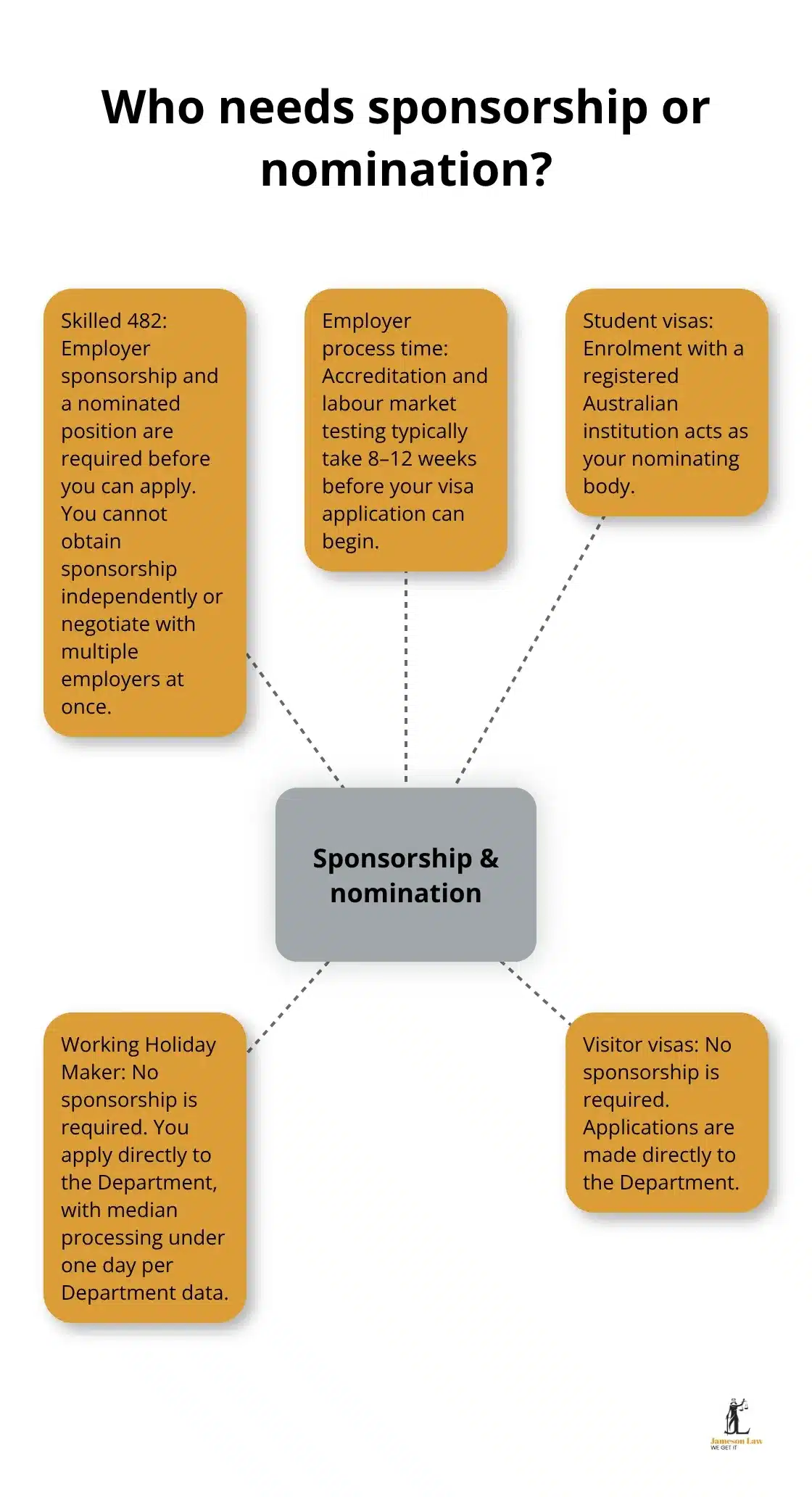
Sponsorship and nomination requirements differ dramatically between visa categories, yet this distinction confuses most applicants. Skilled migration visas (subclass 482) require an Australian employer to sponsor you and nominate a specific position before you can apply; you cannot obtain sponsorship independently or negotiate with multiple employers simultaneously. The employer must go through accreditation and labour market testing, which typically takes 8–12 weeks before your visa application can even begin.

Student visas require enrolment with a registered Australian educational institution, which acts as your nominating body. Working Holiday Maker visas (subclasses 417 and 462) require no sponsorship-you apply directly to the Department-making them faster to obtain with median processing times under one day according to Department data. Visitor visas similarly require no sponsorship.

Overview of sponsorship and nomination requirements across major temporary visa categories in Australia. - Temporary visa Australia requirements

The distinction matters because sponsorship delays often exceed visa processing delays themselves. Applicants frequently blame the Department for slow processing when the real bottleneck sits with their employer’s nomination stage. Understanding where your visa category sits within this sponsorship framework helps you plan realistic timelines and identify which stage will determine your overall application speed.

How Long Does Your Temporary Visa Application Actually Take

Processing Times Vary Significantly by Visa Type

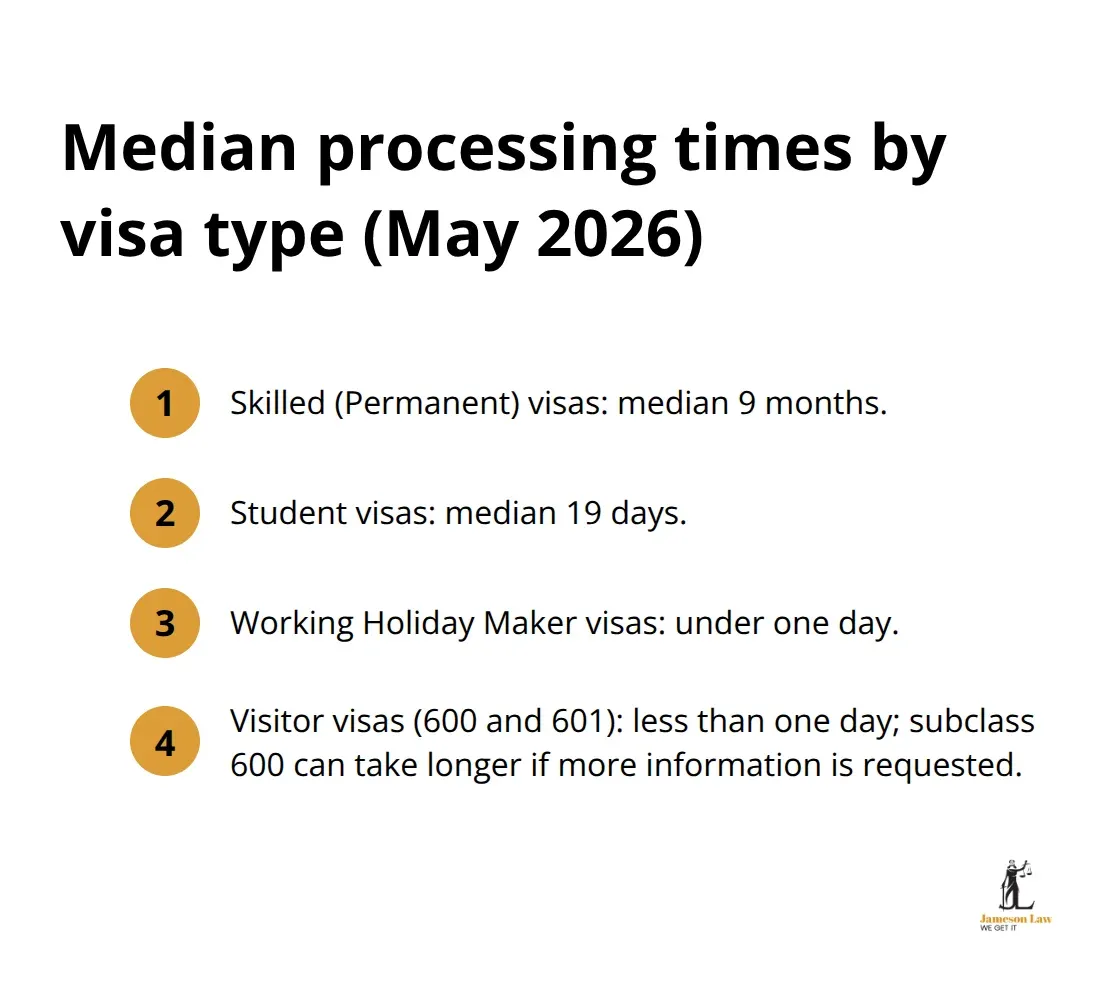
The Department of Home Affairs publishes median processing times monthly, and these figures tell you what to expect if your application runs smoothly. As of May 2026, Skilled (Permanent) visas have a median processing time of 9 months, Student visas average 19 days, Working Holiday Maker visas sit under one day, and Visitor visas for subclasses 600 and 601 combined take less than one day, though subclass 600 can extend considerably longer if additional information is requested.

Median processing times published by the Department of Home Affairs for key visa types as of May 2026. - Temporary visa Australia requirements

These medians represent the middle point of all decisions made that month, meaning half of applications finish faster and half take longer. The Department emphasises that processing times reflect decisions on both new and older applications, so applications lodged months earlier may be processed ahead of newer submissions depending on complexity and completeness.

Submit Complete Applications Online From the Start

The single most effective action you can take is lodging your complete application online with every supporting document attached upfront. Incomplete applications trigger requests for further information, and each request adds weeks to your timeline. The Department explicitly states that delays occur when applications lack necessary supporting documents, and your response time to information requests directly impacts overall processing speed. For Temporary Skilled visas specifically, you gain a significant advantage when you nominate and apply concurrently rather than sequentially, as this parallel approach eliminates waiting periods between stages.
External Health and Character Checks Control Your Timeline

Health, character and national security checks rely on external agencies and information sources completely outside the Department’s control, and these external health and character checks represent the largest variable affecting your timeline. If you have any health conditions requiring ongoing treatment or any character concerns in your background, obtain medical records and documentation now rather than waiting. Health assessments conducted by panel doctors require historical documentation from your home country, and missing records force the panel doctor to request additional information from overseas institutions, compounding delays substantially. Character assessments pull from police records, court history and international databases, and any undisclosed information discovered during this process can trigger application refusal or significant delays for further investigation. The Department’s May 2026 data confirms that external checks remain the primary cause of processing delays, so proactive preparation in these areas saves time more effectively than any other strategy.

What Happens After the Department Makes Its Decision

Once the Department makes a decision on your application, you receive notification immediately. If your visa is granted, you can commence work or study on the date specified in your grant notice. If your application is refused, the Department provides detailed reasons and information about your review options for refused applications, though most refused applications cannot be appealed through the courts and instead require application for a new visa addressing the original refusal reasons.

Final Thoughts

Australia’s temporary visa system provides distinct pathways for skilled workers, students, and visitors, each with specific requirements and processing timelines that demand careful attention. Success depends on understanding your visa category, preparing documentation thoroughly, and addressing health and character assessments proactively before you submit your application. Skilled migration visas require employer sponsorship and labour market testing before your application even begins, student visas require institutional enrolment, and Working Holiday Maker visas offer the fastest processing at under one day.

Meeting temporary visa Australia requirements early transforms your application timeline significantly. Applicants who gather medical records, financial documentation, and English language test results before lodging their application avoid the delays that plague incomplete submissions, and the Department’s May 2026 data confirms that external health and character checks represent the largest variable in processing times. Sponsorship and nomination stages often exceed visa processing itself, yet many applicants overlook this bottleneck when planning their timeline.

We at Jameson Law provide immigration law assistance to help you navigate these requirements and understand your obligations. If you need guidance on temporary visa requirements or have questions about your specific circumstances, contact Jameson Law for practical legal advice tailored to your situation.

Speak to an Expert Lawyer today

Laywers-Jameson-Law-The-best-law-firm-in-Sydney- Sydney Lawyers - Sydney
BOOK NOW

WE'RE IN IT TO WIN IT

Book your consultation

Book Now
Book Now Mobile 06 02 2025

This form submission is encrypted and secured to ensure your information remains confidential.

What our Clients

Related Publications:

What our clients say

.

Jameson Law - Voted the Best Law firm in Sydney Award

Legal Answers ... In Short

We're here to help

Our mission is to ensure our client matters are resolved successfully every time. Success to us does not simply involve winning, but moreover ensuring we take the most feasible, economic and stress-free path to help our clients achieve their goals. We fight hard for our clients, and always go by the motto: we’re in it to win it.

Jameson Law - Best Law Firm in Sydney

WE'RE IN IT TO WIN IT

Book your consultation

Call us now on (02) 8806 0866 or fill out the form below

Book Now Mobile

This form submission is encrypted and secured to ensure your information remains confidential.

WE'RE IN IT TO WIN IT

Book your consultation

Book Now Mobile 06 02 2025
lock

This form submission is encrypted and secured to ensure your information remains confidential.

Our Sydney Offices

Offices Parramatta and Sydney Jameson Law
Parramatta CBD - Head Office
jameson Law - Blacktown
jameson Law - Liverpool Office
Jameson Law - Bankstown
Court Houses We Frequent Jameson Law

Court Houses We Frequent

Balmain Local Court

Registry: Monday to Friday, 9:00am to 4:30pm

Bankstown Local Court

Court Operating Hours: 9:30am-4:30pm

Blacktown Local Court

Registry Hours: 9:00 – 4:30
Telephone Hours: 8:30 -4:30
Days open: Mon-Fri

Burwood Local Court

Registry Hours: 9:00 – 4:30
Telephone Hours: 8:30 – 4:30
Days open: Mon – Fri

Campbell Local Court

Registry Hours: 9:00 – 4:30
Telephone Hours: 8:30 – 4:30
Days open: Mon – Fri

Central Local Court

Registry Hours: 9:00 – 1:00 and 2:00 – 4:30
Telephone Hours: 8:30 – 4:30

Downing Local Court

Registry Hours: 9:00 – 1:00 and 2:00 – 4:30
Telephone Hours: 8:30 – 4:30

Wollongong Local Court

Registry Hours: 9:00 – 1:00 and 2:00 – 4:30
Telephone Hours: 8:30 – 4:30

Fairfield Local Court

Registry Hours: 9:00 – 1:00 and 2:00 – 4:30
Telephone Hours: 8:30 – 4:30

Hornsby Local Court

Registry Hours: 9:00 – 1:00 and 2:00 – 4:30
Telephone Hours: 8:30 – 4:30

Liverpool Local Court

Registry Hours: 9:00 – 1:00 and 2:00 – 4:30
Telephone Hours: 8:30 – 4:30

Manly Local Court

Registry Hours: 9:00 – 1:00 and 2:00 – 4:30
Telephone Hours: 8:30 – 4:30

Newtown Local Court

Registry Hours: 9:00 – 1:00 and 2:00 – 4:30
Telephone Hours: 8:30 – 4:30

Parramatta Local Court

Registry Hours: 9:00 – 1:00 and 2:00 – 4:30
Telephone Hours: 8:30 – 4:30

Penrith Local Court

Registry Hours: 9:00 – 1:00 and 2:00 – 4:30
Telephone Hours: 8:30 – 4:30

Sutherland Local Court

Registry Hours: 9:00 – 1:00 and 2:00 – 4:30
Telephone Hours: 8:30 – 4:30

Waverley Local Court

Registry Hours: 9:00 – 1:00 and 2:00 – 4:30
Telephone Hours: 8:30 – 4:30

Windsor Local Court

Registry Hours: 9:00 – 1:00 and 2:00 – 4:30
Telephone Hours: 8:30 – 4:30

Wollongong Local Court

Registry Hours: 9:00 – 1:00 and 2:00 – 4:30
Telephone Hours: 8:30 – 4:30

Downing Centre District Court

Registry Hours: 9:00 – 4:30
Telephone Hours: 8:30 – 4:30
Days open: Mon – Fri

Parramatta District Court

Registry Hours: 9:00 – 4:30
Days open: Mon-Fri

Penrith District Court

Registry Hours: 9:00 – 4:30
Days open: Mon-Fri

Campbelltown District Court

Registry Hours: 9:00 – 4:30
Days open: Mon – Fri

Liverpool District Court

Registry Hours: 9:00 – 4:30
Days open: Mon – Fri

Wollongong District Court

Registry Hours: 9:00 – 1:00 and 2:00 – 4:30
Telephone Hours: 8:30 – 4:30

Supreme Court New South Wales

Registry Hours: 9:00 AM – 4:30 PM
Telephone Hours: 8:30 AM – 4:30 PM
Days Open: Monday to Friday

Federal Circuit and Family Court of Australia

Registry Hours: 9:00 AM – 4:30 PM
Telephone Hours: 8:30 AM – 5:00 PM
Days Open: Monday to Friday

Federal Court

Monday to Friday, 8:30 AM – 4:30 PM

High Court

Monday to Friday, 8:30 AM – 5:00 PM

Children’s Court of New South Wales

Registry Hours: 9:00 AM – 4:30 PM
Telephone Hours: 8:30 AM – 4:30 PM
Days Open: Monday to Friday

Coroner’s Court New South Wales

Registry Hours: 9:00 AM – 4:30 PM
Telephone Hours: 8:30 AM – 4:30 PM
Days Open: Monday to Friday

Industrial Relations Commission of New South Wales

Registry Hours: 9:00 AM – 4:30 PM
Telephone Hours: 8:30 AM – 4:30 PM
Days Open: Monday to Friday

Land and Environment Court of New South Wales

Registry Hours: 9:00 AM – 4:30 PM
Telephone Hours: 8:30 AM – 4:30 PM
Days Open: Monday to Friday

WE'RE IN IT TO WIN IT

Book your consultation

Book Now
Book Now Mobile 06 02 2025
lock

This form submission is encrypted and secured to ensure your information remains confidential.