PUBLICATION

Road accident compensation NSW: Claiming Your Entitlements

"Claim road accident compensation in NSW with our guide to your legal entitlements, damages, and claim timelines."
Road accident compensation NSW: Claiming Your Entitlements

A road accident can leave you facing medical bills, lost income, and ongoing pain. In NSW, you have legal rights to claim compensation for these losses, but the process requires understanding what you’re entitled to and how to navigate it properly.

At Jameson Law, we’ve helped countless accident victims secure the compensation they deserve. This guide walks you through your options, the claims process, and the factors that determine your payout.

What Compensation Can You Actually Claim?

The CTP Insurance Scheme and Your Rights

NSW operates under the Compulsory Third Party (CTP) insurance scheme, which means most road accident victims can access compensation regardless of who caused the crash. This is fundamentally different from relying on the at-fault driver’s willingness to pay. In 2025, NSW processed 15,053 motor accident injury claims with approximately $1.78 billion paid in benefits and lump sums, averaging around $118,000 per claim according to SIRA data from January 2026.

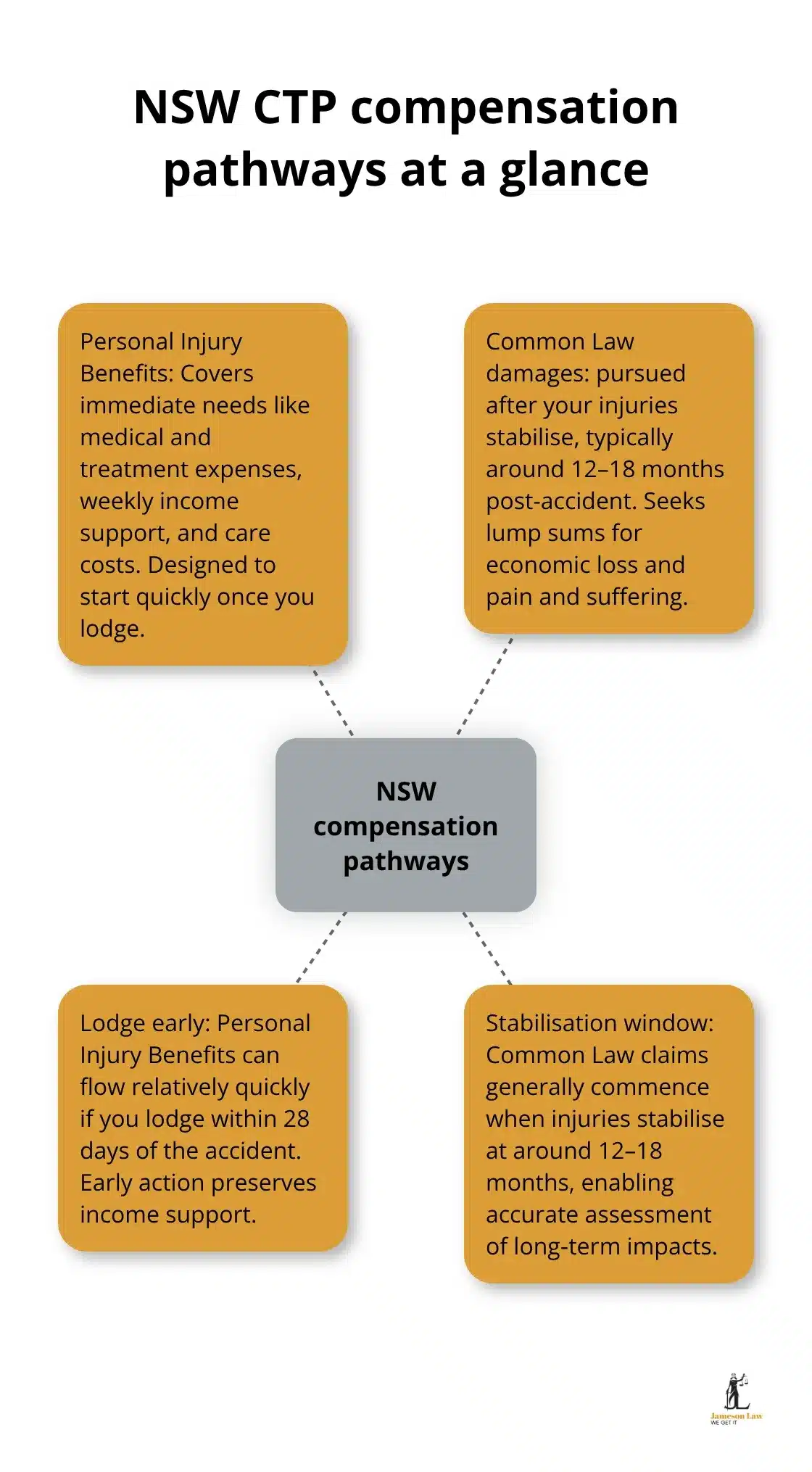
The compensation structure splits into two distinct pathways. Personal Injury Benefits cover your immediate needs: medical and treatment expenses, weekly income support, and care costs. These start flowing relatively quickly if you lodge within 28 days of the accident. The second pathway is a Common Law damages claim, pursued separately after your injuries stabilise, typically around 12 to 18 months post-accident.

Diagram showing Personal Injury Benefits and Common Law damages as the two NSW CTP compensation pathways, with key timing and coverage points. - Road accident compensation NSW

This covers past and future economic loss plus pain and suffering.

How Injury Classification Determines Your Entitlements

The critical distinction lies in injury classification. Threshold injuries, considered minor, qualify for up to 12 months of weekly income support and medical expenses only. Non-threshold injuries, the serious category, extend benefits beyond 24 months and attract lump sum payouts for economic loss. If your injury results in permanent impairment exceeding 10 per cent Whole Person Impairment, you qualify for an additional lump sum specifically for pain and suffering.

Psychological injuries receive equal treatment under NSW law. Non-threshold psychological conditions like PTSD or depression attract the same lump sum eligibility as physical injuries.

Who Can Claim Compensation

Eligibility extends broadly across road users. Drivers, passengers, riders, pedestrians, and cyclists all qualify. Immediate family members can claim for nervous shock if they witnessed the accident or its immediate aftermath. Remarkably, you can claim even if you were partially or fully at fault, though this affects the compensation percentage. If the other driver is uninsured or unidentified, the Nominal Defendant covers your claim with identical rights and benefits.

Critical Deadlines That Protect Your Entitlements

Lodging your Personal Injury Benefits claim within 28 days matters significantly because income support backdates to the accident date. Miss this window and you lose those earlier weeks of income replacement. The damages claim form has a separate three-month window. Late lodgement can substantially reduce your entitlements.

The insurer typically issues an initial assessment within 7 to 14 days, a benefit decision within approximately four weeks, and first payments within ten business days after acceptance. A second liability decision determining threshold versus non-threshold status arrives around nine months. Most disputes resolve outside court. In 2025, only 36 of 15,053 claims went to court, representing just 0.2 per cent, with the remaining disputes settled through negotiation or the Personal Injury Commission.

Understanding these compensation pathways and deadlines positions you to act quickly and protect your claim. The next section walks you through the practical steps you need to take immediately after an accident to preserve your evidence and strengthen your position.

Protecting Your Claim from Day One

Report the Accident and Secure Your Event Number

The first 28 days after a road accident determine whether you receive full income support or miss out on weeks of compensation. Most accident victims don’t realise how quickly deadlines arrive or what documentation insurers actually need. Your first priority is reporting the accident to police if anyone is injured, if hazardous materials are involved, or if a tow is needed. You can call 131 444 if the crash doesn’t require immediate emergency response. Obtain the police event number from the attending officer or your report confirmation-insurers require this to process your claim. Simultaneously, notify your insurer within 24 hours. Most insurers now accept online notifications through their portals or mobile apps, which creates a timestamped record.

Provide your insurer with the police event number, the other driver’s details, vehicle registration, and insurance information if exchanged at the scene. Don’t speculate about fault or injuries in this initial notification. Stick to facts: location, date, time, vehicle descriptions, and a basic sequence of events. Insurers often deny or delay claims when claimants contradict themselves between the initial report and later medical evidence.

Gather Documentation That Determines Your Payout

Documentation determines your compensation amount far more than your account of what happened. Gather the accident details immediately while your memory is sharp: exact location, time, weather conditions, traffic conditions, and how the accident occurred. Take photographs of vehicle damage from multiple angles, road conditions, traffic signs, and the accident scene itself if safe to do so. Collect contact details from any witnesses-their statements carry significant weight if liability is disputed. Request the police report within days by quoting your event number.

Medical evidence forms your foundation for compensation. Obtain a GP Certificate of Fitness within days of the accident, not weeks later. This document establishes injury causation and severity at a critical time. As your treatment progresses, keep every receipt: physiotherapy, psychology sessions, medication, specialist appointments. Insurers scrutinise treatment gaps, so consistent medical engagement directly correlates with higher lump sum awards.

Document Your Lost Income and Future Earning Capacity

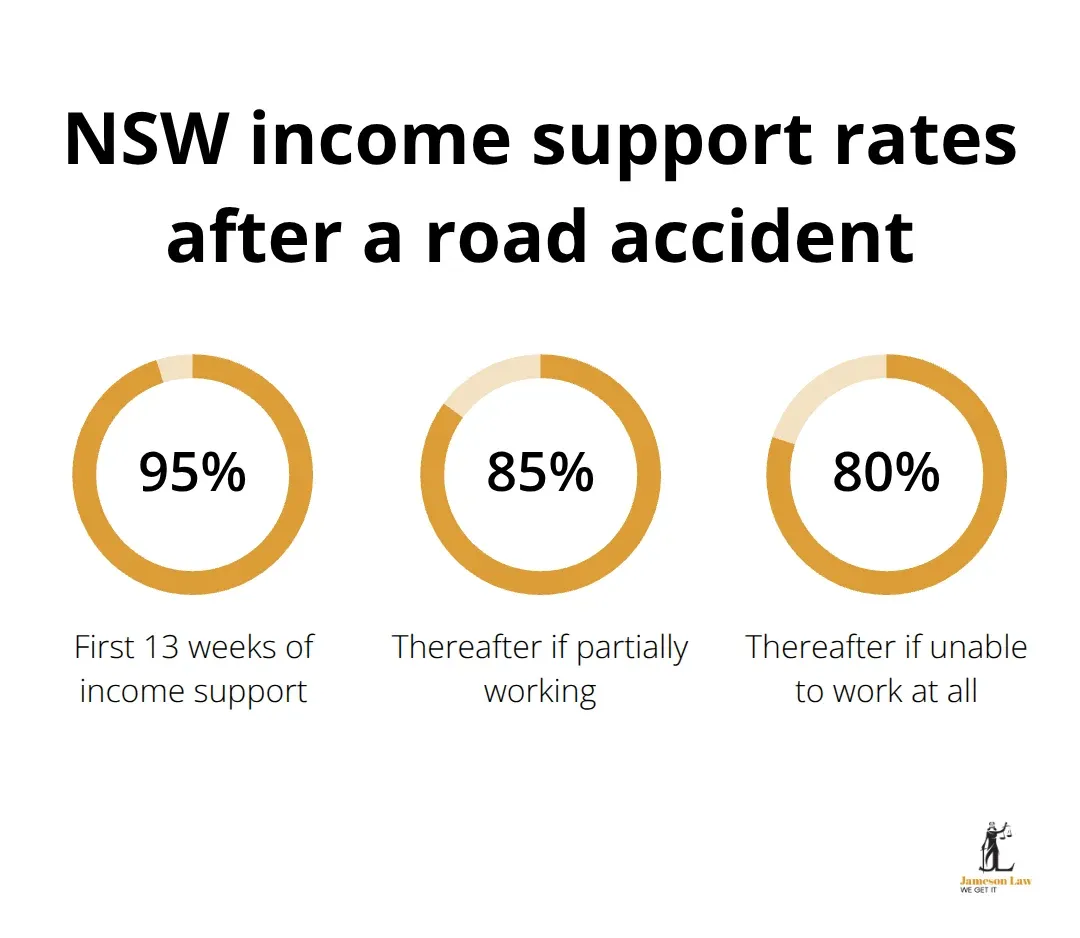
For lost income, gather pay slips from the four weeks before the accident, employment contracts, and written confirmation from your employer of your usual weekly earnings. If self-employed, provide tax returns and business income records. Insurers assess income support as a percentage of pre-accident earnings: approximately 95 per cent for the first 13 weeks, then 85 per cent if partially working or 80 per cent if unable to work at all. Accurate income documentation prevents disputes over these percentages.

Percentage chart showing NSW income support rates: 95% first 13 weeks, then 85% if partially working or 80% if unable to work.

When injuries stabilise around 12 to 18 months post-accident, request a medical impairment assessment from a specialist qualified to determine Whole Person Impairment. This assessment unlocks eligibility for lump sum damages if your impairment exceeds 10 per cent.

Engage Legal Representation to Strengthen Your Position

Legal representation strengthens your claim substantially. A legal representative manages communication with the insurer, prevents you from making damaging statements, and ensures deadlines are met. Many claimants inadvertently reduce their compensation by answering insurer inquiries without legal guidance. Your representative also negotiates the lump sum amount once medical evidence is complete, a process where experience and knowledge of comparable claims produce significantly higher outcomes than self-representation.

Acting immediately and systematically transforms your claim from uncertain to solid. With your documentation organised, your deadlines met, and professional guidance in place, you move into the next phase where injury assessment and lump sum negotiation determine your final compensation outcome.

What Really Determines Your Compensation Amount

How Injury Classification Shapes Your Payout

Injury severity dominates compensation calculations far more than most claimants realise. The distinction between threshold and non-threshold injuries creates a massive gap in what you receive. Threshold injuries cap weekly income support at 12 months, while non-threshold injuries extend beyond 24 months and unlock lump sum payments for economic loss and pain and suffering. SIRA data from 2025 shows the average motor accident claim paid approximately $118,000, but this figure masks enormous variation. Non-threshold injuries with permanent impairment exceeding 10 per cent Whole Person Impairment attract pain and suffering lump sums alongside economic loss payments, easily pushing total compensation well above this average.

Your medical evidence directly determines this classification. Insurers assess injury severity through medical reports, specialist assessments, and treatment consistency. Gaps in treatment signal to insurers that your injury wasn’t serious enough to warrant ongoing care, which reduces lump sum valuations substantially. A claimant who attends physiotherapy weekly for 18 months presents a far stronger case for significant impairment than someone who attended sporadically.

Medical Expenses Form Only Part of Your Claim

Medical expenses themselves represent only one component of your total claim. Physiotherapy, psychology sessions, specialist consultations, and medication costs receive reimbursement, but these typically account for 5 to 15 per cent of your total payout. The real compensation comes from income support and lump sums based on future earning capacity and pain and suffering. If you earned $80,000 annually before the accident and cannot return to work, your lost income over the next 30 years until retirement becomes the primary driver of your compensation amount, potentially reaching hundreds of thousands of dollars when calculated with appropriate discount rates for present value.

Lost Wages and Future Earning Capacity Drive Most Claims

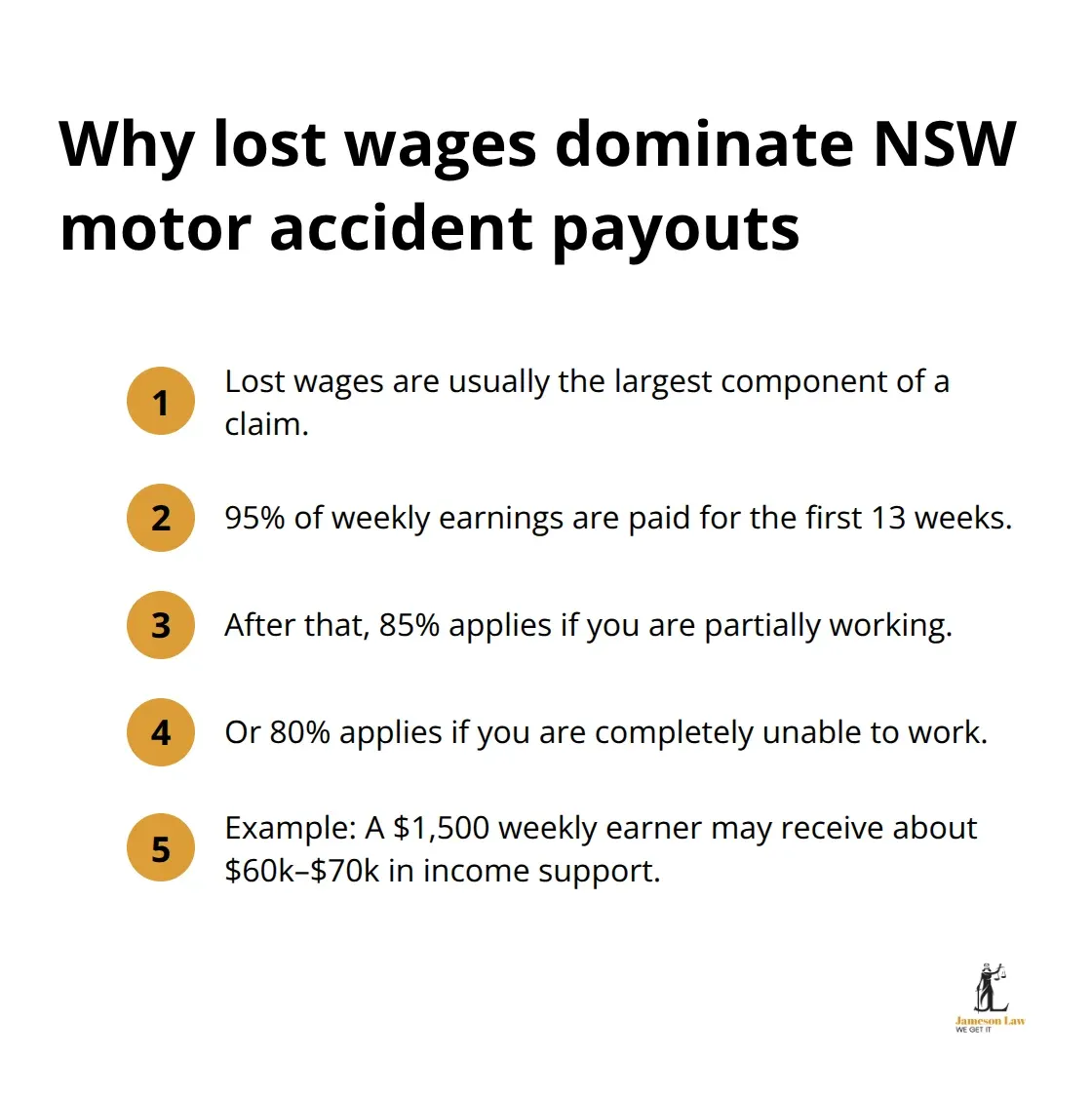
Lost wages create the largest component of most compensation claims, yet many claimants underestimate this when gathering documentation. If you cannot work for 18 months, you receive approximately 95 per cent of your weekly earnings for the first 13 weeks, then 85 per cent if partially working or 80 per cent if completely unable to work. For someone earning $1,500 weekly, this totals roughly $60,000 to $70,000 in income support alone.

Compact list summarising lost wage drivers and example amounts in NSW motor accident claims. - Road accident compensation NSW

Future earning capacity extends this calculation significantly. If your injury prevents you from returning to your pre-accident occupation but you can work in a lower-paid role, insurers calculate the difference between your pre-accident and post-accident earning capacity over your working life. A 35-year-old unable to return to their $120,000 construction job but capable of earning $50,000 in office work faces a 30-year earning loss of approximately $2.1 million at present value, depending on discount rate calculations. Demonstrating this future loss requires medical evidence that your injury creates permanent restrictions. Specialist reports specifically addressing your capacity to return to your usual occupation prove essential.

Pain and Suffering Damages for Serious Injuries

Pain and suffering damages apply only to non-threshold injuries with permanent impairment exceeding 10 per cent. This component is highly subjective, yet NSW courts apply established guidelines based on comparable cases. Injuries resulting in 10 to 15 per cent impairment typically attract lump sums between $15,000 and $50,000, while 40 to 50 per cent impairment reaches $200,000 to $400,000. Psychological injuries receive equal consideration. PTSD or depression meeting non-threshold criteria qualifies for identical pain and suffering lump sums as physical injuries, though insurers scrutinise psychological claims more heavily and require detailed psychological reports from registered psychologists or psychiatrists.

Negotiating your lump sum requires understanding comparable settlements. Insurers possess databases of settled claims and use these to justify their initial offers. Legal representation becomes invaluable here because experienced representatives understand typical settlement ranges for your specific injury type and can identify when insurers offer below-market amounts.

Final Thoughts

Road accident compensation NSW requires you to act within the first 28 days to protect your entitlements fully. Your immediate priorities-reporting to police, notifying your insurer, and gathering documentation-determine whether you receive complete income support or forfeit weeks of compensation. Medical evidence, employment records, and witness statements form the foundation that insurers use to calculate your payout, and without systematic documentation, even serious injuries produce lower valuations.

The compensation process extends far beyond your initial claim, with injury classification, medical impairment assessment, and documented earning capacity driving your final payout much more than accident circumstances. Non-threshold injuries with permanent impairment exceeding 10 per cent unlock lump sum damages for pain and suffering alongside economic loss payments-a distinction that can mean the difference between receiving $50,000 and $500,000. Most claimants underestimate their entitlements because they focus on immediate medical costs rather than long-term earning capacity and future needs.

Contact Jameson Law to discuss your road accident compensation claim and understand what you’re genuinely entitled to receive. We operate on a no win, no fee basis for plaintiff claims, meaning you pay nothing unless we secure compensation for you. Your next step is a confidential discussion about your specific situation.

Speak to an Expert Lawyer today

Laywers-Jameson-Law-The-best-law-firm-in-Sydney- Sydney Lawyers - Sydney
BOOK NOW

WE'RE IN IT TO WIN IT

Book your consultation

Book Now
Book Now Mobile 06 02 2025

This form submission is encrypted and secured to ensure your information remains confidential.

What our Clients

Related Publications:

What our clients say

.

Jameson Law - Voted the Best Law firm in Sydney Award

Legal Answers ... In Short

We're here to help

Our mission is to ensure our client matters are resolved successfully every time. Success to us does not simply involve winning, but moreover ensuring we take the most feasible, economic and stress-free path to help our clients achieve their goals. We fight hard for our clients, and always go by the motto: we’re in it to win it.

Jameson Law - Best Law Firm in Sydney

WE'RE IN IT TO WIN IT

Book your consultation

Call us now on (02) 8806 0866 or fill out the form below

Book Now Mobile

This form submission is encrypted and secured to ensure your information remains confidential.

WE'RE IN IT TO WIN IT

Book your consultation

Book Now Mobile 06 02 2025
lock

This form submission is encrypted and secured to ensure your information remains confidential.

Our Sydney Offices

Offices Parramatta and Sydney Jameson Law
Parramatta CBD - Head Office
jameson Law - Blacktown
jameson Law - Liverpool Office
Jameson Law - Bankstown
Court Houses We Frequent Jameson Law

Court Houses We Frequent

Balmain Local Court

Registry: Monday to Friday, 9:00am to 4:30pm

Bankstown Local Court

Court Operating Hours: 9:30am-4:30pm

Blacktown Local Court

Registry Hours: 9:00 – 4:30
Telephone Hours: 8:30 -4:30
Days open: Mon-Fri

Burwood Local Court

Registry Hours: 9:00 – 4:30
Telephone Hours: 8:30 – 4:30
Days open: Mon – Fri

Campbell Local Court

Registry Hours: 9:00 – 4:30
Telephone Hours: 8:30 – 4:30
Days open: Mon – Fri

Central Local Court

Registry Hours: 9:00 – 1:00 and 2:00 – 4:30
Telephone Hours: 8:30 – 4:30

Downing Local Court

Registry Hours: 9:00 – 1:00 and 2:00 – 4:30
Telephone Hours: 8:30 – 4:30

Wollongong Local Court

Registry Hours: 9:00 – 1:00 and 2:00 – 4:30
Telephone Hours: 8:30 – 4:30

Fairfield Local Court

Registry Hours: 9:00 – 1:00 and 2:00 – 4:30
Telephone Hours: 8:30 – 4:30

Hornsby Local Court

Registry Hours: 9:00 – 1:00 and 2:00 – 4:30
Telephone Hours: 8:30 – 4:30

Liverpool Local Court

Registry Hours: 9:00 – 1:00 and 2:00 – 4:30
Telephone Hours: 8:30 – 4:30

Manly Local Court

Registry Hours: 9:00 – 1:00 and 2:00 – 4:30
Telephone Hours: 8:30 – 4:30

Newtown Local Court

Registry Hours: 9:00 – 1:00 and 2:00 – 4:30
Telephone Hours: 8:30 – 4:30

Parramatta Local Court

Registry Hours: 9:00 – 1:00 and 2:00 – 4:30
Telephone Hours: 8:30 – 4:30

Penrith Local Court

Registry Hours: 9:00 – 1:00 and 2:00 – 4:30
Telephone Hours: 8:30 – 4:30

Sutherland Local Court

Registry Hours: 9:00 – 1:00 and 2:00 – 4:30
Telephone Hours: 8:30 – 4:30

Waverley Local Court

Registry Hours: 9:00 – 1:00 and 2:00 – 4:30
Telephone Hours: 8:30 – 4:30

Windsor Local Court

Registry Hours: 9:00 – 1:00 and 2:00 – 4:30
Telephone Hours: 8:30 – 4:30

Wollongong Local Court

Registry Hours: 9:00 – 1:00 and 2:00 – 4:30
Telephone Hours: 8:30 – 4:30

Downing Centre District Court

Registry Hours: 9:00 – 4:30
Telephone Hours: 8:30 – 4:30
Days open: Mon – Fri

Parramatta District Court

Registry Hours: 9:00 – 4:30
Days open: Mon-Fri

Penrith District Court

Registry Hours: 9:00 – 4:30
Days open: Mon-Fri

Campbelltown District Court

Registry Hours: 9:00 – 4:30
Days open: Mon – Fri

Liverpool District Court

Registry Hours: 9:00 – 4:30
Days open: Mon – Fri

Wollongong District Court

Registry Hours: 9:00 – 1:00 and 2:00 – 4:30
Telephone Hours: 8:30 – 4:30

Supreme Court New South Wales

Registry Hours: 9:00 AM – 4:30 PM
Telephone Hours: 8:30 AM – 4:30 PM
Days Open: Monday to Friday

Federal Circuit and Family Court of Australia

Registry Hours: 9:00 AM – 4:30 PM
Telephone Hours: 8:30 AM – 5:00 PM
Days Open: Monday to Friday

Federal Court

Monday to Friday, 8:30 AM – 4:30 PM

High Court

Monday to Friday, 8:30 AM – 5:00 PM

Children’s Court of New South Wales

Registry Hours: 9:00 AM – 4:30 PM
Telephone Hours: 8:30 AM – 4:30 PM
Days Open: Monday to Friday

Coroner’s Court New South Wales

Registry Hours: 9:00 AM – 4:30 PM
Telephone Hours: 8:30 AM – 4:30 PM
Days Open: Monday to Friday

Industrial Relations Commission of New South Wales

Registry Hours: 9:00 AM – 4:30 PM
Telephone Hours: 8:30 AM – 4:30 PM
Days Open: Monday to Friday

Land and Environment Court of New South Wales

Registry Hours: 9:00 AM – 4:30 PM
Telephone Hours: 8:30 AM – 4:30 PM
Days Open: Monday to Friday

WE'RE IN IT TO WIN IT

Book your consultation

Book Now
Book Now Mobile 06 02 2025
lock

This form submission is encrypted and secured to ensure your information remains confidential.