

Injury compensation payout NSW amounts depend on the applicable claim scheme, statutory rules and the strength of the evidence. If you have suffered a personal injury, understanding these factors is important for setting realistic expectations. The amount you receive is not arbitrary; it is calculated based on strict legislative thresholds, the specific scheme governing your accident, and the objective strength of your medical and financial evidence.
At Jameson Law, we guide clients through the complexities of NSW compensation schemes to ensure their claims are accurately valued. This guide breaks down the core elements that dictate your entitlements and common mistakes to avoid.
Injury Compensation Payout NSW: Core Factors
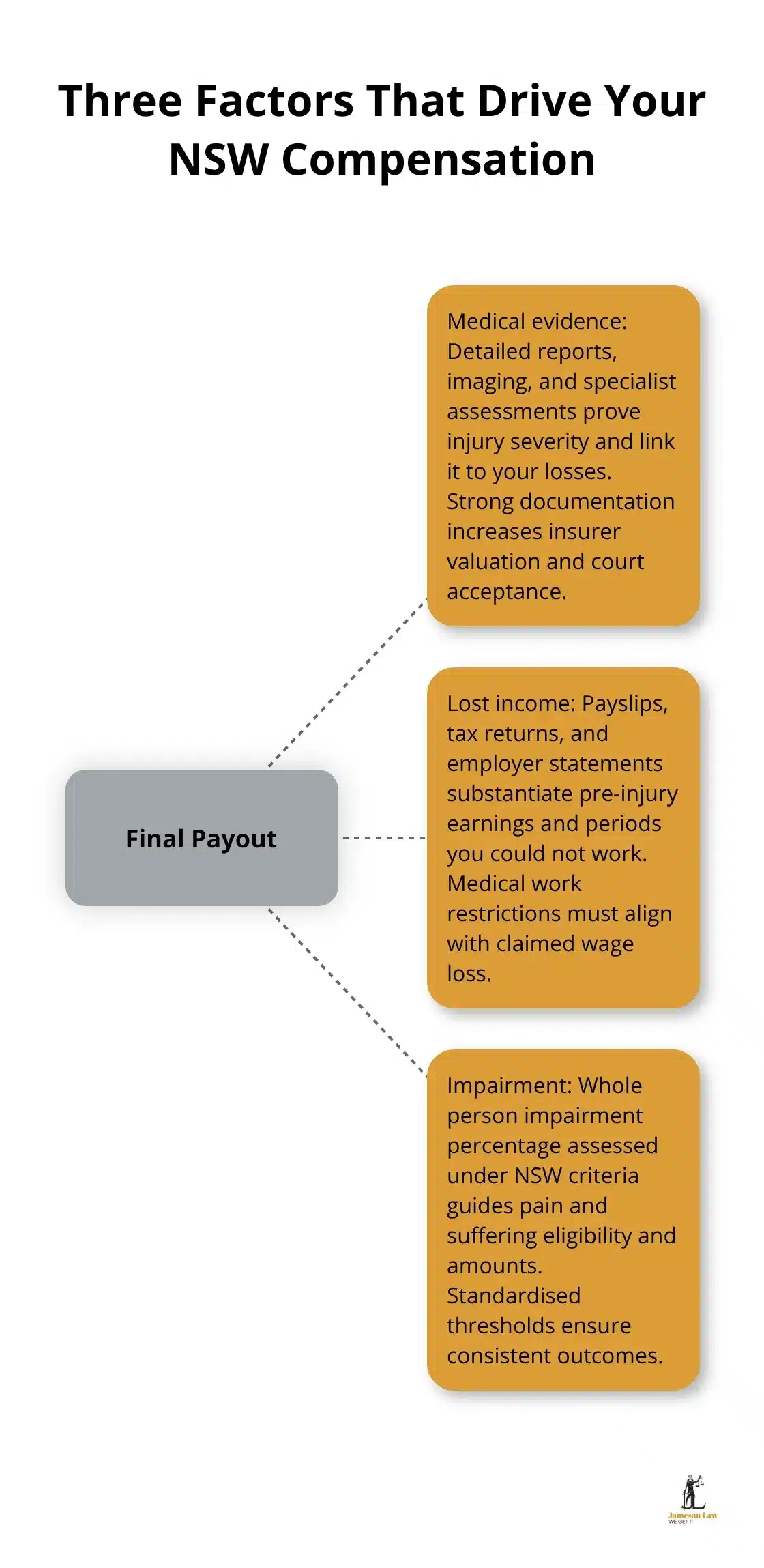
Your compensation payout is determined by objective evidence mapping your losses to statutory categories. Whether your claim is resolved by settlement negotiation or through an administrative body like the Personal Injury Commission, your compensation is generally shaped by the following factors.
1. Independent Medical Evidence
The foundation of any injury claim is comprehensive medical documentation. Insurers and legal decision-makers rely on clinical notes, imaging results, and independent medico-legal expert reports to establish the severity and causation of your injury. If you delay seeking treatment or fail to attend specialist appointments, gaps in your medical timeline can be interpreted as evidence that your injuries are not severe, potentially limiting your compensation.
2. Past and Future Economic Loss
Compensation for lost wages requires strict documentation. You must provide payslips, tax returns, and employer statements to verify your pre-injury earnings. For future economic loss, your claim must be supported by medical evidence detailing ongoing work restrictions and demonstrating how your injury permanently affects your earning capacity.
3. Treatment and Care Needs
Your payout will factor in past out-of-pocket medical expenses and the projected cost of future treatment, rehabilitation, and necessary domestic care. These figures must be substantiated by receipts and expert care assessments.
How Different NSW Schemes Apply Statutory Thresholds
There is no single “compensation calculator” in NSW. Your entitlements and the applicable thresholds differ significantly depending on the legal framework governing your accident.
| Claim Type | Governing Legislation | Relevant Impairment or Non-Economic Loss Rule |
|---|---|---|
| Motor Vehicle Accidents | Motor Accident Injuries Act 2017 | Generally requires Whole Person Impairment (WPI) greater than 10%. |
| Workers Compensation | NSW workers compensation permanent impairment rules | Physical injury: generally greater than 10% WPI. Primary psychological injury: at least 15% WPI. |
| Public Liability & Medical Negligence | Civil Liability Act 2002 | Severity must be at least 15% of a most extreme case. |
Contributory Negligence
In fault-based claims under the Civil Liability Act or common law damages claims for motor accidents, your payout may be reduced if you are found to have contributed to your own injury (e.g., not wearing a seatbelt or ignoring safety warnings). The final payout is proportionally reduced by your degree of contributory negligence.
Protecting the Value of Your Claim
Many claimants inadvertently damage the value of their compensation by making crucial errors in the days and weeks following an injury.
Seek Immediate Medical Treatment
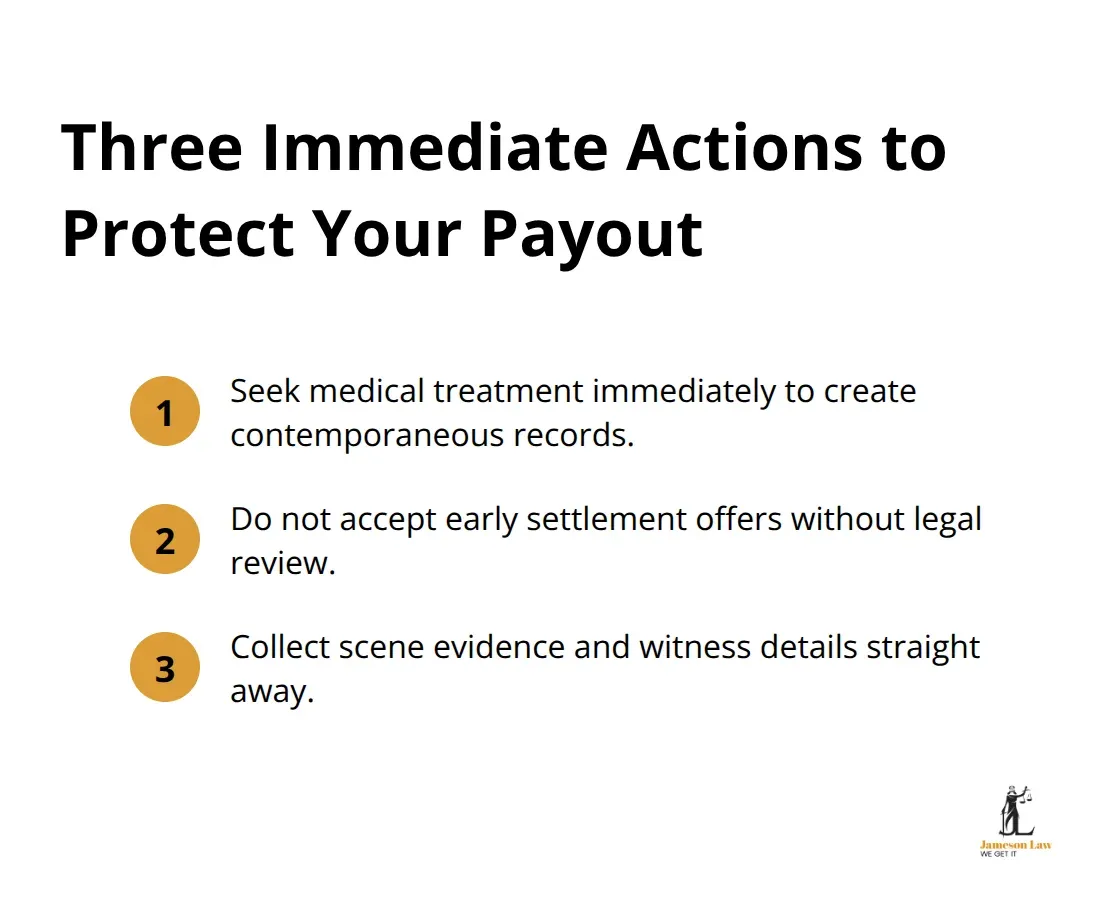
Seek appropriate medical treatment as soon as reasonably practicable after an injury. Contemporaneous medical records—created on the day of the incident or shortly after—are vital for establishing causation. Delayed treatment can complicate your claim and make it difficult to prove your injury resulted from the specific accident.
Gather Scene Evidence
If you are involved in a motor accident or public liability incident, gather evidence at the scene if it is safe to do so. Take photographs, collect witness contact details, and ensure the incident is formally reported to the police or the venue manager.
Do Not Accept Early Offers Without Legal Advice
Insurers may offer an early settlement before the full extent of your injury is known. Accepting an early offer typically requires signing a deed of release, preventing you from claiming further compensation if your condition worsens or if you require unexpected surgery in the future. Always seek independent legal advice to assess whether an offer accurately reflects your long-term economic loss and future care needs.
Frequently Asked Questions
What impairment thresholds can affect a NSW compensation claim?
The rule depends on the scheme. Motor accident non-economic loss generally requires WPI greater than 10%. Workers compensation permanent impairment lump sums generally require more than 10% WPI for physical injury or at least 15% WPI for a primary psychological injury; secondary psychological injury is excluded. Civil liability non-economic loss uses a severity threshold of at least 15% of a most extreme case, not a WPI test.
How is lost income calculated in a personal injury claim?
Lost income is calculated based on documented past and future economic loss. This requires payslips, tax returns, and expert medical evidence detailing your work restrictions and how your injury permanently impacts your earning capacity.
Do all personal injury claims go to court?
No. Many personal injury claims in NSW resolve through statutory processes or settlement negotiation without a final court hearing. Eligible motor accident and workers compensation disputes may also be determined by the Personal Injury Commission.
Final Thoughts
Determining your injury compensation payout requires a meticulous assessment of medical evidence, economic loss documentation, and the application of complex statutory thresholds. Because each NSW scheme operates under different legislative rules, relying on generic estimates can be misleading.
A personal injury lawyer can help identify the applicable scheme, assess the available evidence, and explain the heads of loss that may be claimed. Depending on your eligibility and our agreement, Jameson Law may be able to assist you on a No Win, No Fee basis for plaintiff claims.
To discuss the factors determining your compensation payout, contact the personal injury team at Jameson Law for expert legal advice.