PUBLICATION

Personal Injury Time Limits NSW: How Long You Have to Claim

"Discover NSW personal injury claim deadlines and time limits to protect your legal rights and compensation eligibility today."
Personal Injury Time Limits NSW: How Long You Have to Claim

If you’ve been injured in NSW, you’re racing against the clock. Personal injury time limits in NSW are strict, and missing a deadline can cost you your right to claim compensation entirely.

At Jameson Law, we’ve seen too many people lose valid claims because they waited too long. This guide breaks down exactly how much time you have and what you need to do right now to protect your claim.

The Three-Year Clock That Governs NSW Personal Injury Claims

How the Three-Year Limitation Period Works

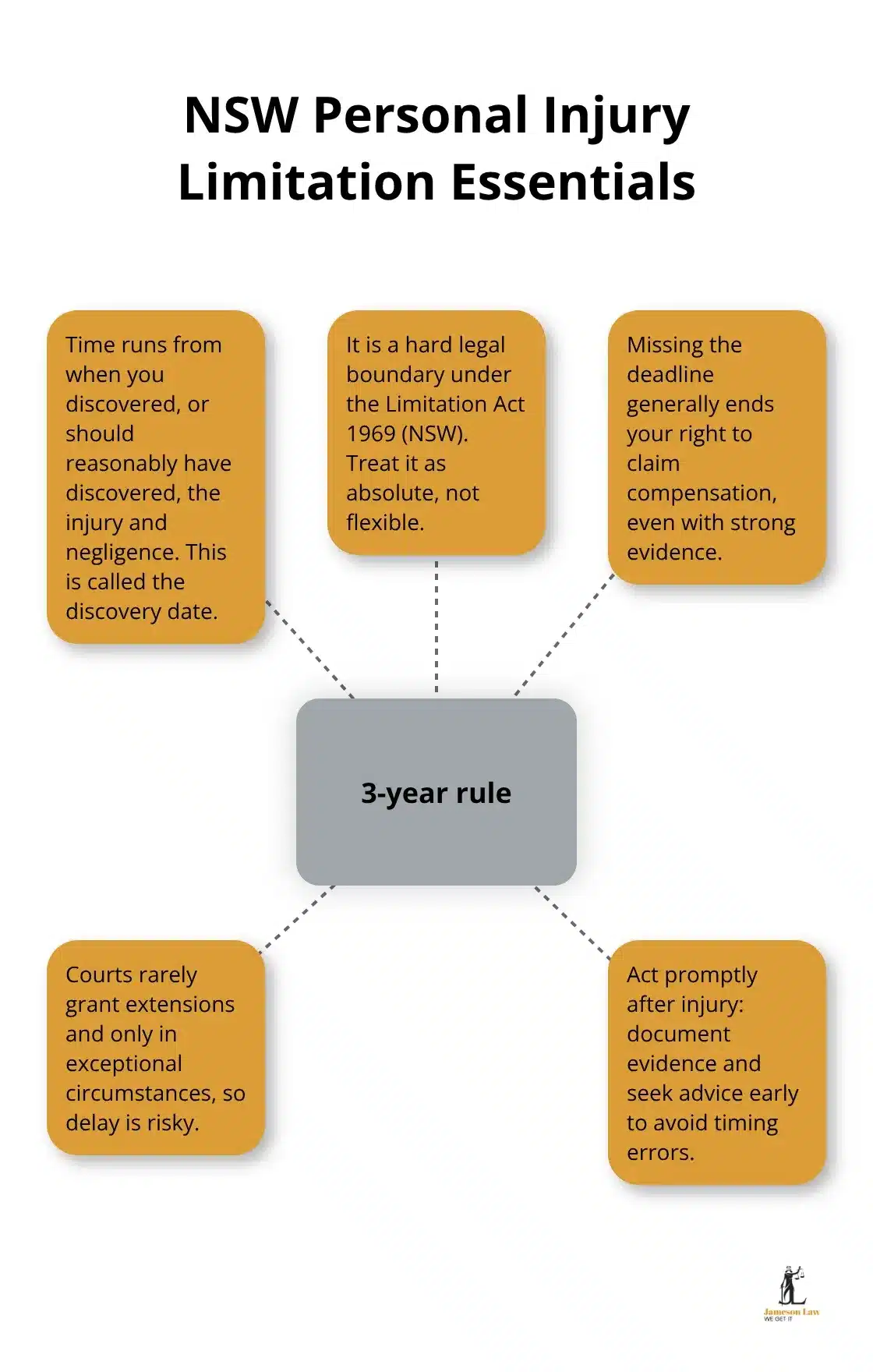
A limitation period is simply a legal deadline. Under NSW law, you have three years from the date you became aware of your injury to file a personal injury claim. This isn’t a suggestion or a guideline-it’s a hard legal boundary set out in the Limitation Act 1969 (NSW). Once that three years expires, your right to claim compensation disappears permanently, even if you have a valid case and solid evidence of fault.

Diagram showing the key rules that govern NSW personal injury time limits - Personal injury time limits NSW

The courts rarely grant extensions, and when they do, the bar is extremely high. This means the moment you’re injured, time is already working against you.

When Your Three-Year Clock Actually Starts

The three-year period doesn’t start from the date of your accident. It starts from the date you discovered-or reasonably should have discovered-that you were injured and that someone else’s negligence caused it. For a car accident, this is usually straightforward: the injury is obvious on the day of the crash. But for conditions that develop slowly, like back pain from a workplace injury or complications from medical negligence, the discovery date can shift forward. This is critical because it directly affects when your deadline actually expires.

The 12-Year Long-Stop That Overrides Everything

You also need to know about the 12-year long-stop, which acts as an absolute ceiling. Even if you haven’t discovered your injury, you cannot claim more than 12 years after the incident that caused it. This provision exists to prevent claims from proceeding indefinitely, regardless of when you became aware of the harm.

Special Rules for Minors

If you were under 18 when injured, the three-year clock doesn’t start until your 18th birthday, giving you until age 21 to lodge your claim. However, if a close relative caused the injury, you have until age 25 to start your claim. These extensions exist because children can’t reasonably pursue legal action on their own, but they don’t give you unlimited time.

When Courts May Extend Your Deadline

The NSW Limitation Act provides narrow grounds for extending the deadline beyond three years in exceptional circumstances-but extensions are discretionary, not automatic. Courts may extend your deadline by up to 5 years in limited cases. Courts consider factors like the length of delay, whether you acted reasonably despite the delay, and whether the other party would face genuine prejudice if the case proceeded. Missing your deadline without securing an extension means your claim is permanently barred, regardless of its merit. Understanding these time limits is only the first step. What matters now is knowing exactly what actions you must take immediately after your injury to protect your claim.

Your Key Deadlines for NSW Personal Injury Claims

When Your Three-Year Clock Starts Ticking

The three-year limitation period under the Limitation Act 1969 (NSW) is your primary deadline, but it operates differently than most people assume. Your clock starts from the date you discovered-or reasonably should have discovered-that you were injured and that someone else’s negligence caused it. For obvious injuries like fractures from a car crash, this discovery date is straightforward. For gradual conditions such as occupational diseases, repetitive strain injuries, or complications from medical treatment, the discovery date can shift significantly later, potentially giving you more time than you initially think. The critical point is that you must lodge your claim before three years pass from this discovery date.

The 12-Year Long-Stop That Overrides Everything

The Limitation Act 1969 (NSW) also imposes a 12-year long-stop period from the date of the incident itself, whichever expires first. This means even if you only discovered your injury five years after an accident, you cannot claim more than 12 years from that original incident. This provision prevents claims from proceeding indefinitely, regardless of when you became aware of the harm.

Motor Vehicle and Workplace Deadlines

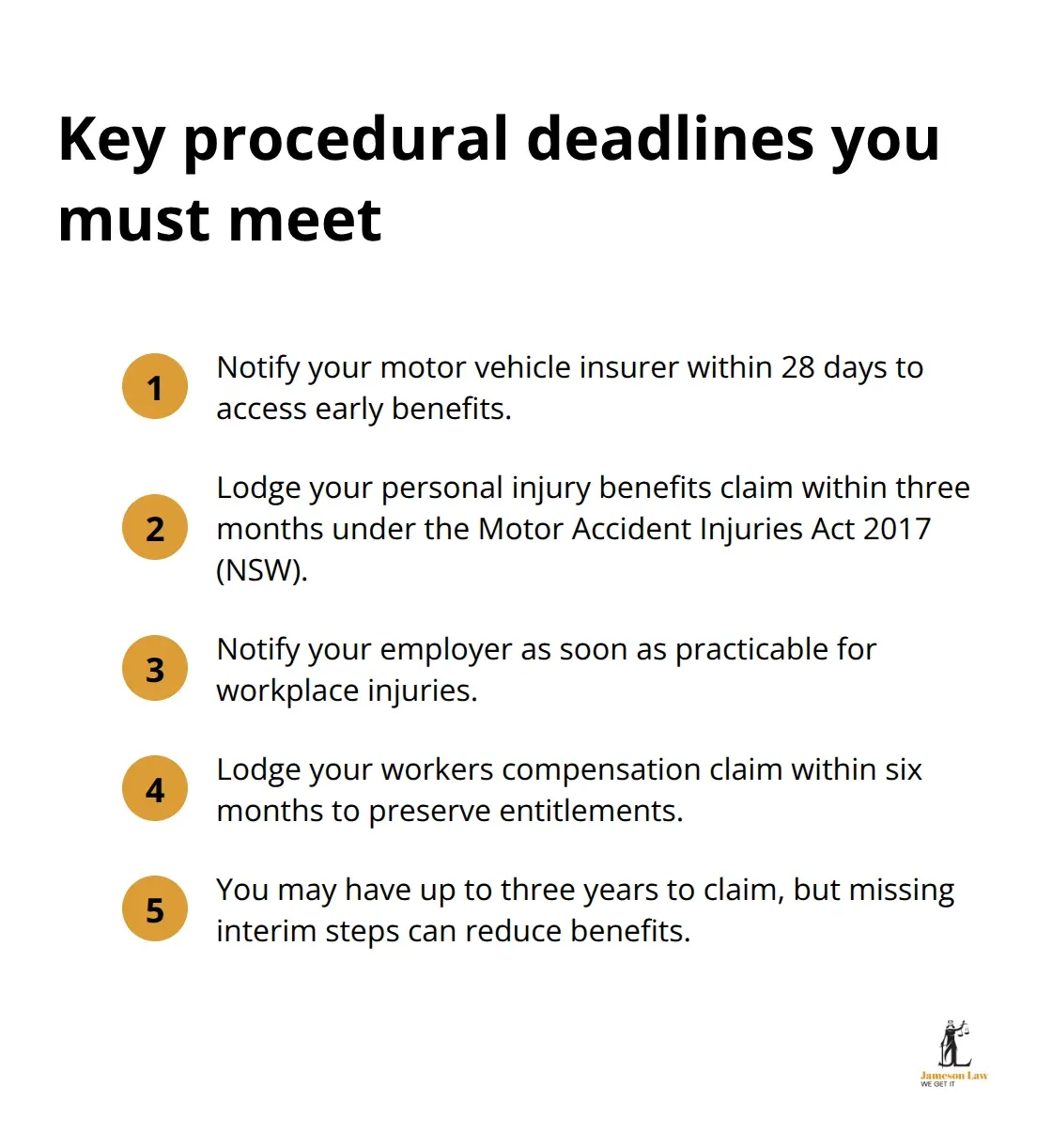
Motor vehicle claims carry additional procedural deadlines that operate alongside the limitation period. You must notify your insurer within 28 days of a motor vehicle accident to access early benefits, and you must lodge a personal injury benefits claim within three months under the Motor Accident Injuries Act 2017 (NSW). Workplace injuries require notifying your employer as soon as practicable and lodging your workers compensation claim within six months, though you have up to three years to claim. Missing these intermediate deadlines doesn’t necessarily bar your claim, but it can cost you benefits and weaken your position.

Compact list of NSW motor vehicle and workplace injury claim deadlines - Personal injury time limits NSW

Extended Deadlines for Minors

If you were under 18 when injured, your deadline extends until your 21st birthday, giving you three years from when you turned 18 rather than from the injury date itself. If a close relative caused your injury, the clock extends further to your 25th birthday. The rationale is simple: children cannot reasonably pursue legal action independently, so the law pauses their limitation period during childhood. However, this extension is not unlimited-once you reach 21 or 25 depending on the circumstances, the standard rules apply and your three-year countdown begins immediately.

When Courts Grant Extensions

Courts can extend your deadline beyond three years, but only in exceptional circumstances and only by up to five years. Extensions are discretionary, never automatic, and courts weigh factors including the length of your delay, whether you acted reasonably despite the delay, prejudice to the defendant, and whether evidence remains reliable. The Limitation Act 1969 (NSW) permits extensions where the court considers it just and reasonable, but the bar is genuinely high. Waiting to see if an extension might be granted is a dangerous strategy-you must treat your three-year deadline as absolute and plan accordingly. If you discover your injury was latent, meaning it wasn’t apparent at the time of the incident, courts may grant discretionary extensions, but you still cannot exceed the 12-year long-stop. Seeking legal advice immediately after injury confirms your exact discovery date and deadline, particularly if your injury developed gradually or if you’re unsure whether you fall within standard timeframes.

Protect Your Claim Now

Act Immediately to Preserve Evidence

The moment after injury is when most people fail to protect their claims. You won’t have another chance to collect fresh evidence or notify parties while memories remain sharp and records exist in their original form. Start collecting documentation immediately, before details fade and witnesses become harder to locate.

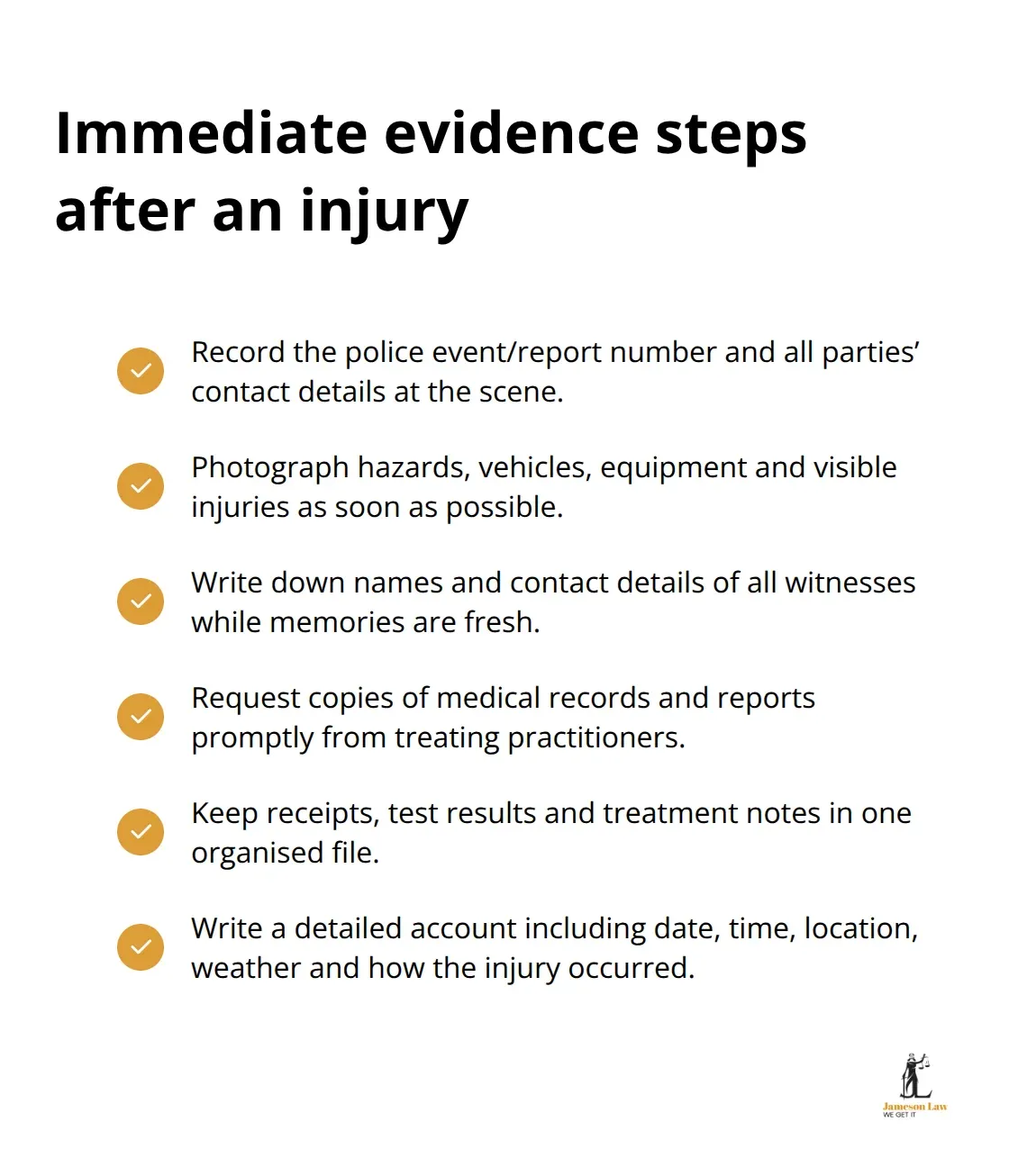
Checklist of actions to preserve evidence for NSW personal injury claims

For motor vehicle accidents, obtain the police report number and contact details of all parties involved at the scene. For workplace injuries, take photographs of the hazard or equipment that caused your injury and write down the names of anyone who witnessed what happened. For medical negligence, request copies of all medical records from the treating practitioner within days, not weeks.

The Limitation Act 1969 (NSW) gives you three years, but that clock moves faster than you think. The strength of your claim depends entirely on how thoroughly you document everything now.

Collect Medical Records and Documentation

Medical records matter most because they establish the chain between the incident and your injury. Under the Motor Accident Injuries Act 2017 (NSW), you must lodge a personal injury benefits claim within three months to access early treatment, so obtain your medical assessment immediately and keep every receipt, test result, and practitioner report.

Workplace claims require notifying your employer as soon as practicable, ideally within 30 days. This action both protects your rights and creates an official record of your injury. For any claim type, write a detailed account of what happened while it remains fresh in your memory, including the date, time, location, weather conditions, and exactly how the injury occurred. This written account becomes invaluable later when you need to recall specifics or explain gaps in your recollection.

Notify Relevant Parties Within Statutory Timeframes

Notifying relevant parties establishes a documented timeline that strengthens your position substantially. Contact your insurer or employer within the statutory windows because delays weaken your credibility and can cost you benefits.

For motor vehicle accidents, notify your insurer within 28 days to access early benefits under the Motor Accident Injuries Act 2017 (NSW), and lodge your formal benefits claim within three months. Workplace injuries require employer notification as soon as practicable and claim lodgement within six months to preserve your entitlements.

Medical negligence claims don’t carry the same procedural deadlines, but notifying the practitioner or hospital in writing creates documented evidence that you discovered the negligence at a specific time. This notification directly affects your three-year countdown under the Limitation Act 1969 (NSW).

Seek Legal Advice Before Your Deadline Approaches

Seek legal advice before your three-year window closes, not as your deadline approaches. A lawyer confirms your exact discovery date, identifies whether your injury qualifies for any extension provisions, and calculates your precise deadline based on your circumstances.

If your injury developed gradually or you’re unsure when you truly discovered it, legal advice clarifies this immediately rather than leaving you guessing. Courts consider whether you acted reasonably when deciding extension applications, and acting quickly demonstrates reasonable conduct. Delaying legal advice until year two or three of your limitation period shows poor judgment to a court and undermines any extension application.

Final Thoughts

Personal injury time limits in NSW operate as hard deadlines that courts will not overlook. The three-year limitation period under the Limitation Act 1969 (NSW) expires whether you act or not, and courts rarely grant extensions unless circumstances are genuinely exceptional. You cannot assume an extension will materialise or that you possess more time than you actually do.

Your claim carries an expiry date that depends on when you discovered your injury and your specific circumstances, but it arrives faster than most people anticipate. Every week you delay moves you closer to losing your right to claim compensation entirely, regardless of how valid your case may be. Acting quickly preserves evidence while memories remain sharp, notifies relevant parties within statutory timeframes, and gathers medical documentation before records change form.

Contact Jameson Law today to confirm your exact deadline and identify any extension possibilities for your situation. We handle personal injury claims on a no win, no fee basis, which means you pay nothing unless we recover compensation for you. Your deadline will not wait, and neither should you.

Speak to an Expert Lawyer today

Laywers-Jameson-Law-The-best-law-firm-in-Sydney- Sydney Lawyers - Sydney
BOOK NOW

WE'RE IN IT TO WIN IT

Book your consultation

Book Now
Book Now Mobile 06 02 2025

This form submission is encrypted and secured to ensure your information remains confidential.

What our Clients

Related Publications:

What our clients say

.

Jameson Law - Voted the Best Law firm in Sydney Award

Legal Answers ... In Short

We're here to help

Our mission is to ensure our client matters are resolved successfully every time. Success to us does not simply involve winning, but moreover ensuring we take the most feasible, economic and stress-free path to help our clients achieve their goals. We fight hard for our clients, and always go by the motto: we’re in it to win it.

Jameson Law - Best Law Firm in Sydney

WE'RE IN IT TO WIN IT

Book your consultation

Call us now on (02) 8806 0866 or fill out the form below

Book Now Mobile

This form submission is encrypted and secured to ensure your information remains confidential.

WE'RE IN IT TO WIN IT

Book your consultation

Book Now Mobile 06 02 2025
lock

This form submission is encrypted and secured to ensure your information remains confidential.

Our Sydney Offices

Offices Parramatta and Sydney Jameson Law
Parramatta CBD - Head Office
jameson Law - Blacktown
jameson Law - Liverpool Office
Jameson Law - Bankstown
Court Houses We Frequent Jameson Law

Court Houses We Frequent

Balmain Local Court

Registry: Monday to Friday, 9:00am to 4:30pm

Bankstown Local Court

Court Operating Hours: 9:30am-4:30pm

Blacktown Local Court

Registry Hours: 9:00 – 4:30
Telephone Hours: 8:30 -4:30
Days open: Mon-Fri

Burwood Local Court

Registry Hours: 9:00 – 4:30
Telephone Hours: 8:30 – 4:30
Days open: Mon – Fri

Campbell Local Court

Registry Hours: 9:00 – 4:30
Telephone Hours: 8:30 – 4:30
Days open: Mon – Fri

Central Local Court

Registry Hours: 9:00 – 1:00 and 2:00 – 4:30
Telephone Hours: 8:30 – 4:30

Downing Local Court

Registry Hours: 9:00 – 1:00 and 2:00 – 4:30
Telephone Hours: 8:30 – 4:30

Wollongong Local Court

Registry Hours: 9:00 – 1:00 and 2:00 – 4:30
Telephone Hours: 8:30 – 4:30

Fairfield Local Court

Registry Hours: 9:00 – 1:00 and 2:00 – 4:30
Telephone Hours: 8:30 – 4:30

Hornsby Local Court

Registry Hours: 9:00 – 1:00 and 2:00 – 4:30
Telephone Hours: 8:30 – 4:30

Liverpool Local Court

Registry Hours: 9:00 – 1:00 and 2:00 – 4:30
Telephone Hours: 8:30 – 4:30

Manly Local Court

Registry Hours: 9:00 – 1:00 and 2:00 – 4:30
Telephone Hours: 8:30 – 4:30

Newtown Local Court

Registry Hours: 9:00 – 1:00 and 2:00 – 4:30
Telephone Hours: 8:30 – 4:30

Parramatta Local Court

Registry Hours: 9:00 – 1:00 and 2:00 – 4:30
Telephone Hours: 8:30 – 4:30

Penrith Local Court

Registry Hours: 9:00 – 1:00 and 2:00 – 4:30
Telephone Hours: 8:30 – 4:30

Sutherland Local Court

Registry Hours: 9:00 – 1:00 and 2:00 – 4:30
Telephone Hours: 8:30 – 4:30

Waverley Local Court

Registry Hours: 9:00 – 1:00 and 2:00 – 4:30
Telephone Hours: 8:30 – 4:30

Windsor Local Court

Registry Hours: 9:00 – 1:00 and 2:00 – 4:30
Telephone Hours: 8:30 – 4:30

Wollongong Local Court

Registry Hours: 9:00 – 1:00 and 2:00 – 4:30
Telephone Hours: 8:30 – 4:30

Downing Centre District Court

Registry Hours: 9:00 – 4:30
Telephone Hours: 8:30 – 4:30
Days open: Mon – Fri

Parramatta District Court

Registry Hours: 9:00 – 4:30
Days open: Mon-Fri

Penrith District Court

Registry Hours: 9:00 – 4:30
Days open: Mon-Fri

Campbelltown District Court

Registry Hours: 9:00 – 4:30
Days open: Mon – Fri

Liverpool District Court

Registry Hours: 9:00 – 4:30
Days open: Mon – Fri

Wollongong District Court

Registry Hours: 9:00 – 1:00 and 2:00 – 4:30
Telephone Hours: 8:30 – 4:30

Supreme Court New South Wales

Registry Hours: 9:00 AM – 4:30 PM
Telephone Hours: 8:30 AM – 4:30 PM
Days Open: Monday to Friday

Federal Circuit and Family Court of Australia

Registry Hours: 9:00 AM – 4:30 PM
Telephone Hours: 8:30 AM – 5:00 PM
Days Open: Monday to Friday

Federal Court

Monday to Friday, 8:30 AM – 4:30 PM

High Court

Monday to Friday, 8:30 AM – 5:00 PM

Children’s Court of New South Wales

Registry Hours: 9:00 AM – 4:30 PM
Telephone Hours: 8:30 AM – 4:30 PM
Days Open: Monday to Friday

Coroner’s Court New South Wales

Registry Hours: 9:00 AM – 4:30 PM
Telephone Hours: 8:30 AM – 4:30 PM
Days Open: Monday to Friday

Industrial Relations Commission of New South Wales

Registry Hours: 9:00 AM – 4:30 PM
Telephone Hours: 8:30 AM – 4:30 PM
Days Open: Monday to Friday

Land and Environment Court of New South Wales

Registry Hours: 9:00 AM – 4:30 PM
Telephone Hours: 8:30 AM – 4:30 PM
Days Open: Monday to Friday

WE'RE IN IT TO WIN IT

Book your consultation

Book Now
Book Now Mobile 06 02 2025
lock

This form submission is encrypted and secured to ensure your information remains confidential.