



Domestic violence charges in NSW carry serious legal consequences that can affect every aspect of your life. A conviction can result in jail time, criminal records, and lasting impacts on employment, housing, and family arrangements.
At Jameson Law, we’ve helped many clients navigate these complex cases. This guide explains what constitutes domestic violence under NSW law, how the criminal process works, and what penalties you might face.
What Domestic Violence Actually Means Under NSW Law
The Legal Definition and Scope
Domestic violence in NSW isn’t limited to physical assault. The Crimes (Domestic and Personal Violence) Act 2007 defines it as behaviour that causes fear for personal safety or causes physical injury. This includes psychological abuse, economic control, sexual assault, threats, harassment, and damage to property. The law recognises that abuse often happens in patterns over time, not as isolated incidents.
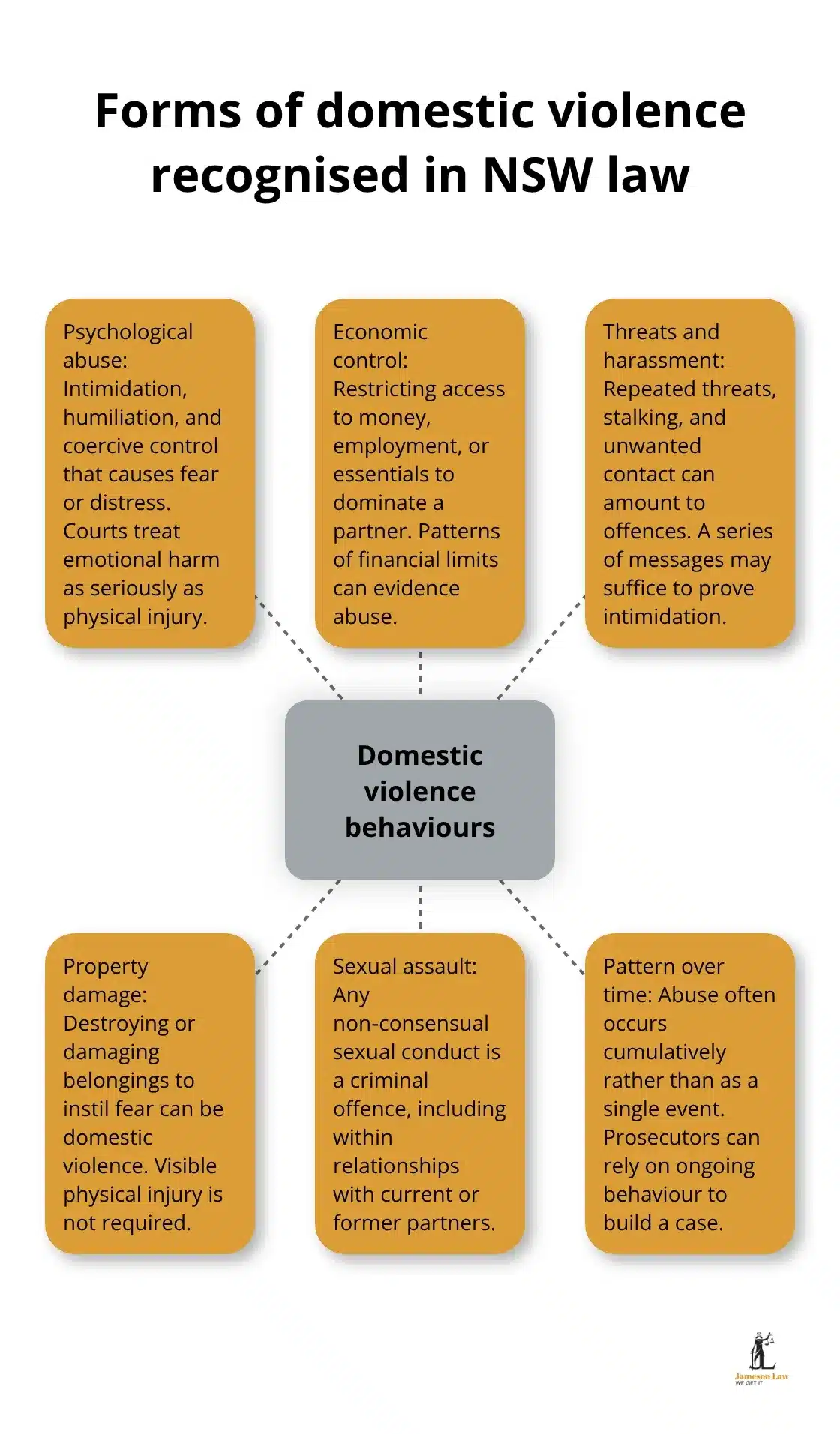
NSW Police recorded domestic violence-related incidents in recent years, with the majority involving a current or former intimate partner. Prosecutors don’t need to prove a single violent act. They can build a case from repeated threatening messages, controlling behaviour about finances, isolating someone from family, or constant intimidation. Courts in NSW have consistently held that emotional and psychological harm counts just as heavily as physical harm. A person can face charges from behaviour that leaves no visible marks but causes genuine fear.
Who the Law Covers
The relationship between the people involved determines whether charges apply. Domestic violence laws cover intimate partners, family members, carers, and people in close personal relationships. You can face charges if you’ve lived with someone, are dating them, or have a child together. Former partners fall under these laws too.
The law applies regardless of whether you’re married, in a de facto relationship, or dating casually. Police have broad discretion when responding to domestic violence calls, and NSW courts favour protecting the person alleging abuse. If someone claims you’ve caused fear or physical harm through behaviour like repeated unwanted contact, controlling their movements, or financial restrictions, you could face charges even without obvious injury.
Apprehended Violence Orders and Early Intervention
Police use Apprehended Violence Orders as a civil tool before criminal charges proceed. This order requires you to avoid contact and stay away from specific locations. Police can issue these orders within hours, and they remain active while criminal cases progress. Understanding what constitutes domestic violence matters because NSW takes these matters seriously. Convictions carry mandatory minimum sentencing in some cases, and courts rarely accept defences based on relationship history or provocation.
The next section explains how police respond to domestic violence reports and what happens during the initial investigation phase.
The Criminal Process for Domestic Violence Cases in NSW
How Police Respond and Investigate
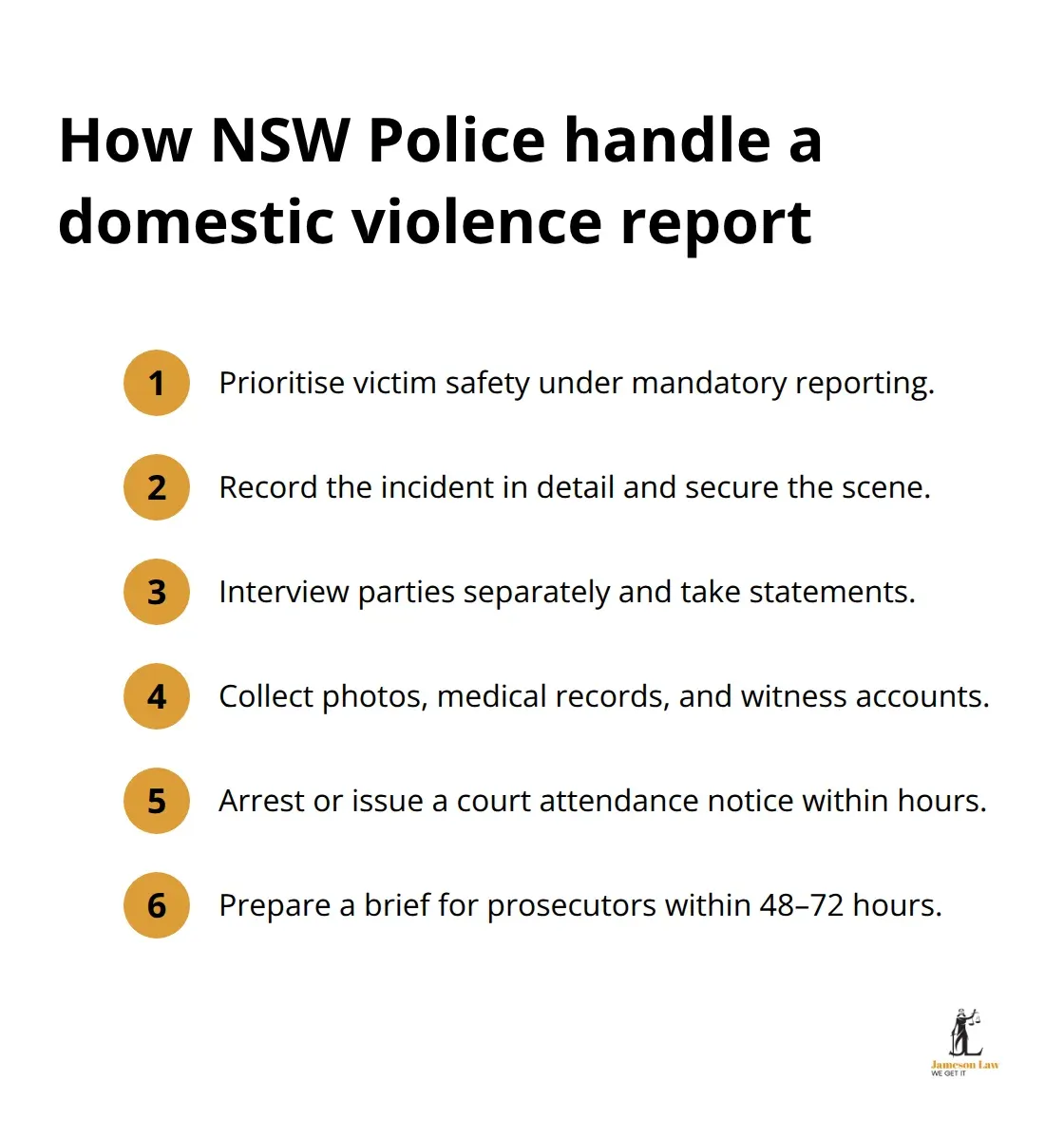
When NSW Police respond to a domestic violence report, they operate under a mandatory reporting framework that prioritises victim safety over de-escalation. Officers must document the incident, interview both parties separately, and collect evidence including photographs, medical records, and witness statements. In most cases, police will arrest you or issue a notice to appear at court within hours of the call.
NSW Police data shows that domestic violence incidents account for approximately one in five of all police callouts. Officers treat these situations as criminal matters rather than private disputes. The investigating officer prepares a brief of evidence that goes to the prosecutor, who decides whether to proceed with formal charges. This happens quickly-often within 48 to 72 hours-meaning you could face court without adequate time to prepare a proper defence.
Apprehended Violence Orders and Bail Conditions
Police can issue an Apprehended Violence Order on the spot, and it takes effect immediately, even if you disagree with the allegations. These orders typically prohibit you from contacting the other person, going near their home or workplace, and possessing weapons. Breaching an order carries additional criminal charges with jail time as a penalty.
Bail conditions imposed by the court run alongside the order and often mirror its restrictions, creating a dual system of control. When you first appear in court, the magistrate decides whether to grant bail and under what conditions. NSW courts apply strict bail tests in domestic violence matters, meaning you face genuine risk of being held in custody until trial. The prosecution must prove your release poses an unacceptable risk, but courts consistently interpret this broadly in domestic violence cases. If bail is granted, conditions typically include non-contact orders, residence requirements, and regular reporting to police. Violating any condition results in immediate re-arrest and potential jail time before trial.
You need legal representation at the bail hearing because the outcome determines whether you remain in the community or enter custody. Many people lose employment, housing, and custody arrangements while awaiting trial simply because they cannot meet bail conditions or cannot afford legal assistance.
Court Proceedings and Strategic Decisions
Court proceedings follow a structured path that requires strategic decision-making at each stage. At the first appearance, the magistrate explains the charges and discusses bail. The prosecution presents their case, and your lawyer can cross-examine witnesses and challenge evidence. If the matter proceeds to trial in the District Court, both sides present full evidence, and a judge or jury determines guilt.
NSW courts rarely accept traditional defences in domestic violence cases. Self-defence arguments must meet strict tests, and courts view them sceptically when the other party claims fear. Provocation is not a valid defence to domestic violence charges, though it may reduce sentencing after conviction. Lack of intent is difficult to establish because many charges focus on behaviour that causes fear rather than intentional harm.
The prosecution does not need to prove you meant to cause harm, only that your actions had that effect. This distinction matters enormously. A heated argument or multiple text messages can constitute harassment or intimidation without you intending either outcome. Your lawyer must identify weaknesses in the prosecution’s evidence early, challenge witness credibility, and explore whether the allegations are factually accurate. Negotiating with prosecutors for reduced charges or withdrawn allegations happens at multiple stages, but this requires demonstrating genuine problems with their case rather than simply hoping for leniency.
The strength of the evidence against you determines your options at each stage. A skilled defence lawyer identifies inconsistencies in witness statements, challenges the reliability of evidence, and exposes gaps in the prosecution’s narrative. These weaknesses become leverage in negotiations with prosecutors or arguments before the court. Understanding what the prosecution must prove-and what they cannot-shapes your entire defence strategy from the bail hearing through to trial.
Penalties and Consequences of Domestic Violence Convictions
Jail Sentences and Custodial Outcomes
A domestic violence conviction in NSW results in jail sentences that vary based on the specific charge, your criminal history, and the circumstances of the offence. Assault occasioning actual bodily harm carries a maximum sentence of five years imprisonment, while common assault carries two years. The Crimes (Domestic and Personal Violence) Act 2007 creates specific offences for breaching Apprehended Violence Orders, which attract up to two years jail. NSW sentencing guidelines require courts to treat domestic violence seriously, and judges rarely impose non-custodial sentences for first-time offenders unless exceptional circumstances apply. This means even a first conviction can result in immediate imprisonment.
The Judicial Commission of NSW publishes sentencing data showing that custodial sentences are standard rather than exceptional in domestic violence matters. If you receive a suspended sentence instead of jail time, you remain under supervision for the suspension period, typically two to three years, and any breach activates the full sentence. Courts also impose fines ranging from several hundred to several thousand dollars alongside imprisonment, creating financial strain on top of incarceration.
Employment and Professional Consequences
A criminal record for domestic violence fundamentally alters your employment prospects. Employers conducting background checks will see your conviction, and many industries including education, healthcare, childcare, and finance automatically exclude people with domestic violence convictions. If you work in security, aged care, or roles involving vulnerable people, a domestic violence conviction typically ends your career in that field permanently.
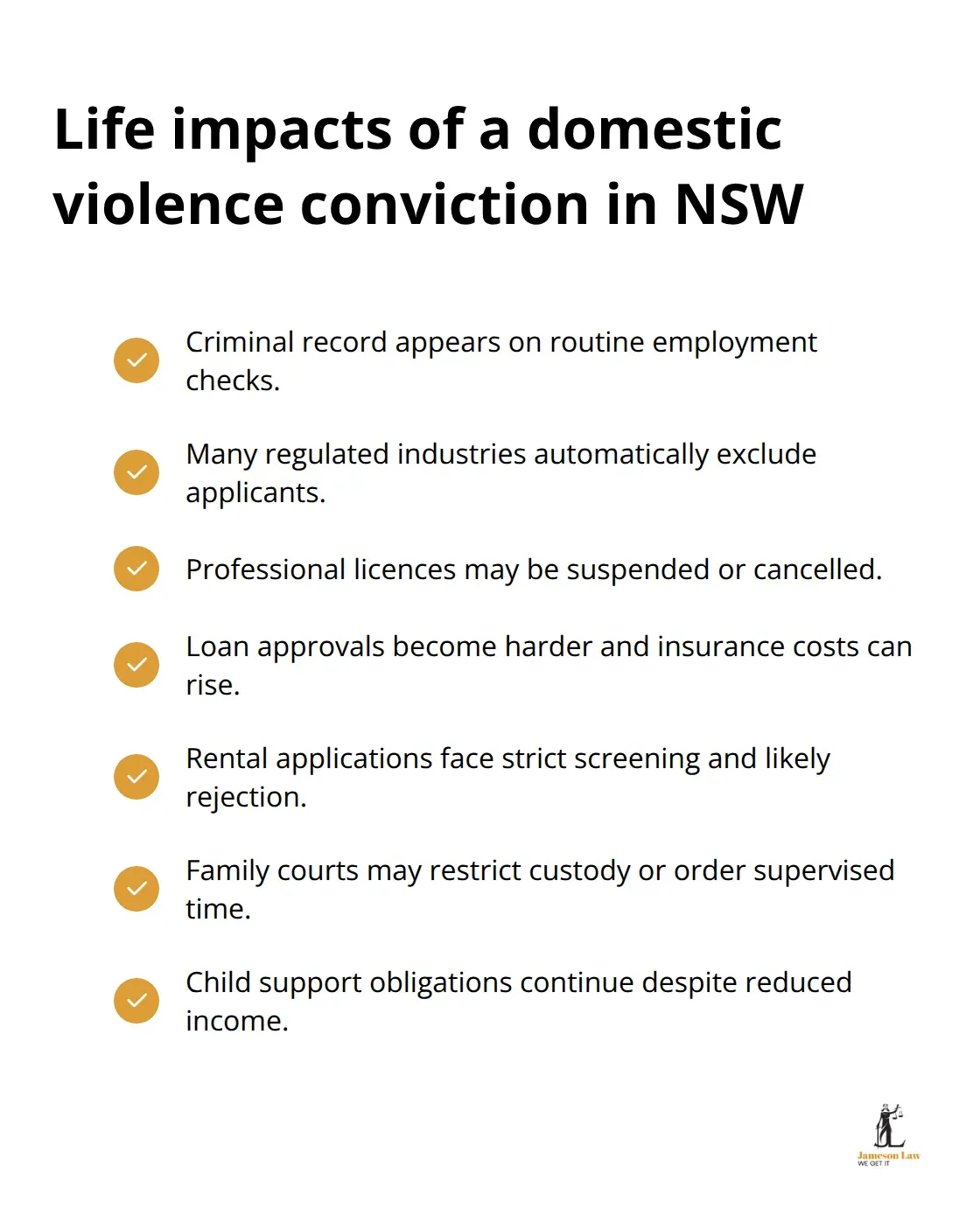
Professional licences in law, medicine, psychology, and other regulated professions face suspension or cancellation following domestic violence convictions. Financial institutions may decline loan applications, and you may face higher insurance premiums or exclusion from certain policies. The criminal record remains on your file indefinitely in NSW, affecting every background check for the remainder of your life.
Housing and Accommodation Barriers
Housing providers routinely reject applications from people with domestic violence records, particularly when you seek rental accommodation. Landlords view these convictions as indicating risk to others and apply strict screening processes. Securing housing becomes significantly more difficult, and you may face discrimination from property managers and real estate agents who conduct background checks as standard practice.
Family Law and Parental Rights
Family law courts treat domestic violence convictions as serious when determining custody and access to children. The Family Court of Australia and Federal Circuit Court consider convictions when assessing whether a parent poses a risk to children, and convictions often result in supervised access only or complete exclusion from parental responsibility. Child support obligations continue regardless of conviction, but your reduced employment prospects make meeting these obligations harder. A conviction can permanently damage your relationship with your children and restrict your involvement in their lives for years to come.
Final Thoughts
Domestic violence charges in NSW carry consequences that extend far beyond the courtroom and affect your employment prospects, housing options, family relationships, and financial stability for years to come. The criminal process moves quickly, bail conditions restrict your freedom before trial, and courts apply strict sentencing standards that often result in jail time even for first offences. Acting immediately after police contact you or issue an Apprehended Violence Order gives you the best chance of minimising the impact on your life.
The most important step you can take is obtaining legal advice right away, as early intervention allows your lawyer to challenge bail conditions, identify weaknesses in the prosecution’s evidence, and explore options for negotiating reduced charges or withdrawn allegations. Waiting until your court date significantly limits your options and reduces the chance of a favourable outcome. Your lawyer works quickly to protect your rights at every stage, from the bail hearing through to trial, and challenges evidence and cross-examines witnesses to achieve the best possible result for your circumstances.
If you face domestic violence charges or have received an Apprehended Violence Order, contact Jameson Law for immediate legal assistance. Support services including counselling, financial assistance, and legal aid information are available through NSW Community Services and the Law Society of NSW referral service.