

Personal injury claims in NSW can feel overwhelming when you’re dealing with physical trauma and its financial aftermath. Whether you have been hurt in a workplace accident, a car crash, or due to someone else’s negligence, comprehensively understanding your rights is your first line of defence.
At Jameson Law, our highly experienced legal team has helped countless NSW residents navigate the civil claims process and secure the robust compensation they deserve. This guide walks you through every essential step in 2026—from gathering the right evidence at the scene to calculating your true legal entitlements.
What Counts as a Personal Injury Claim
The Four Essential Elements of Negligence
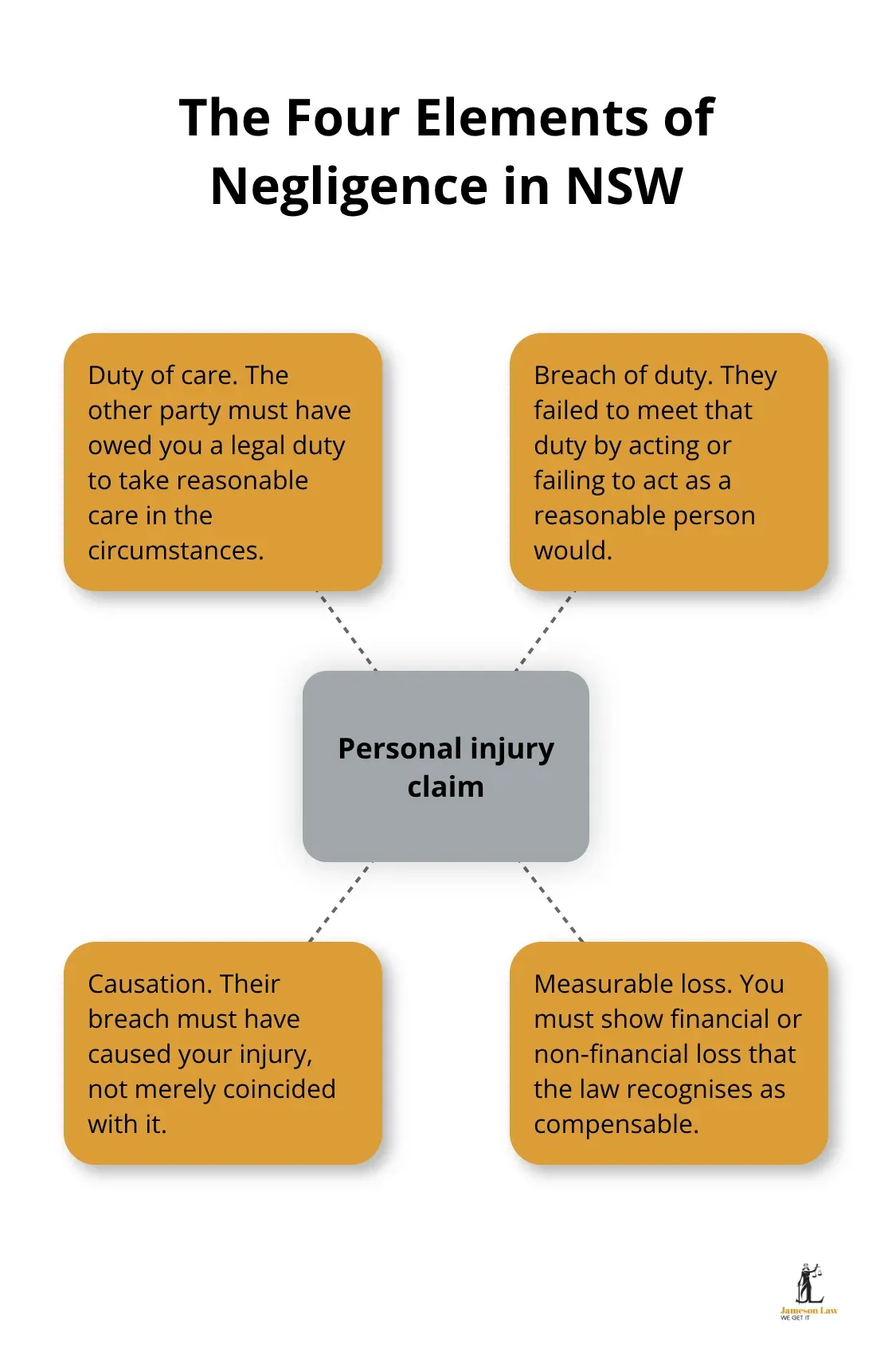
A personal injury claim arises when another party’s negligence directly causes you physical or psychological harm. In NSW, proving negligence requires satisfying four essential legal elements:
- Duty of Care: Establishing the other party owed you a legal obligation to ensure your safety.
- Breach of Duty: Proving they failed to exercise reasonable care (e.g., ignoring a hazard).
- Causation: Demonstrating that this specific breach was the direct cause of your accident.
- Measurable Loss: Presenting verified financial (medical bills, lost wages) or non-financial (pain and suffering) damages.
Not every accident creates a valid claim. If you trip on your own untied shoelace at home, you have no claim. However, if you trip on a broken step at a shopping centre that management knew about but failed to repair, you have strong grounds for compensation.
| Claim Category | Governing Scheme | Key Statutory Deadlines |
|---|---|---|
| Motor Vehicle (CTP) | SIRA / Motor Accident Injuries Act | Police report within 28 days; Claim within 3 months. |
| Public Liability | Civil Liability Act 2002 | Formal court proceedings within 3 years of the injury date. |
| Workers’ Compensation | Workers Compensation Act 1987 | Notify employer immediately; Lodge claim within 6 months. |
Motor Vehicle Claims and CTP Insurance
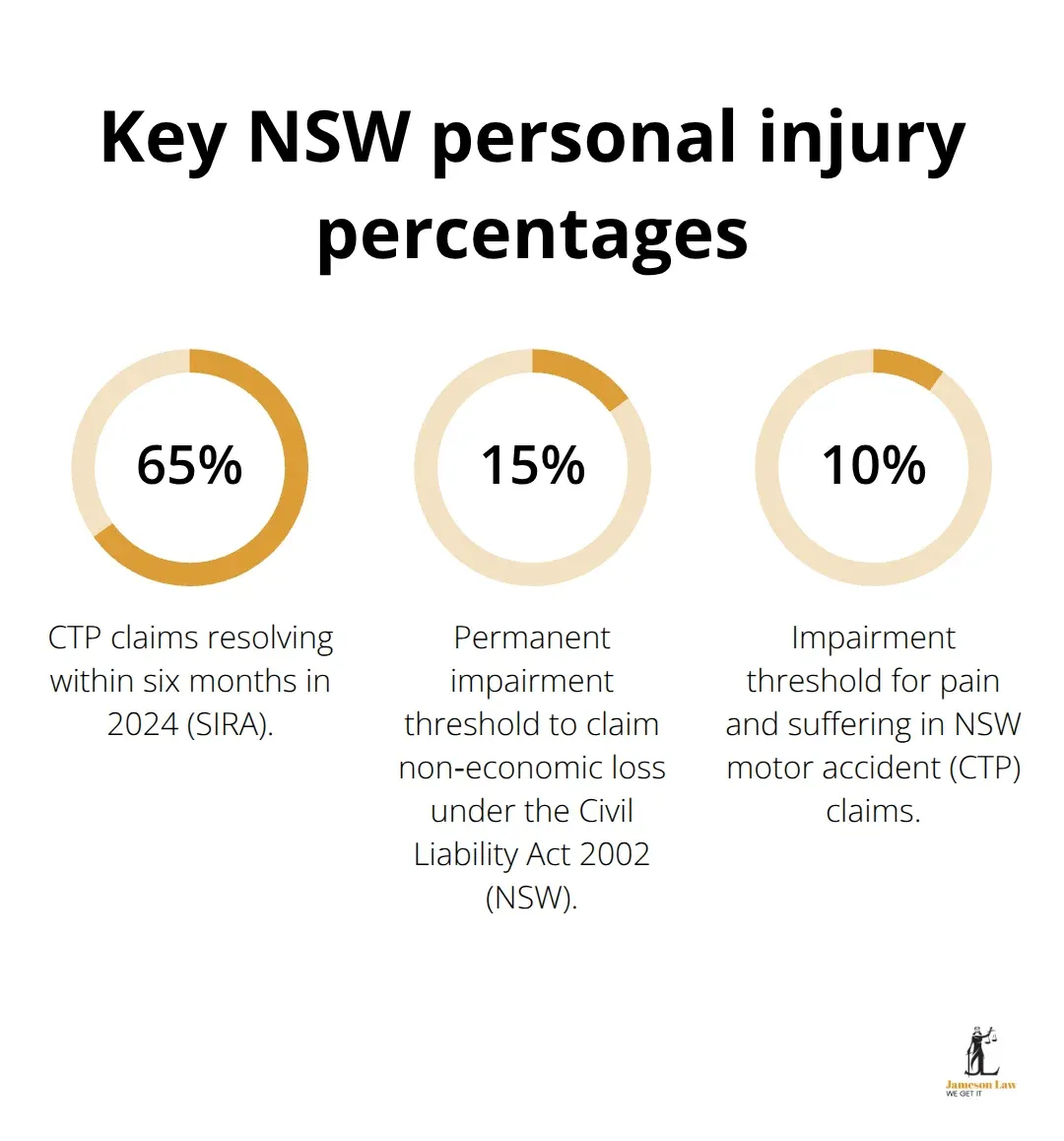
Motor vehicle accidents fall under the Compulsory Third-Party (CTP) insurance scheme regulated by the State Insurance Regulatory Authority (SIRA). You can claim medical expenses, rehabilitation, and lost income. To claim non-economic loss (pain and suffering), your Whole Person Impairment (WPI) must exceed 10%.
Workplace Injuries and Public Liability
Workplace injuries operate under workers’ compensation legislation, which generally provides structured benefits regardless of fault. Conversely, public liability claims cover injuries on someone else’s property (e.g., supermarkets, footpaths), requiring you to explicitly prove the occupier breached their duty of care.
Moving From Evidence to Action
Act Within Critical Timeframes
The narrow window immediately following an incident dictates whether your claim will succeed or be barred by legislation. Within 24 hours of a serious motor accident, you must file a police report to generate the Event Number required by insurers.
Seek medical attention immediately, even if your symptoms feel minor. Soft tissue injuries and internal trauma often do not manifest fully for days. Without contemporaneous medical records linking your pain directly to the date of the incident, insurers will aggressively contest causation.
Gather and Organise Evidence Systematically
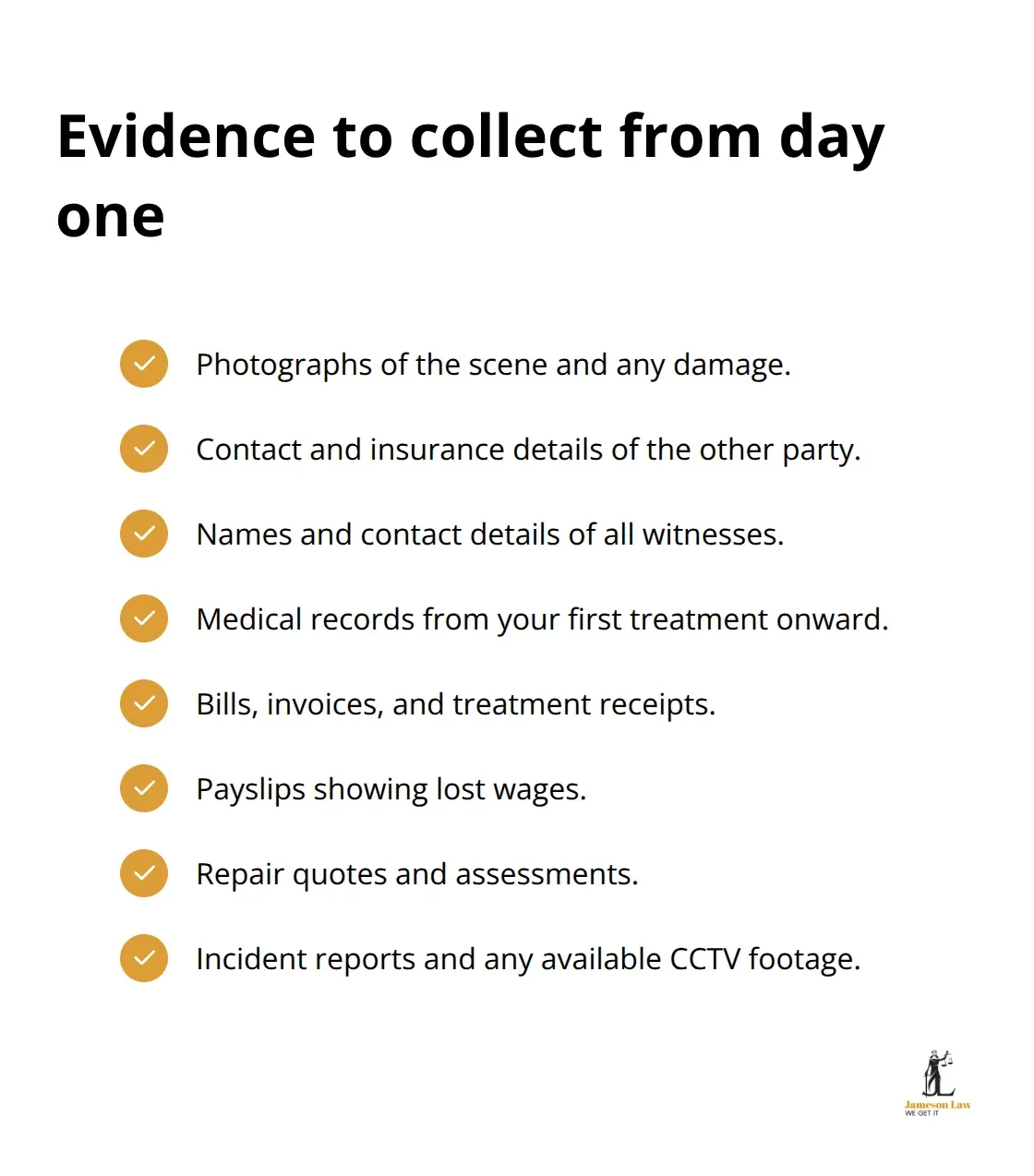
Insurers assess claims based on empirical proof, not verbal accounts. Build a dedicated dossier containing:
- Photographs of the hazard, vehicle damage, and visible injuries.
- Contact details of the at-fault party and any independent eyewitnesses.
- Incident reports formally lodged with retail management or police.
- All medical certificates, specialist referrals, and treatment receipts.
Notify the Responsible Party Formally
Do not rely on informal conversations or verbal agreements. Issue a formal notification of claim in writing. Many unrepresented individuals attempt to negotiate directly with corporate insurers to save on legal fees—this almost always results in a drastically reduced settlement. Insurers deploy highly trained claims assessors specifically tasked with minimising corporate payouts.
Compensation and Damages in NSW
Economic and Non-Economic Losses
Personal injury payouts are divided into two strict categories under the Civil Liability Act 2002 (NSW):
Economic Loss: Covers quantifiable out-of-pocket expenses. This includes historical and future medical costs, rehabilitation, domestic care assistance, and crucially, past lost wages and the impairment of your future earning capacity.
Non-Economic Loss: Covers intangible harm, such as pain, suffering, and loss of enjoyment of life. To access this, you must meet statutory severity thresholds. In public liability, your injury must be assessed at a minimum of 15% of a “most extreme case.”
How Insurers Assess Your Entitlements
An insurer will typically make an initial, low-ball offer, anticipating that you lack the legal background to challenge it. Calculating your true provable loss requires a forensic analysis of your medical prognosis, income trajectory, and relevant case law precedents. Engaging an expert legal team ensures that future economic loss—which often accounts for the largest portion of a severe injury claim—is calculated with precision, protecting your long-term financial security.
Final Thoughts
Securing justice through personal injury claims NSW demands immediate action, meticulous documentation, and a thorough understanding of the applicable legislative thresholds. Your claim’s viability heavily depends on securing early medical evidence, issuing formal notifications within statutory limits, and rejecting inadequate preliminary offers.
Missing a strict deadline—such as the three-month CTP lodgement window or the three-year public liability statute of limitations—will permanently extinguish your right to claim. Attempting to navigate independent medical examinations and aggressive insurance adjusters alone places you at a severe disadvantage.
At Jameson Law, our expert team manages personal injury and civil liability matters on a transparent No Win, No Fee basis, meaning you face no upfront financial risk. We calculate your true legal entitlements, fiercely negotiate with insurers, and take matters to court if a fair settlement cannot be reached. Contact our Sydney office today for a free, comprehensive assessment of your claim to ensure your future is fully protected.