PUBLICATION

NSW Criminal Court Process: From Charge to Verdict

"Understand the NSW criminal court process from initial charge through verdict with our step-by-step guide to Australian courts."
NSW Criminal Court Process: From Charge to Verdict

Facing criminal charges in NSW can feel overwhelming. The court system has many stages, strict procedures, and important deadlines that affect your rights and future.

We at Jameson Law have guided countless clients through the NSW criminal court process. This guide walks you through each step, from the moment you’re charged through to verdict, so you understand what happens and what to expect.

How NSW Courts Handle Criminal Cases

The Hierarchical Court Structure

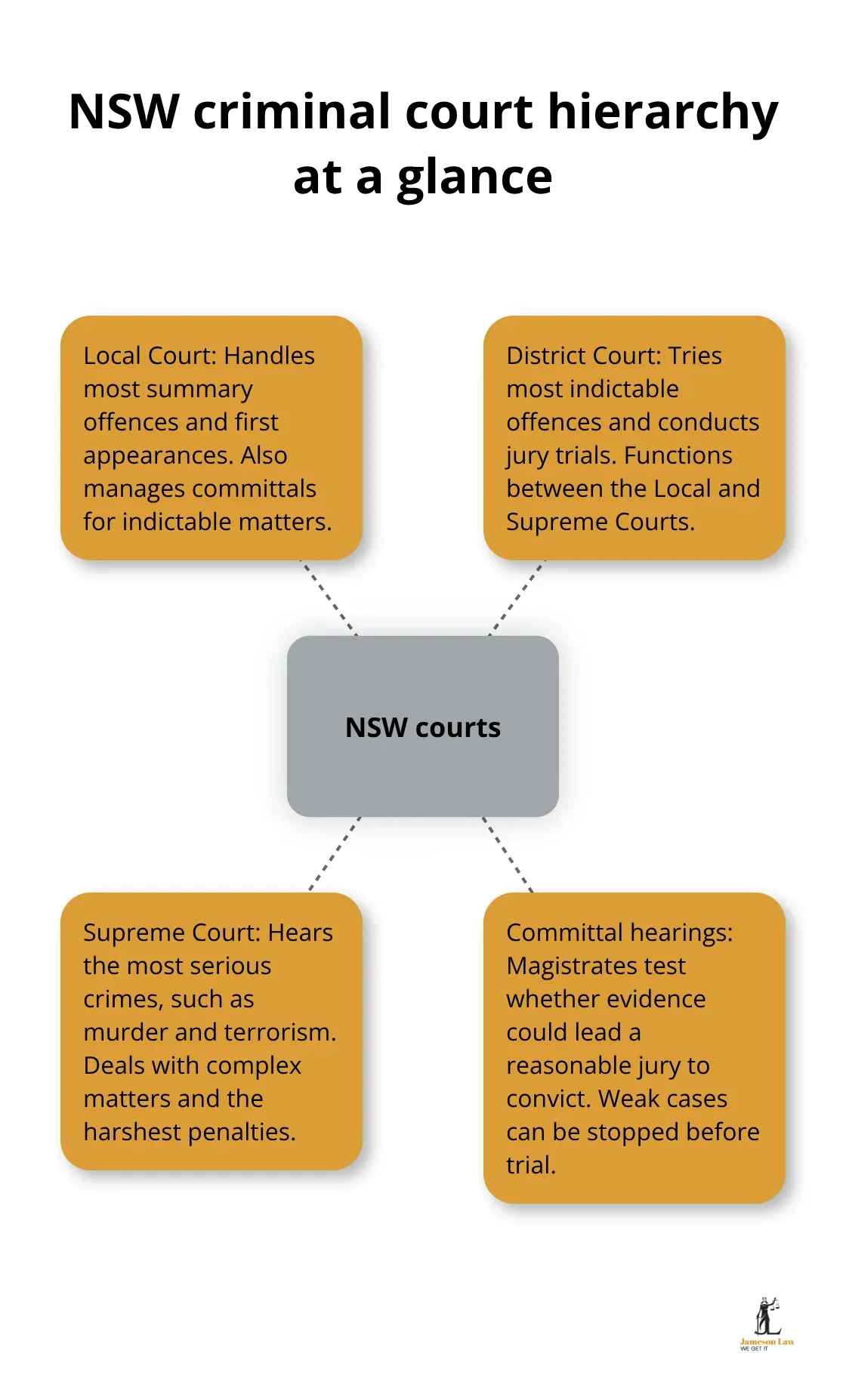
NSW operates a hierarchical court system that matches case severity with appropriate judicial resources. The Local Court sits at the foundation, handling the vast majority of criminal matters as the entry point for all charges. The Local Court processes summary offences like theft, assault and drug possession, with magistrates managing these cases efficiently. For serious indictable offences, the Local Court conducts committal hearings to assess whether evidence warrants progression to higher courts.

Diagram showing Local, District and Supreme Court roles in NSW criminal matters - NSW criminal court process

The District Court then handles indictable offences such as sexual assault and robbery, serving as the middle tier between Local and Supreme Courts. The Supreme Court reserves its docket for the most serious matters including murder and terrorism.

This structure means your case will almost certainly start in the Local Court, regardless of severity, and may escalate based on the charges and evidence presented.

Key Decision-Makers in Your Case

Multiple players shape outcomes at each stage of your matter. Magistrates in the Local Court manage initial appearances, bail decisions and sentencing for summary offences. Judges in District and Supreme Courts oversee trial procedures and deliver verdicts for indictable matters. Juries in District and Supreme Court trials determine guilt or innocence for serious cases. Prosecutors from the NSW Office of the Director of Public Prosecutions present evidence and arguments to prove guilt beyond reasonable doubt. Your defence lawyer identifies weaknesses in the prosecution case, challenges evidence and advocates for your rights. Court officers manage administrative processes, and victim support services assist witnesses throughout proceedings.

Understanding these roles helps you recognise who controls different aspects of your case and when their involvement matters most to your outcome. Early legal advice is increasingly valuable for achieving better outcomes as you navigate the court system.

Summary and Indictable Offences

NSW law categorises criminal offences into summary and indictable categories, determining which court handles your matter. Summary offences include minor assaults, shoplifting and traffic violations, heard and finalised in Local Court with sentences typically under two years imprisonment. Indictable offences cover serious crimes like burglary, aggravated assault and drug trafficking, heard in District or Supreme Court with potential sentences exceeding two years. Some offences are hybrid, meaning prosecutors choose whether to proceed summarily in Local Court or as indictable in higher courts depending on circumstances and facts.

This classification directly affects where you appear, who decides your case and potential penalties you face. Understanding which category applies to your charges shapes your entire court pathway and the strategic decisions your legal team makes moving forward.

What Happens After You’re Charged

Your First Court Appearance and Bail Decisions

Once police charge you with a criminal offence in NSW, the clock starts ticking on several critical decisions and procedures that shape your entire court journey. Your first appearance in Local Court typically occurs within days of arrest, where the magistrate will explain your charges and address bail. Bail decisions matter enormously because remaining in custody before trial significantly impacts your ability to prepare a defence, maintain employment and family relationships, and gather evidence.

The NSW Bail Act 2013 presumes you should be released on bail unless the prosecution proves you pose an unacceptable risk of not appearing in court, committing further offences, or endangering the community. Courts consider factors like your ties to the community, criminal history, employment status and whether you have stable accommodation. If bail is refused, you have the right to apply again within seven days, and securing legal representation at this stage is vital because bail applications require compelling arguments about why you should be released.

Understanding Bail Conditions

Conditions attached to bail might include reporting to police, curfews, non-contact orders with alleged victims or witnesses, or restrictions on travel. Breaching these conditions can result in immediate arrest and remand in custody. Understanding exactly what your bail conditions require prevents accidental violations that could undermine your freedom before trial.

Committal Proceedings for Indictable Offences

For indictable offences, your case progresses to committal proceedings in the Local Court, where the prosecution must present enough evidence to satisfy the magistrate that a reasonable jury could convict you. This is your opportunity to challenge the prosecution’s case before trial occurs, potentially having charges dismissed entirely if evidence is weak. The magistrate does not decide guilt or innocence at committal; they only assess whether sufficient evidence exists to put you on trial in the District or Supreme Court.

You can cross-examine prosecution witnesses, call your own evidence, and make submissions about whether the case should proceed, making this stage strategically important for identifying weaknesses in the prosecution narrative. The committal process typically takes months, with multiple court mentions allowing your legal team to obtain and review police evidence, interview witnesses, and prepare tactical responses.

Pre-Trial Procedures and Strategic Options

Between charges and trial, pre-trial procedures include disclosure of evidence, bail reviews if circumstances change, applications to suppress illegally obtained evidence, and negotiations with prosecutors about reducing charges or entering early guilty pleas. The Early Appropriate Guilty Plea scheme introduced in NSW in 2018 offers sentence discounts for early pleas, making accepting responsibility more financially and personally advantageous than fighting charges.

Experienced legal representation from your first appearance significantly influences whether you remain free pending trial and whether your case resolves favourably before expensive and stressful trial proceedings begin. Your lawyer identifies which procedural steps apply to your specific charges and circumstances, then develops a strategy that protects your interests at each stage. The decisions you make during this phase-about bail, evidence challenges, and plea negotiations-often determine the trajectory of your entire case and the resources required to resolve it.

What Happens During Trial and How Verdicts Are Reached

Once your case reaches trial in District or Supreme Court, the process shifts dramatically from procedural stages to actual evidence presentation and judgement. The rules that govern what evidence the court will hear become critical because NSW courts apply strict evidentiary standards that exclude unreliable, unfairly obtained or prejudicial information.

Evidence Rules and Admissibility

Evidence obtained through illegal search and seizure, coerced confessions, or breaches of your rights can be suppressed entirely, potentially collapsing the prosecution case before it gains traction. Your defence lawyer will identify and challenge problematic evidence early, often through pre-trial applications that prevent damaging material from reaching the jury. The prosecution must prove guilt beyond reasonable doubt, meaning the jury must be convinced to the point where they would act on that conviction in matters of importance in their own lives. This is a high threshold that requires solid, admissible evidence presented coherently.

How the Prosecution Presents Its Case

The prosecution presents its case first, calling witnesses and tendering documents to build a narrative of guilt. The prosecution’s opening address outlines their case theory, their witnesses then give evidence under oath, and your defence lawyer cross-examines each witness to test credibility, accuracy and consistency. Cross-examination is where defence strategies create real impact because skilled questioning exposes inconsistencies, reveals bias, or shows the witness lacks knowledge about key facts.

Your Defence Strategy and Evidence Decisions

After the prosecution closes its case, your defence chooses whether to call evidence or rely on weaknesses already exposed. Many defendants choose to remain silent rather than testify because testifying allows prosecutors to cross-examine them aggressively, though remaining silent cannot be held against you. Your lawyer will advise whether testifying strengthens your case or creates unnecessary risk.

Closing Arguments and Jury Instructions

Once both sides complete evidence, closing addresses allow each lawyer to interpret the evidence and persuade the jury toward their conclusion. The judge then provides instructions on the law and how jurors should approach their task, emphasising that they decide facts while the judge handles legal questions. Jury deliberation and unanimous verdict requirements mean all twelve jurors must agree on guilt or innocence in criminal trials. If jurors cannot reach agreement after reasonable deliberation, a mistrial is declared and the case may be retried.

Verdict and Sentencing

The verdict is delivered in open court, and if guilty, sentencing follows either immediately or after an adjournment for reports and submissions. These mechanics show where your defence strategy creates real impact and why experienced representation matters profoundly when your freedom is at stake.

Final Thoughts

The NSW criminal court process from charge to verdict involves multiple stages, strict procedures, and critical decisions that shape your freedom and future. A verdict of acquittal ends the matter entirely, while conviction leads to sentencing and a 28-day window to lodge an appeal if legal errors or procedural breaches affected fairness. Appeals focus on whether the trial process was conducted properly, not on disagreement with the verdict itself, and the Court of Criminal Appeals can order a new trial, vary sentences, or dismiss appeals based on the evidence presented.

Your early decisions matter enormously because securing legal representation from your first appearance, understanding bail conditions, and engaging strategically with pre-trial procedures can mean the difference between remaining free and spending months in custody. The prosecution must prove guilt beyond reasonable doubt, a high threshold that requires solid, admissible evidence presented coherently, and your defence lawyer identifies weaknesses in that evidence at every stage. We at Jameson Law help clients navigate the NSW criminal court process with clarity and confidence, positioning them for the best possible outcome from charge through to verdict.

Speak to an Expert Lawyer today

Laywers-Jameson-Law-The-best-law-firm-in-Sydney- Sydney Lawyers - Sydney
BOOK NOW

WE'RE IN IT TO WIN IT

Book your consultation

Book Now
Book Now Mobile 06 02 2025

This form submission is encrypted and secured to ensure your information remains confidential.

What our Clients

Related Publications:

What our clients say

.

Jameson Law - Voted the Best Law firm in Sydney Award

Legal Answers ... In Short

We're here to help

Our mission is to ensure our client matters are resolved successfully every time. Success to us does not simply involve winning, but moreover ensuring we take the most feasible, economic and stress-free path to help our clients achieve their goals. We fight hard for our clients, and always go by the motto: we’re in it to win it.

Jameson Law - Best Law Firm in Sydney

WE'RE IN IT TO WIN IT

Book your consultation

Call us now on (02) 8806 0866 or fill out the form below

Book Now Mobile

This form submission is encrypted and secured to ensure your information remains confidential.

WE'RE IN IT TO WIN IT

Book your consultation

Book Now Mobile 06 02 2025
lock

This form submission is encrypted and secured to ensure your information remains confidential.

Our Sydney Offices

Offices Parramatta and Sydney Jameson Law
Parramatta CBD - Head Office
jameson Law - Blacktown
jameson Law - Liverpool Office
Jameson Law - Bankstown
Court Houses We Frequent Jameson Law

Court Houses We Frequent

Balmain Local Court

Registry: Monday to Friday, 9:00am to 4:30pm

Bankstown Local Court

Court Operating Hours: 9:30am-4:30pm

Blacktown Local Court

Registry Hours: 9:00 – 4:30
Telephone Hours: 8:30 -4:30
Days open: Mon-Fri

Burwood Local Court

Registry Hours: 9:00 – 4:30
Telephone Hours: 8:30 – 4:30
Days open: Mon – Fri

Campbell Local Court

Registry Hours: 9:00 – 4:30
Telephone Hours: 8:30 – 4:30
Days open: Mon – Fri

Central Local Court

Registry Hours: 9:00 – 1:00 and 2:00 – 4:30
Telephone Hours: 8:30 – 4:30

Downing Local Court

Registry Hours: 9:00 – 1:00 and 2:00 – 4:30
Telephone Hours: 8:30 – 4:30

Wollongong Local Court

Registry Hours: 9:00 – 1:00 and 2:00 – 4:30
Telephone Hours: 8:30 – 4:30

Fairfield Local Court

Registry Hours: 9:00 – 1:00 and 2:00 – 4:30
Telephone Hours: 8:30 – 4:30

Hornsby Local Court

Registry Hours: 9:00 – 1:00 and 2:00 – 4:30
Telephone Hours: 8:30 – 4:30

Liverpool Local Court

Registry Hours: 9:00 – 1:00 and 2:00 – 4:30
Telephone Hours: 8:30 – 4:30

Manly Local Court

Registry Hours: 9:00 – 1:00 and 2:00 – 4:30
Telephone Hours: 8:30 – 4:30

Newtown Local Court

Registry Hours: 9:00 – 1:00 and 2:00 – 4:30
Telephone Hours: 8:30 – 4:30

Parramatta Local Court

Registry Hours: 9:00 – 1:00 and 2:00 – 4:30
Telephone Hours: 8:30 – 4:30

Penrith Local Court

Registry Hours: 9:00 – 1:00 and 2:00 – 4:30
Telephone Hours: 8:30 – 4:30

Sutherland Local Court

Registry Hours: 9:00 – 1:00 and 2:00 – 4:30
Telephone Hours: 8:30 – 4:30

Waverley Local Court

Registry Hours: 9:00 – 1:00 and 2:00 – 4:30
Telephone Hours: 8:30 – 4:30

Windsor Local Court

Registry Hours: 9:00 – 1:00 and 2:00 – 4:30
Telephone Hours: 8:30 – 4:30

Wollongong Local Court

Registry Hours: 9:00 – 1:00 and 2:00 – 4:30
Telephone Hours: 8:30 – 4:30

Downing Centre District Court

Registry Hours: 9:00 – 4:30
Telephone Hours: 8:30 – 4:30
Days open: Mon – Fri

Parramatta District Court

Registry Hours: 9:00 – 4:30
Days open: Mon-Fri

Penrith District Court

Registry Hours: 9:00 – 4:30
Days open: Mon-Fri

Campbelltown District Court

Registry Hours: 9:00 – 4:30
Days open: Mon – Fri

Liverpool District Court

Registry Hours: 9:00 – 4:30
Days open: Mon – Fri

Wollongong District Court

Registry Hours: 9:00 – 1:00 and 2:00 – 4:30
Telephone Hours: 8:30 – 4:30

Supreme Court New South Wales

Registry Hours: 9:00 AM – 4:30 PM
Telephone Hours: 8:30 AM – 4:30 PM
Days Open: Monday to Friday

Federal Circuit and Family Court of Australia

Registry Hours: 9:00 AM – 4:30 PM
Telephone Hours: 8:30 AM – 5:00 PM
Days Open: Monday to Friday

Federal Court

Monday to Friday, 8:30 AM – 4:30 PM

High Court

Monday to Friday, 8:30 AM – 5:00 PM

Children’s Court of New South Wales

Registry Hours: 9:00 AM – 4:30 PM
Telephone Hours: 8:30 AM – 4:30 PM
Days Open: Monday to Friday

Coroner’s Court New South Wales

Registry Hours: 9:00 AM – 4:30 PM
Telephone Hours: 8:30 AM – 4:30 PM
Days Open: Monday to Friday

Industrial Relations Commission of New South Wales

Registry Hours: 9:00 AM – 4:30 PM
Telephone Hours: 8:30 AM – 4:30 PM
Days Open: Monday to Friday

Land and Environment Court of New South Wales

Registry Hours: 9:00 AM – 4:30 PM
Telephone Hours: 8:30 AM – 4:30 PM
Days Open: Monday to Friday

WE'RE IN IT TO WIN IT

Book your consultation

Book Now
Book Now Mobile 06 02 2025
lock

This form submission is encrypted and secured to ensure your information remains confidential.