


Facing allegations of an AVO breach NSW carries severe legal consequences. Whether the order is an Apprehended Domestic Violence Order (ADVO) or an Apprehended Personal Violence Order (APVO), the NSW criminal justice system treats non-compliance strictly.
At Jameson Law, our criminal defence team regularly advises clients on the stringent provisions of the Crimes (Domestic and Personal Violence) Act 2007 (NSW). This guide provides authoritative legal information on the statutory framework of an AVO breach, the prosecution’s evidentiary burden, and the processes within the NSW Local Court.
The Legal Framework of an AVO Breach in NSW
Section 14: Contravening an Apprehended Violence Order
In New South Wales, breaching any condition of an active AVO is a criminal offence. The primary legislation governing this is Section 14 of the Crimes (Domestic and Personal Violence) Act 2007 (NSW).
To secure a conviction under Section 14, the prosecution must prove three core elements beyond reasonable doubt:
- A valid Apprehended Violence Order (interim or final) was in force against you.
- You knowingly contravened a specific prohibition or restriction specified in that order.
- You were served with a copy of the order or were present in court when the order was made (establishing that you knew the order existed and understood its conditions).
It is important to distinguish between an ADVO (which relates to domestic relationships, such as partners or family members) and an APVO (which relates to personal disputes, such as neighbours or co-workers). While the underlying relationship differs, Section 14 applies universally to the contravention of both.
Statutory Penalties and the Special Sentencing Provision
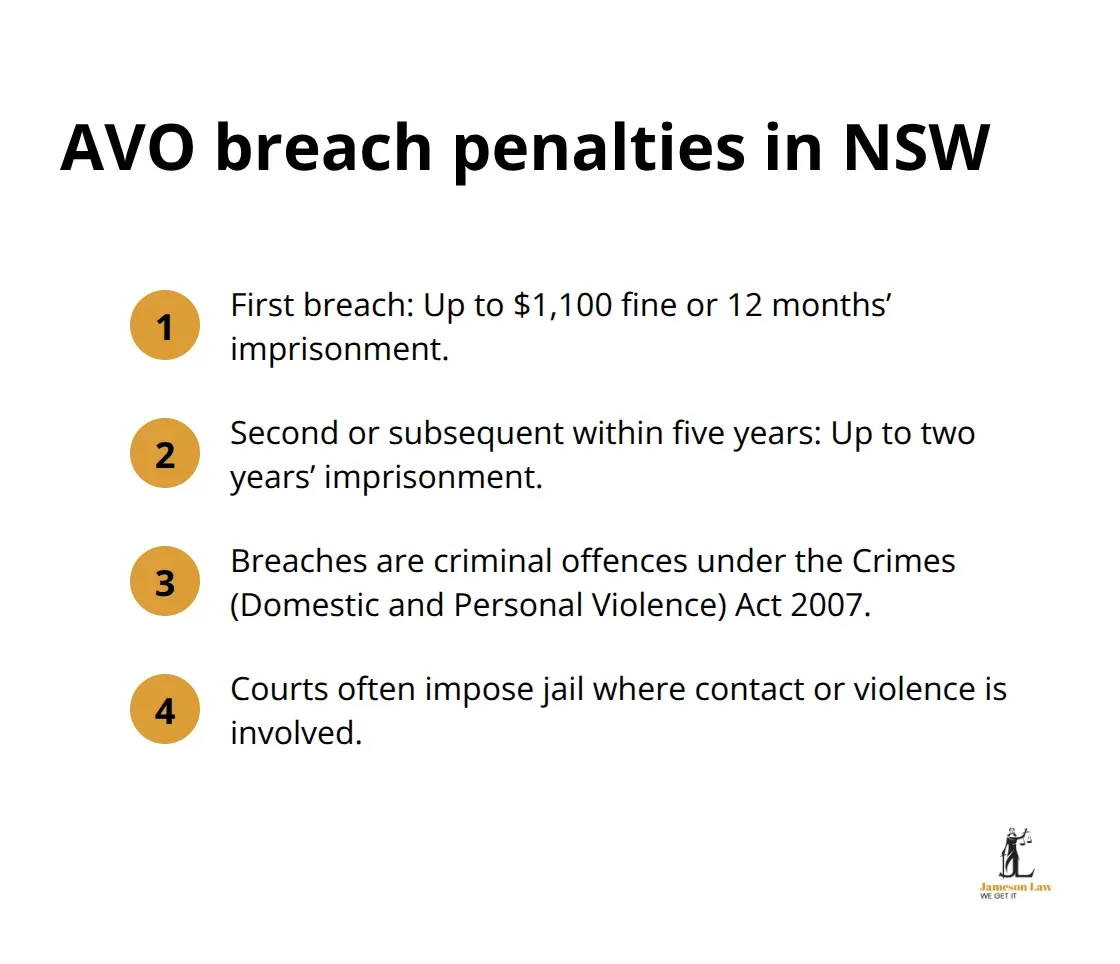
The basic offence under Section 14(1) carries a maximum penalty of two years imprisonment, 50 penalty units, or both. A separate offence under Section 14(1A), introduced for certain intentional ADVO breaches causing or intended to cause harm or fear, carries a maximum of three years imprisonment, 100 penalty units, or both.
Section 14(4) contains a special sentencing provision. If a Section 14(1) breach involved an act of violence against a person, the statute requires a term of imprisonment unless the court otherwise orders; if it does not impose imprisonment, it must give reasons. This does not make full-time custody automatic in every case. The Judicial Commission of NSW highlights that deterrence and denunciation are paramount in sentencing domestic violence-related breaches.
Arrest, Bail, and Local Court Proceedings
Police Investigation and Arrest Powers
NSW Police are mandated to investigate reported AVO breaches thoroughly and promptly. If police form a reasonable suspicion that a contravention has occurred, they have the power to arrest you. This often involves gathering evidence such as text messages, call logs, CCTV footage, and statements from the Person in Need of Protection (PINOP).
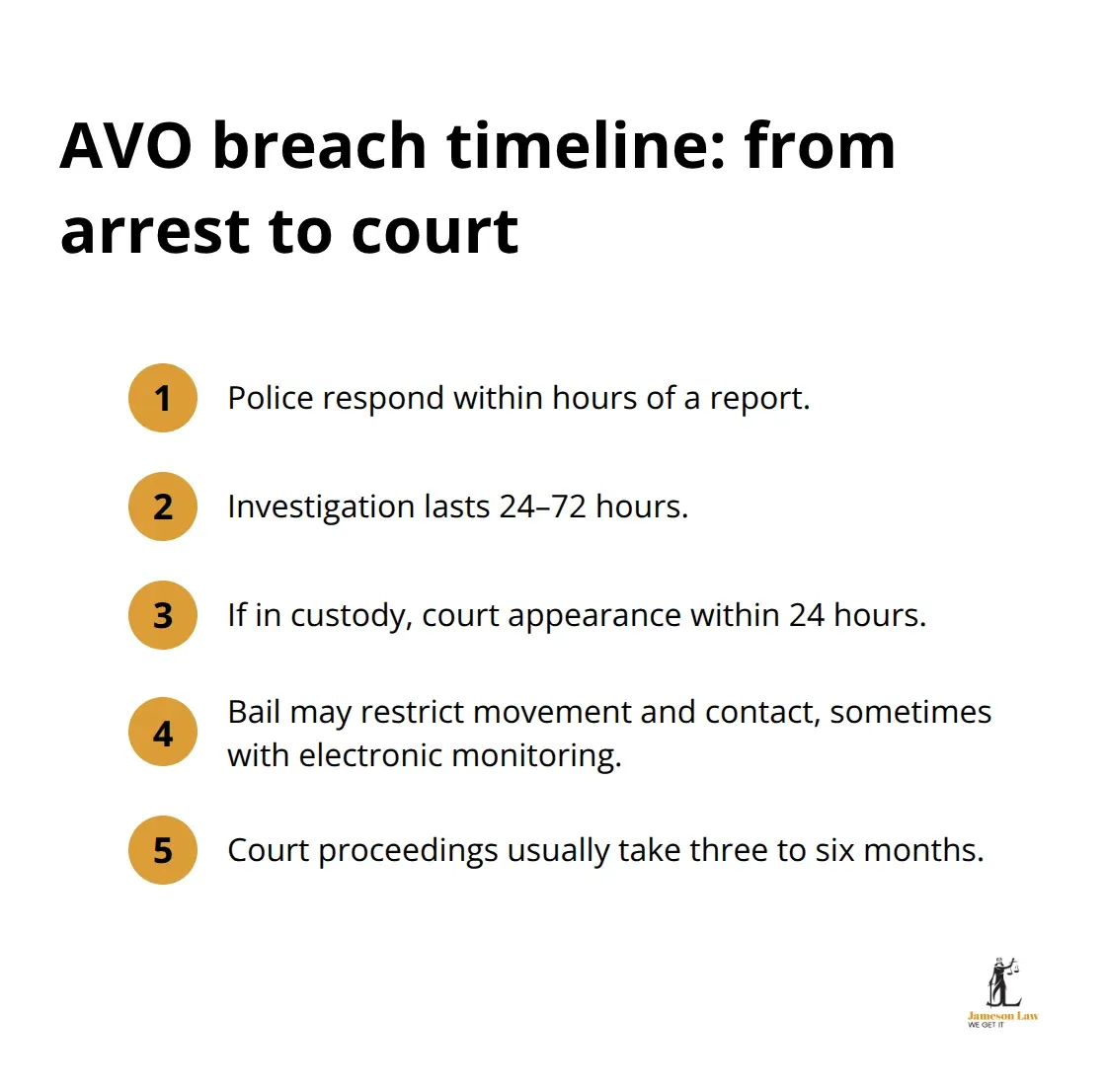
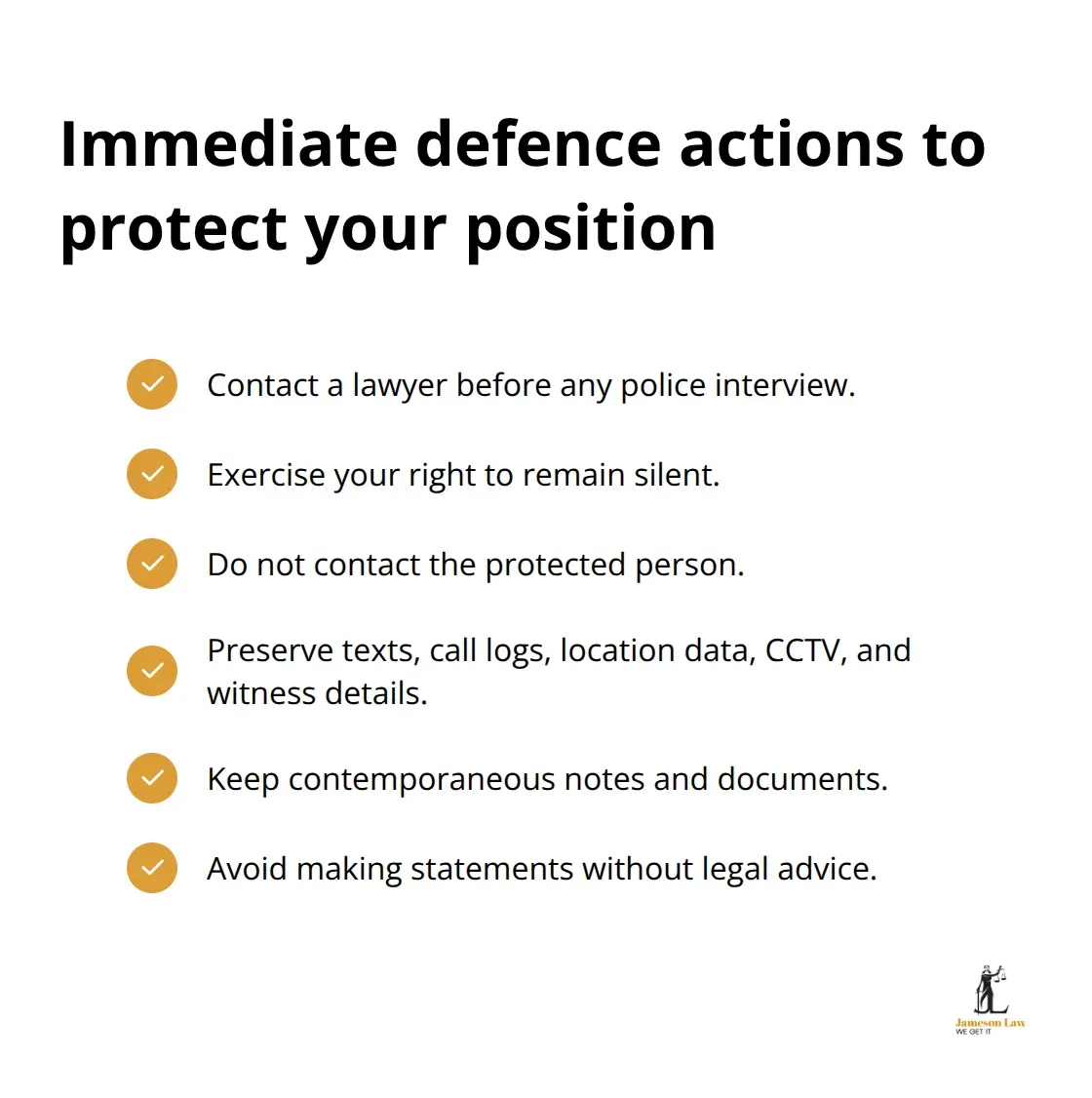
Following an arrest, you will generally be taken to a police station for an interview. It is a fundamental legal right under Australian law to remain silent and to seek legal advice before participating in an interview. Legal Aid NSW consistently advises that participating in an interview without legal counsel can inadvertently damage your position.
Bail Applications and Show Cause Provisions
Once charged, police determine whether to grant “police bail” or refuse bail. If bail is refused, you must be brought before a Magistrate in the NSW Local Court as soon as practicable.
Bail is determined under the Bail Act 2013 (NSW). Whether a show-cause requirement applies depends on the precise offence charged and the statutory category; it should not be assumed merely because an AVO breach is alleged. The court separately considers whether any unacceptable risk can be addressed by bail conditions.
Evaluating the Evidence and Legal Issues
Knowledge and Service of the Order
A fundamental factual issue in any AVO breach allegation is whether the defendant had requisite knowledge of the order. If the order was never formally served on you by police, and you were not present in court when the Magistrate made the order, the prosecution may struggle to prove the third element of Section 14.
Factual Disputes and “Invited” Contact
A common scenario arises when the protected person initiates contact or “invites” the defendant to breach the conditions (e.g., inviting them to their house). It is vital to understand that an AVO is an order of the Court, not an agreement between two people. The protected person cannot “authorise” a breach. If a condition prohibits you from being within a certain distance of a residence, attending that residence—even with an invitation—constitutes a criminal breach.
However, if the contact was genuinely accidental or unforeseeable—such as unexpectedly encountering the protected person in a public supermarket—a factual argument may exist that the contravention was not “knowing.”
The NSW Local Court Process
If you enter a plea of “Not Guilty” to a Section 14 charge, the matter will proceed to a defended hearing in the NSW Local Court. During this hearing, the prosecution will tender their brief of evidence (including police body-worn video and witness statements). The defence has the opportunity to cross-examine prosecution witnesses and tender exculpatory evidence.
If you enter a plea of “Guilty,” or are found guilty after a hearing, the Magistrate proceeds to sentencing. While the maximum penalty is two years imprisonment, Magistrates possess a range of sentencing options under the Crimes (Sentencing Procedure) Act 1999 (NSW), including Community Correction Orders (CCOs), Conditional Release Orders (CROs), and fines.
Frequently Asked Questions
What is the penalty for breaching an AVO in NSW?
The basic offence under Section 14(1) carries a maximum penalty of two years imprisonment, 50 penalty units, or both. A separate offence under Section 14(1A) can apply to an intentional ADVO breach causing or intended to cause harm or fear, with a maximum of three years imprisonment, 100 penalty units, or both. If a Section 14(1) breach involves an act of violence, Section 14(4) requires a term of imprisonment unless the court otherwise orders and records its reasons.
What must the prosecution prove for an AVO breach conviction?
The prosecution must prove beyond reasonable doubt that a valid AVO existed, that you knowingly contravened a specific condition of that order, and that you were served with or aware of the order at the time of the alleged breach.
Will I be arrested for breaching an AVO?
Police may arrest a person suspected of an AVO breach, but arrest and bail outcomes depend on the alleged conduct, risk factors and the Bail Act 2013 (NSW). A person should obtain legal advice promptly and understand their right to silence before participating in a police interview.
Final Thoughts
A Section 14 charge for an AVO breach in NSW is an inherently serious matter that the courts manage with strict adherence to public safety and deterrence principles. The escalation from an administrative order to a formal criminal charge requires careful navigation of the evidentiary brief, bail conditions, and statutory defences.
Understanding the exact prohibitions on your AVO and the immediate consequences of an arrest is vital for compliance. Because the potential penalties include custodial sentences—particularly where allegations involve violence—obtaining accurate legal guidance based on your specific factual matrix is essential.
For strategic advice and representation regarding Apprehended Violence Orders and related criminal proceedings in the NSW Local Court, contact Jameson Law to discuss your situation confidentially with our defence team.