

The path from a criminal charge to verdict in NSW varies with the offence and plea. Understanding the court documents, evidence, hearing type and choices at each stage helps an accused person give informed instructions and prepare for court.
At Jameson Law, our criminal defence team represents accused individuals across New South Wales. This guide explains the practical workflow of a criminal case from the perspective of the accused. (For a detailed structural breakdown of the different courts, jurisdictional limits, and the Early Appropriate Guilty Plea scheme, see our comprehensive guide on NSW criminal court processes: a practical overview.)
Criminal Charge to Verdict: Initial Court Steps
Court Attendance Notice (CAN) and Bail
Your involvement in the court system officially begins when police issue a Court Attendance Notice (CAN). The CAN states the alleged offences and the date, time and location of the first court appearance. A police facts sheet, if provided, is a separate document.
If you were arrested, police will make a determination on “police bail.” If refused, you must be brought before a Magistrate as soon as practicable. The Magistrate will decide whether to grant “court bail” under the Bail Act 2013 (NSW), assessing unacceptable risks including failure to appear, committing a serious offence, endangering safety, or interfering with witnesses or evidence. Any bail conditions imposed (such as curfews or reporting obligations) must be strictly followed.
The First Mention in the Local Court
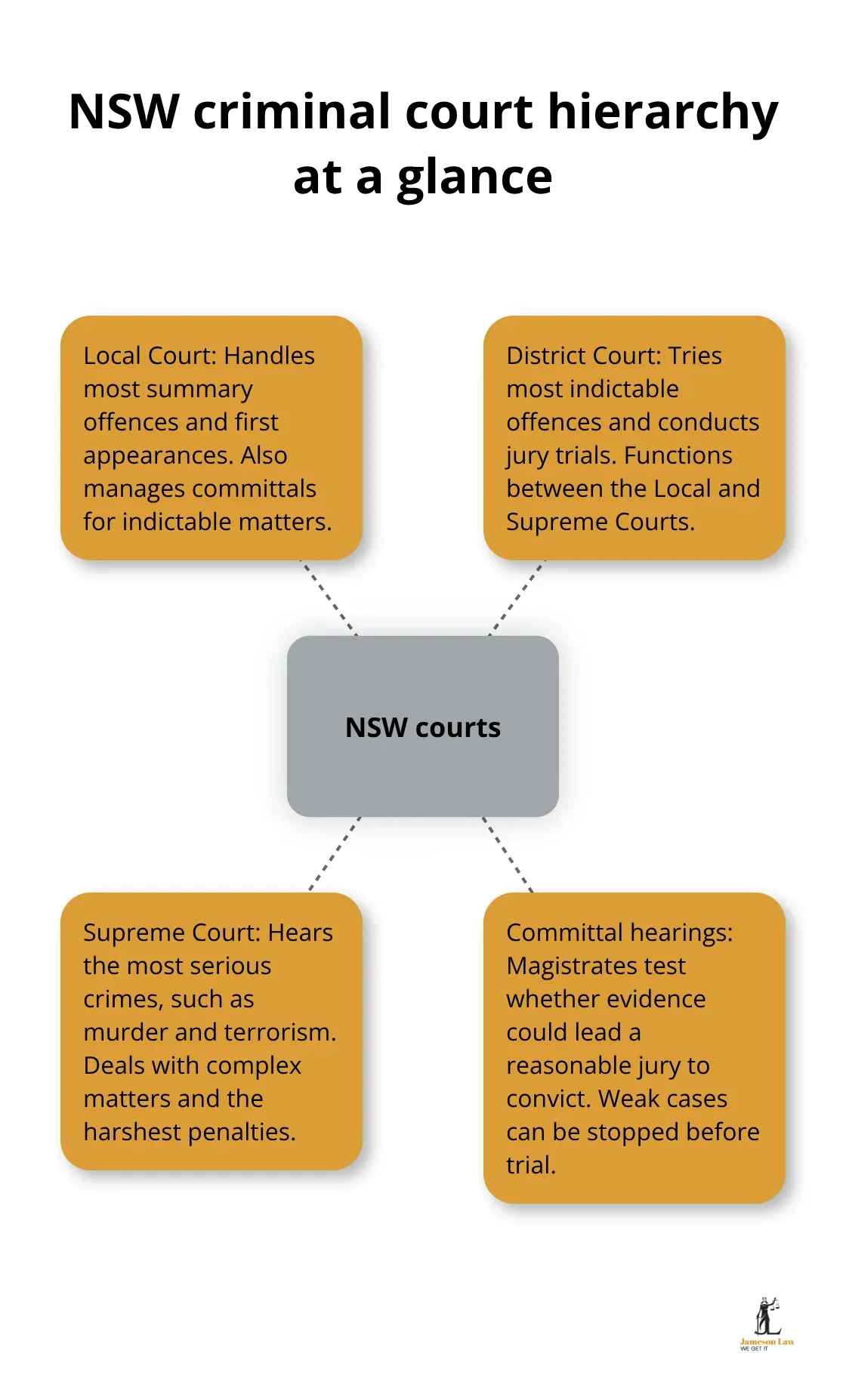
Almost all criminal matters begin in the Local Court. Your first appearance is known as a “mention.” At this stage, the court does not expect a trial to occur. The Magistrate will simply ask if you have legal representation and how you intend to plead. In most cases, your lawyer will seek an adjournment so the police can prepare and serve the full brief of evidence.
The Brief of Evidence and Legal Advice
Getting the Brief of Evidence
The timing of the brief depends on the procedure. In many summary matters, brief orders are made after a not-guilty plea; indictable matters dealt with on indictment follow separate charge-certification and case-management steps. The brief contains all the material the police intend to rely on to prove their case, which may include:
- Witness statements and police notebook entries.
- CCTV footage, body-worn camera video, and audio recordings.
- Forensic reports, drug analysis certificates, or medical records.
- Records of your electronically recorded police interview (ERISP), if you participated in one.
Providing Instructions to Your Lawyer
Once the brief is served, you and your defence lawyer will forensically review the evidence. This is a critical stage where you provide your instructions (your version of events). Your lawyer will advise whether the prosecution has sufficient evidence to prove the charges and will discuss potential legal defences, such as self-defence, necessity, or mistaken identity. If you cannot afford a private lawyer, Legal Aid NSW may be able to provide representation, subject to eligibility criteria.
| Preparation Phase | The Accused’s Role | The Defence Lawyer’s Role |
|---|---|---|
| Brief Review | Read the brief carefully; note any factual inaccuracies or missing context. | Analyze the admissibility of the evidence and identify legal flaws in the prosecution’s case. |
| Gathering Evidence | Provide names of potential defence witnesses; gather relevant text messages or receipts. | Subpoena required documents (e.g., CCTV from third parties, medical records) and draft witness statements. |
| Plea Decision | Decide whether to plead Guilty or Not Guilty based on legal advice. | Negotiate with the police prosecutors or ODPP to have charges withdrawn or downgraded where appropriate. |
The Hearing or Trial: Testing the Evidence
If you maintain a plea of “Not Guilty,” the matter will proceed to a contested hearing or trial. The format depends entirely on the classification of the offence.
Summary Defended Hearing (Local Court)
The vast majority of criminal matters (such as minor assaults, drink driving, and drug possession) are summary offences finalised in the Local Court. A Defended Hearing is presided over by a Magistrate sitting alone. There is no jury. The Magistrate determines the admissibility of evidence, decides whether the facts have been proven, and issues a verdict.
Trial on Indictment (District or Supreme Court)
Strictly indictable offences (such as sexual assault, serious fraud, or large commercial drug supply) proceed to a trial in the District Court or Supreme Court after passing through the Local Court committal process. In these trials, a Judge rules on matters of law and evidence, while a jury determines the facts and returns a guilty or not-guilty verdict. Where the law permits, a trial may instead be heard by a judge alone.
The Prosecution Burden and The Accused’s Choice
The cornerstone of the NSW criminal justice system is the presumption of innocence. According to the Judicial Commission of NSW, the prosecution bears the burden of proving every element of the offence beyond reasonable doubt.
As the accused, you do not have to prove your innocence. Furthermore, you have a fundamental right to silence during the trial. You have the absolute choice of whether to give evidence in the witness box. If you choose to testify, you will be cross-examined by the prosecutor. If you choose to remain silent, the Judge will instruct the jury that your silence cannot be used as an admission of guilt.
The Verdict and Next Steps
After all evidence is presented and closing addresses are made, a verdict is delivered.
- Not Guilty: You are acquitted of the charge. You are free to leave, and the matter is finalised. In some summary matters, your lawyer may apply to have the prosecution pay a portion of your legal costs.
- Guilty: If the Magistrate or jury returns a guilty verdict, the matter proceeds to sentencing. The court will consider your criminal history, the objective seriousness of the offence, and subjective factors (such as character references and psychological reports) before determining the penalty under the Crimes (Sentencing Procedure) Act 1999 (NSW).
Frequently Asked Questions
What happens at my first court appearance in NSW?
At your first court appearance (the first mention) in the Local Court, the Magistrate will ask if you have legal representation and how you intend to plead. The court will typically order the police to serve the brief of evidence on your defence lawyer before a final plea is required.
Do I have to give evidence at my own criminal trial in NSW?
No. Under NSW law, an accused person has a fundamental right to silence. You cannot be forced to give evidence or testify in your own defence. The prosecution bears the legal burden of proving the offence beyond reasonable doubt, although specific defences or issues can carry evidential or legal burdens under legislation.
What is the difference between a summary hearing and a trial on indictment?
A summary defended hearing takes place in the Local Court, where a Magistrate alone decides both the facts (guilt or innocence) and the law. A trial on indictment occurs in the District or Supreme Court and is usually heard by a judge and jury, although a judge-alone trial is available where the law permits.
Final Thoughts
The NSW criminal court process is highly formalized, and navigating it successfully requires objective legal analysis and meticulous preparation. From carefully reviewing the brief of evidence to effectively cross-examining prosecution witnesses, every phase of the process must be handled with precision to protect the presumption of your innocence.
Because the prosecution must prove guilt beyond reasonable doubt, exposing inconsistencies, challenging inadmissible evidence, and making strategic choices regarding whether to give evidence are crucial components of a robust defence.
If you have received a Court Attendance Notice or have an upcoming defended hearing or trial, contact the criminal defence team at Jameson Law to discuss your legal strategy.