


Facing criminal charges in New South Wales requires a clear understanding of court procedures, evidence rules, and statutory sentencing principles. Securing qualified criminal law defence Sydney representation ensures your legal rights are protected from your initial police interaction through to Local Court appearances, bail determinations, and defended hearings or trials.
At Jameson Law, our criminal defence team assists individuals across Sydney and NSW in navigating the complexities of the justice system. This guide provides a practical overview of how charges are classified, how the prosecution’s case is tested, and how courts determine sentencing under NSW legislation.
How Criminal Offences Are Classified and Heard in NSW Courts
The classification of an offence under the Criminal Procedure Act 1986 (NSW) determines which court has jurisdiction, whether a jury is involved, and the maximum penalties that apply.
Summary Offences
Summary offences are less serious matters (such as minor traffic offences, offensive behaviour, or low-level property damage) that are finalized in the NSW Local Court by a Magistrate sitting alone. Maximum penalties are specific to each statutory offence and are constrained by Local Court jurisdictional limits.
Indictable Offences and Table Elections
Indictable offences are more serious crimes (such as robbery, major fraud, or serious drug supply). However, not all indictable offences proceed automatically to a trial before a judge and jury in the District or Supreme Court. Under the Criminal Procedure Act 1986, many indictable matters are categorized under Table 1 or Table 2:
- Table 1 Offences: Are dealt with summarily in the Local Court unless the prosecutor or the accused elects to have the matter heard on indictment in the District Court.
- Table 2 Offences: Are dealt with summarily in the Local Court unless the prosecutor elects to proceed on indictment.
Strictly indictable offences (such as murder or large commercial drug trafficking) cannot be finalized summarily and must proceed through the Local Court committal process (including charge certification and case conferencing under the Early Appropriate Guilty Plea scheme) before being committed to the District Court or Supreme Court for trial or sentence.
Practical Overview of the NSW Criminal Court Process and Rights
From the moment of arrest through to a hearing or trial, the criminal process follows strict procedural stages designed to ensure procedural fairness.
| Procedural Stage | Governing Framework | Key Rights & Considerations |
|---|---|---|
| Police Questioning | Evidence Act 1995 (NSW) & LEPRA | Fundamental right to silence under s 89. Exception applies under s 89A (special caution in serious indictable investigations with a lawyer present). |
| Bail Determination | Bail Act 2013 (NSW) | Assessment of ‘Show Cause’ requirements for serious offences, followed by the ‘Unacceptable Risk’ test to determine conditions or detention. |
| Brief of Evidence | Criminal Procedure Act 1986 (NSW) | Prosecution must disclose all material evidence, statements, and recordings before a final plea is entered. |
| Hearing or Trial | NSW Local, District, or Supreme Court | The prosecution bears the legal burden of proving every element of the offence beyond reasonable doubt. |
The Burden and Standard of Proof
Under Australian law, an accused person is presumed innocent. As outlined by the Judicial Commission of NSW, the legal burden rests entirely on the prosecution to prove every element of the charge beyond reasonable doubt. An accused is not required to give evidence or prove their innocence, subject only to specific statutory provisions or defence claims (such as mental health impairment) where a evidentiary or legal burden may arise.
Challenging Inadmissible Evidence
Under the Evidence Act 1995 (NSW), defence practitioners can challenge evidence that was improperly or illegally obtained (Section 138), or evidence where the prejudicial effect substantially outweighs its probative value (Section 137). If a court excludes critical prosecution evidence, the viability of the charge may be significantly affected.
For eligible individuals who cannot afford private legal representation, Legal Aid NSW provides duty services and means-tested grants of aid for criminal matters.
Sentencing Principles, Early Guilty Pleas, and Criminal Records
If an accused enters a plea of guilty or is found guilty following a hearing or trial, the court determines the penalty under the Crimes (Sentencing Procedure) Act 1999 (NSW).
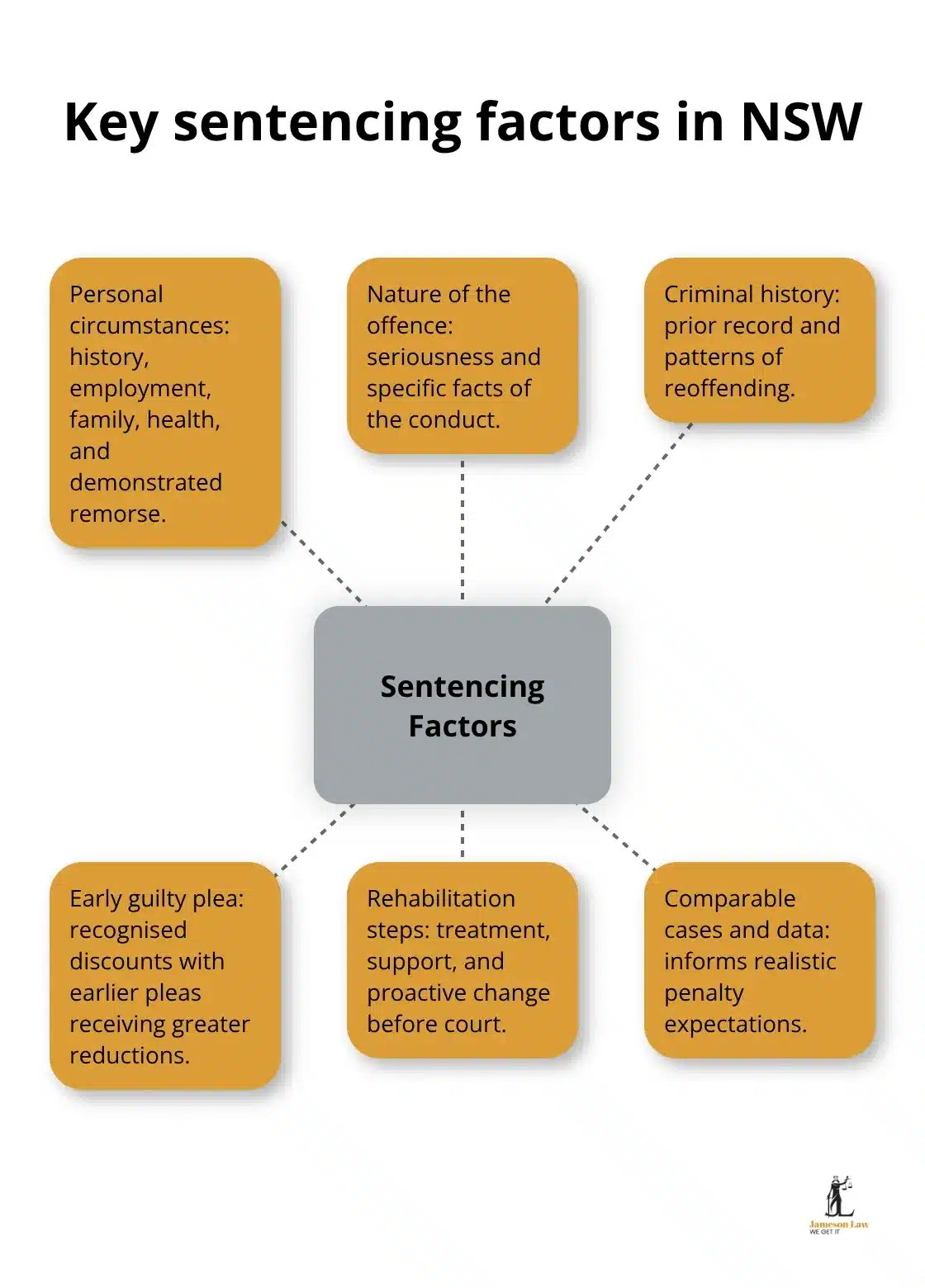
Factors Considered in Sentencing
Sentencing involves an individualized judicial exercise. The judicial officer evaluates the objective seriousness of the conduct (such as planning, injury, or breach of trust) alongside subjective mitigating factors, including:
- Prior character, employment history, and lack of previous convictions.
- Genuine expressions of remorse and participation in rehabilitation or counseling programs.
- Family responsibilities and mental health considerations.
Statutory Discounts for Early Guilty Pleas
Under Part 3, Division 1A of the Crimes (Sentencing Procedure) Act 1999, statutory sentencing discounts apply to strictly indictable offences dealt with on indictment:
- 25% discount: If a guilty plea is entered in the Local Court before committal.
- 10% discount: If entered after committal up to 14 days before the first trial date.
- 5% discount: If entered thereafter.
For summary offences, the timing of a guilty plea is taken into account as a mitigating factor within the general discretion of the Magistrate.
Sentencing Dispositions and Spent Convictions
NSW courts have a spectrum of sentencing options available, ranging from fines and Conditional Release Orders (CROs)—which may be granted with or without recording a conviction under Section 10—to Community Correction Orders (CCOs), Intensive Correction Orders (ICOs), and full-time imprisonment.
Under the Criminal Records Act 1991 (NSW), eligible convictions may become “spent” after a 10-year crime-free period (3 years for juvenile convictions), meaning they generally do not need to be disclosed on standard employment police checks. However, spent conviction rules contain strict statutory exceptions; they do not apply to certain sexual offences or sentences exceeding 6 months imprisonment, or vetting for specific professions (such as law enforcement, judicial roles, and working with children).
Frequently Asked Questions
How are criminal offences classified in NSW?
NSW criminal law classifies offences into summary offences (dealt with by a Magistrate in the Local Court) and indictable offences (more serious crimes). However, many indictable offences (Table 1 and Table 2 offences under the Criminal Procedure Act 1986) are dealt with summarily in the Local Court unless an election is made to proceed on indictment in the District Court.
How does the court decide bail under the NSW Bail Act 2013?
Bail decisions in NSW follow the statutory framework of the Bail Act 2013 (NSW). The court considers whether the accused must ‘show cause’ why detention is not justified for specific serious offences, and assesses whether there is any ‘unacceptable risk’ (such as failing to appear, committing serious offences, endangering safety, or interfering with witnesses) that cannot be mitigated by imposing bail conditions.
Can my silence during police questioning be used against me in court?
Under Section 89 of the Evidence Act 1995 (NSW), a court generally cannot draw an unfavourable inference from an accused’s refusal to answer police questions. However, under Section 89A, an unfavourable inference may be drawn in proceedings for a serious indictable offence if you fail to mention a fact you later rely on in your defence, provided a ‘special caution’ was given in the physical presence of an Australian legal practitioner.
Final Thoughts
Navigating the criminal justice system in New South Wales requires objective legal evaluation, thorough preparation, and compliance with statutory court processes. Understanding the evidence contained in the police brief and knowing your rights regarding police interviews and bail applications are fundamental to protecting your legal position.
Because the consequences of a criminal finding can affect your reputation, livelihood, and personal liberty, obtaining qualified legal advice early ensures your matter is approached with a clear, strategic defence plan.
If you have been charged with an offence or require representation for an upcoming Local Court appearance, contact the criminal defence team at Jameson Law for confidential guidance.