


The outcome of a criminal charge in New South Wales depends heavily on the decisions you make immediately after arrest. Engaging an experienced defence lawyer Sydney provides you with critical strategic guidance through police interviews, bail applications, and complex court proceedings.
At Jameson Law, our criminal defence team regularly represents clients across the Local, District, and Supreme Courts of NSW. This guide explains your fundamental legal rights, what to expect in the criminal justice system, and how to build a robust defence.
Immediate Actions When Facing Criminal Charges
The moment you are charged, the NSW criminal justice system moves rapidly. Most matters commence in the Local Court. The first 28 days are vital: this period dictates the initial disclosure of police evidence, your bail status, and the groundwork for your defence.

Police Interviews and the Right to Silence
During a police investigation, you have a fundamental common law right to remain silent. You are only required to provide basic identifying details. Participating in a formal police interview without obtaining prior legal advice is highly risky, as anything you say can be used as evidence in court.
It is critical to understand the nuance of the right to silence under the Evidence Act 1995 (NSW). Generally, a court cannot draw an unfavourable inference from your silence. However, under Section 89A, if you are being investigated for a serious indictable offence and you fail to mention a fact during official questioning that you later rely on in court, an unfavourable inference may be drawn. Crucially, this exception only applies if the police administered a “special caution” in the physical presence of your Australian legal practitioner. Consequently, securing a lawyer before any police interaction is paramount.
Bail Applications in the Local Court
If police refuse bail at the station, you must be brought before a Magistrate as soon as practicable. A bail application involves your lawyer demonstrating to the court that you do not pose an “unacceptable risk” (such as a flight risk, a risk of re-offending, or a risk of interfering with witnesses) under the Bail Act 2013 (NSW). A properly prepared bail application, supported by character references, proof of employment, and suitable residential ties, is essential for securing your release while your case progresses.
Choosing the Right Defence Lawyer Sydney
Criminal law is highly specialised. When selecting a lawyer, look for substantial criminal defence experience, clear communication and familiarity with the NSW court where the matter will be heard.
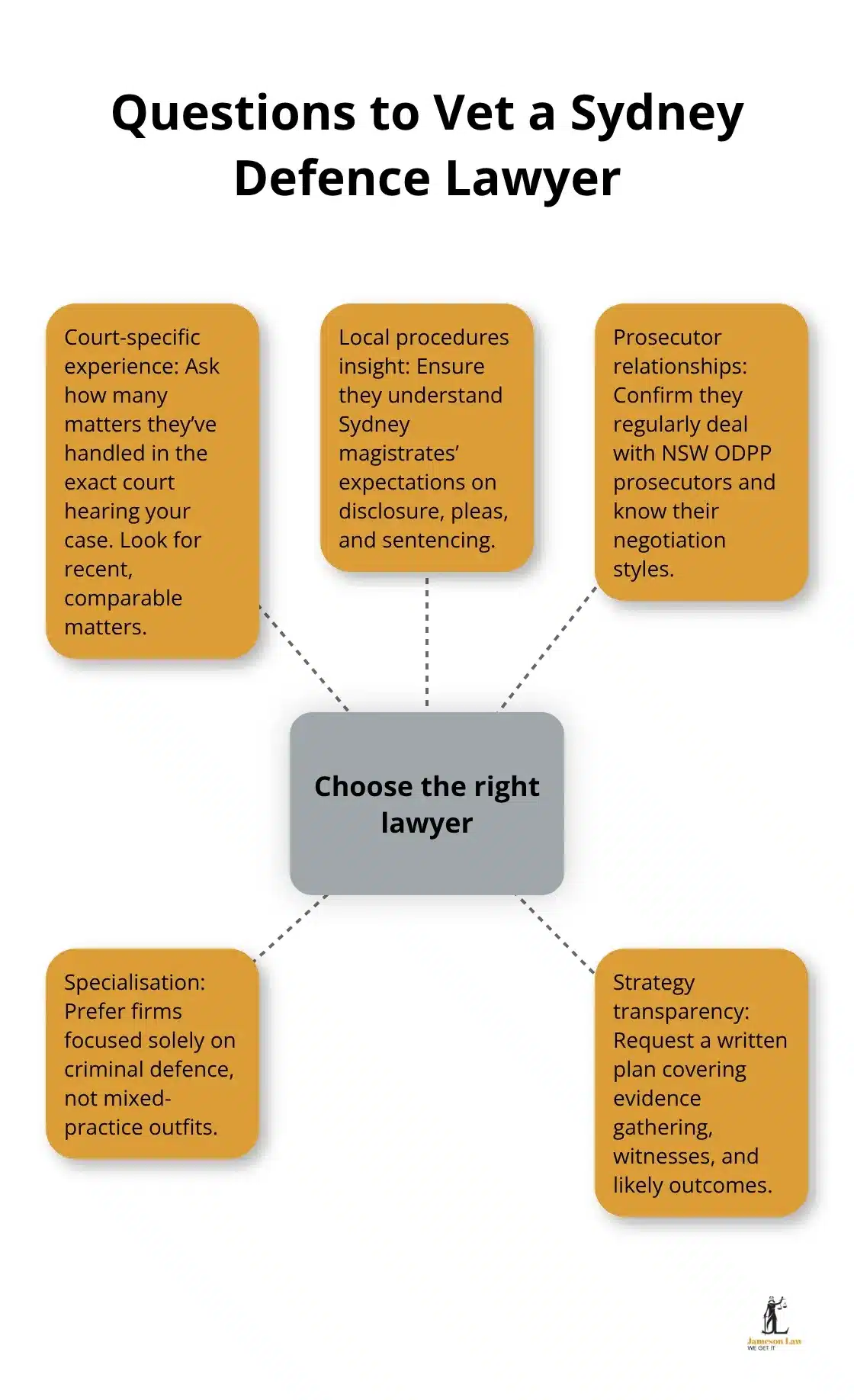
Evaluating Your Options: A Practical Checklist
| What to Look For | Red Flags to Avoid |
|---|---|
| Relevant Experience: The lawyer regularly handles criminal matters like yours. | Unclear Experience: The lawyer cannot explain their relevant criminal law work. |
| Clear Strategy: Provides a realistic assessment of the evidence and outlines worst, best, and likely case scenarios. | Guaranteed Outcomes: Lawyers promising a specific result or claiming “insider” influence with magistrates. |
| Transparent Costs: Offers a clear fee agreement, outlining fixed fees or hourly rates for specific stages of the matter. | Vague Pricing: Inability to estimate trial costs or refusing to provide a written fee agreement upfront. |
Building a Strategic Legal Defence
Effective defence work occurs long before you step into a courtroom. It requires aggressively testing the prosecution’s evidence and understanding statutory diversion options.
Testing Evidence and Cross-Examination
The prosecution must prove their case beyond reasonable doubt. Your lawyer will subpoena CCTV footage, request police body-worn camera video, and critically examine witness statements for inconsistencies. When a matter proceeds to a hearing or trial, the ability to cross-examine witnesses effectively exposes flaws in the police narrative and establishes reasonable doubt.
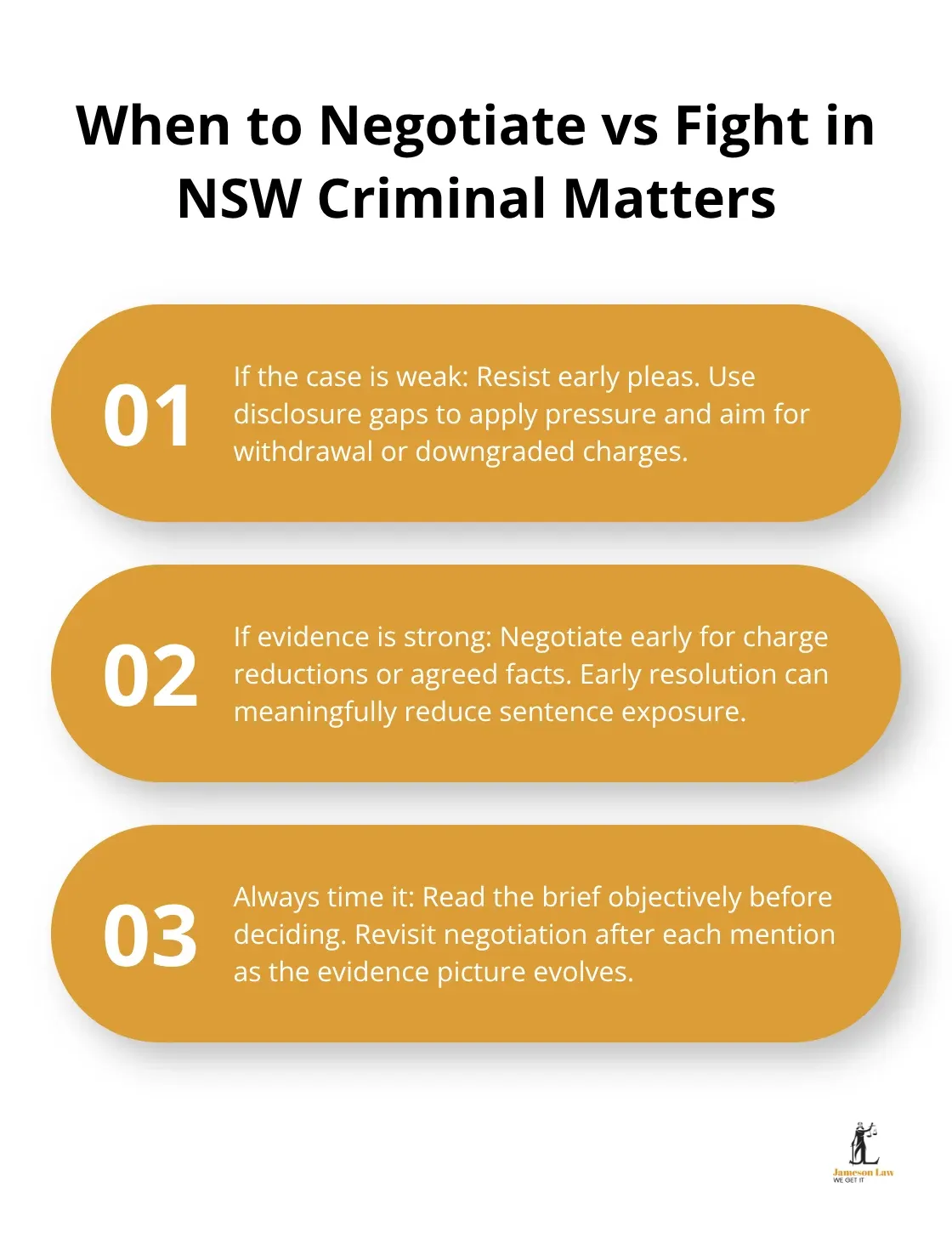
Plea Negotiations and Diversion Options
Under the Early Appropriate Guilty Plea (EAGP) scheme, resolving a matter early can result in a statutory sentence discount. However, a guilty plea should never be entered until the police brief is thoroughly reviewed.
If you suffer from a mental health condition or cognitive impairment, your lawyer may apply to have the charges dealt with under the Mental Health and Cognitive Impairment Forensic Provisions Act 2020 (NSW). If successful, the Magistrate diverts you into a treatment plan and dismisses the charges without recording a conviction. Similarly, for certain lower-level offences, a Magistrate may exercise discretion under Section 10 of the Crimes (Sentencing Procedure) Act 1999 (NSW) to dismiss the charge without a conviction, even after a guilty finding.
Frequently Asked Questions
How do I choose a criminal defence lawyer in Sydney?
Choose a lawyer with substantial criminal law experience, relevant NSW court experience, transparent legal costs and a clear process for reviewing the police brief and advising on strategy.
Can my silence during a police interview be used against me in NSW?
Generally, you have a fundamental right to silence, and an unfavourable inference cannot be drawn from your refusal to answer questions. However, under Section 89A of the Evidence Act 1995 (NSW), in proceedings for a serious indictable offence, an unfavourable inference may be drawn if you fail to mention a fact you later rely on and could reasonably have been expected to mention in the circumstances, but only if a special caution was administered in the physical presence of your Australian legal practitioner.
What happens at a NSW Local Court bail hearing?
At a bail hearing, the Magistrate determines whether you present an ‘unacceptable risk’ under the Bail Act 2013 (NSW). Your lawyer will present arguments and evidence (such as residential stability and community ties) to demonstrate that any risks can be mitigated by imposing strict bail conditions.
Final Thoughts
Facing the NSW criminal justice system is a high-stakes process where early, objective legal advice is critical. From bail preparation to testing police evidence, timely and objective legal advice can help you understand your options and protect your rights.
If you have been charged with an offence or contacted by police for an interview, do not navigate the process alone. For strategic, confidential advice regarding your matter, contact Jameson Law today to speak with our criminal defence team.