


Fraud charges in NSW carry serious consequences that can affect your career, finances, and reputation. If you’re facing allegations, understanding your legal rights and options is the first step toward mounting an effective defence.
At Jameson Law, we’ve guided clients through fraud cases and know what’s at stake. This guide walks you through the elements of fraud law, your protections, and how to build a strong defence strategy.
Understanding Fraud Allegations in NSW
Elements of Fraud Under NSW Law
Under the Crimes Act 1900 (NSW) section 192E, fraud occurs when you dishonestly obtain property or a financial advantage, or cause financial disadvantage to someone else, through deception. The prosecution must prove four elements beyond reasonable doubt: a deception occurred, property or a financial advantage was obtained or financial disadvantage was caused, you acted dishonestly by ordinary community standards, and you knew your conduct was dishonest. This framework matters because weakness in any single element can undermine the entire case.
Deception covers false statements about facts or law, misleading conduct, or even actions that trick a computer system into responding unlawfully. The NSW courts have narrowed this definition over time, so a genuine promise that later fails to materialise is not automatically deception. Dishonesty represents the critical battleground in most fraud defences. It’s assessed against what ordinary people would consider dishonest, not your personal view. A jury decides whether your conduct crossed that line. This means a defence can argue that an ordinary person would not view your actions as dishonest, particularly if you held a genuine belief you had a right to the property or funds involved.
How Value Affects Your Case
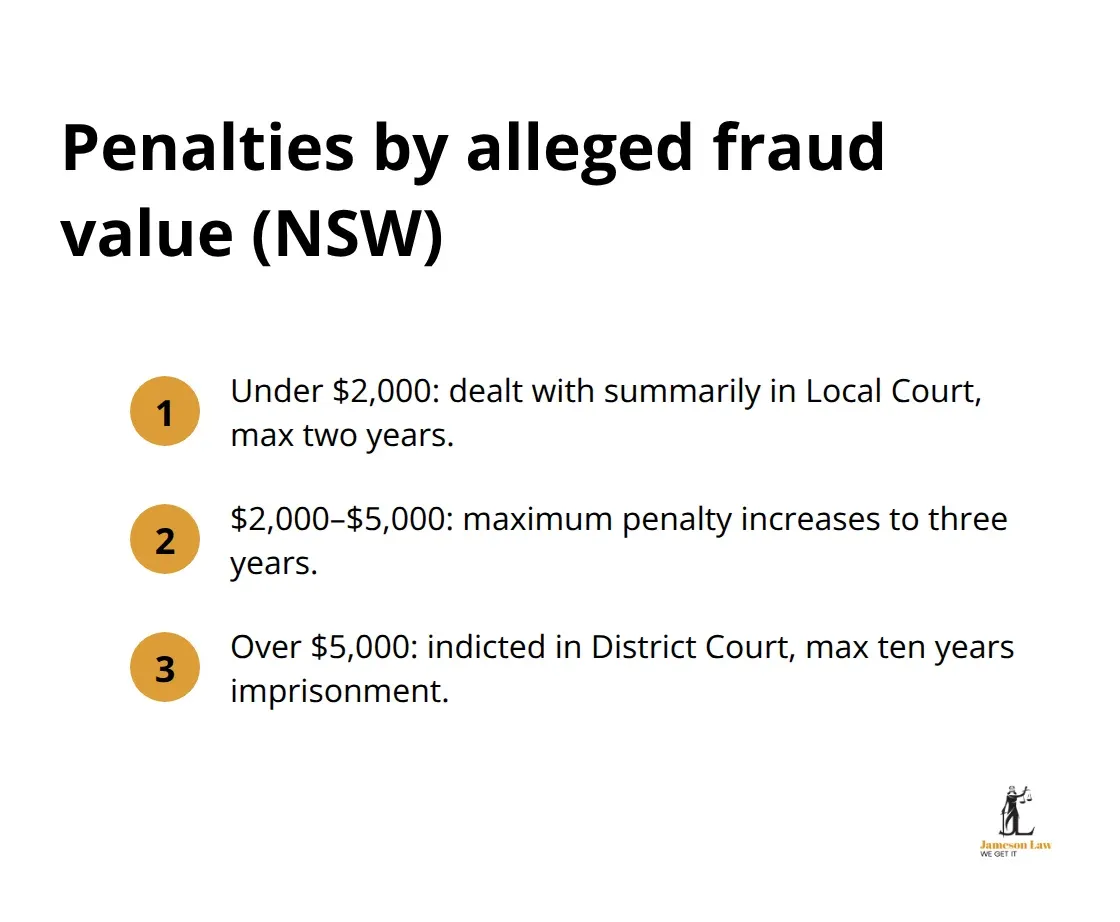
The value of what you obtained shapes how the case proceeds and what penalties apply. Fraud under $2,000 can be dealt with summarily in Local Court with a maximum two-year sentence. Between $2,000 and $5,000, the maximum increases to three years. Anything over $5,000 must be indicted in District Court, where the maximum penalty jumps to ten years imprisonment.
This distinction matters because District Court trials involve significantly higher legal costs and more complex procedures than Local Court matters.
Common Types of Fraud Charges
Fraud charges in NSW take many forms depending on the facts. The most common is obtaining property by deception, which ranges from false invoices to years-long schemes involving fabricated documents or misrepresented credentials. Another frequent charge involves obtaining a financial advantage through deception, which doesn’t require you to have gained money directly but covers situations where someone else benefited or you caused a financial disadvantage to the victim.
A third category involves destroying or concealing accounting records with intent to defraud under section 192F, carrying up to five years imprisonment. Making false or misleading statements to obtain financial advantage falls under section 192G, also with a five-year maximum. Directors of companies can face separate charges under section 192G if they made false statements about the company’s affairs.
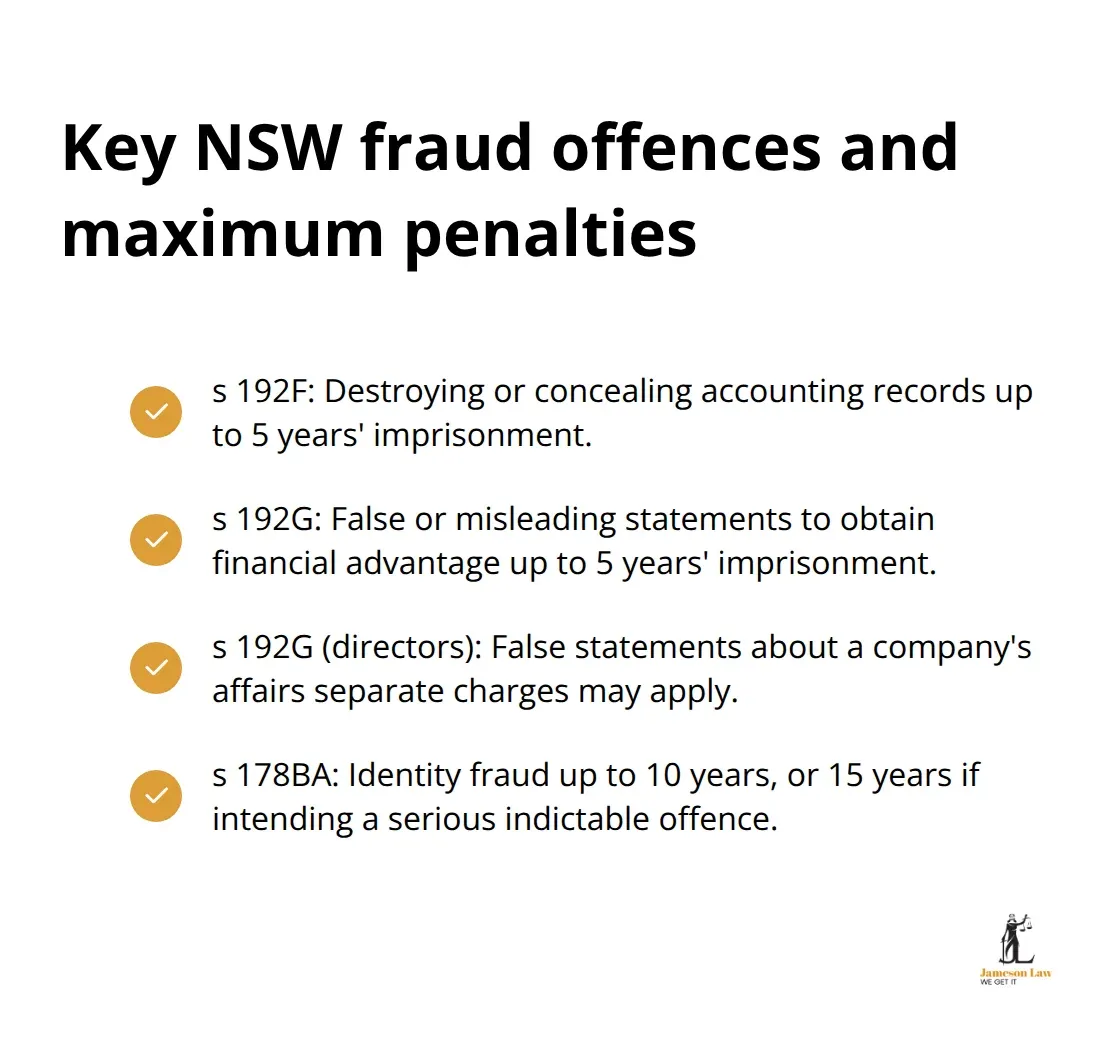
Identity fraud under section 178BA is treated separately and carries up to ten years imprisonment, or fifteen years if you intended to commit a serious indictable offence.
Building the Prosecution’s Case
The prosecution must link each alleged deception directly to each financial outcome transaction by transaction. In multi-count matters, they might allege dozens of separate frauds across a period of months or years. This is where forensic examination of bank records, emails, and invoices becomes essential. Many defences succeed by showing the Crown’s evidence relies on inference rather than direct proof of deception for specific transactions.
The investigation phase typically runs three to twelve months, and police can charge you years after the alleged conduct because there is no statute of limitations for fraud in NSW. Early legal intervention during investigation, ideally within the first 24 to 48 hours of police contact, significantly influences whether charges are laid at all. Understanding these elements and how they apply to your specific circumstances forms the foundation for your defence strategy-something we’ll explore in detail as we examine your legal rights and protections.
Your Rights and Legal Protections
The Right to Legal Representation
The moment police contact you about fraud allegations, your legal position shifts dramatically. You have concrete protections under Australian law, and understanding how to activate them separates outcomes where charges are dropped from those where you face years in District Court.
The right to legal representation is not optional or theoretical-it’s your shield during every interaction with authorities. When police invite you for questioning, you can decline to answer questions without a lawyer present. This matters enormously because anything you say in a police interview becomes evidence the Crown uses against you. Statements made without legal advice frequently become the prosecution’s strongest evidence.
Early intervention within the first 24 to 48 hours of police contact allows your lawyer to engage directly with investigators. This engagement can prevent charges altogether in some cases. Many people believe they should cooperate fully and explain themselves, but this instinct works against you in fraud matters where the Crown builds its case transaction by transaction. A lawyer attending your interview protects your rights, ensures you understand what’s being asked, and prevents you from inadvertently admitting facts the prosecution would otherwise struggle to prove.
The Crimes Act 1900 (NSW) guarantees your right to remain silent. Exercising that right is not an admission of guilt-it’s a tactical decision your lawyer makes based on the evidence against you.
Presumption of Innocence and the Burden of Proof
Your presumption of innocence means the Crown carries the burden of proving guilt beyond reasonable doubt for every element of every charge. This principle transforms how you approach your defence because the prosecution must affirmatively prove deception, dishonesty, and the obtaining of property or financial advantage for each transaction they allege. You don’t need to prove your innocence; they must prove your guilt.
This framework protects you throughout the court process. The Crown cannot shift the burden of proof to you or require you to explain yourself. Instead, your lawyer tests whether the prosecution’s evidence actually meets the standard required by law.
Access to Evidence and Discovery
Access to the Crown’s brief and evidence-called discovery-becomes your forensic toolkit. Within weeks of your first court appearance, your lawyer receives documents the Crown relies on: bank statements, emails, invoices, witness statements, and investigation notes.
Examining this material like a forensic accountant reveals where the Crown’s case rests on inference rather than direct proof. If the Crown alleges you deceived someone through a false invoice, the actual invoice and contemporaneous communications become critical. Did you deliberately falsify the document, or was it prepared based on genuine information available at the time?
If the Crown alleges dishonesty, their brief must contain evidence showing you knew your conduct breached ordinary community standards. Weaknesses here-such as evidence showing you held a genuine belief you had a right to the funds-undermine the entire case. Your lawyer’s role includes testing every document, identifying gaps in the Crown’s narrative, and building a defence strategy around facts, not assumptions.
Building Your Defence Foundation
Early legal representation means this examination happens while police are still investigating. Sometimes this scrutiny prevents charges that would not survive closer examination. The evidence the Crown gathers during investigation forms the foundation of their case, and weaknesses identified early shape how your defence develops. Understanding what the prosecution must prove, combined with access to their evidence, positions you to challenge their case effectively at every stage.
Building Your Defence Strategy
Start Your Defence Immediately
Your defence begins the moment you engage a lawyer, not when you walk into court. The most effective defences take shape through meticulous examination of the Crown’s evidence and strategic decisions made early in the process. Within the first 24 to 48 hours of police contact, your lawyer can request copies of investigation materials, analyse the strength of alleged deceptions, and identify whether the prosecution can actually prove dishonesty by ordinary community standards. This early stage determines whether your defence focuses on challenging the Crown’s evidence at committal proceedings or negotiating which counts proceed to trial.
Examine Every Transaction
Many fraud matters involve multiple alleged transactions across months or years, which means the Crown must prove deception and dishonesty for each one separately. A lawyer experienced in fraud defence reads through bank statements, emails, and invoices like a forensic accountant, tracing every transaction the Crown alleges and testing whether the evidence actually demonstrates intentional deception or dishonesty.
For instance, if the Crown alleges you falsified invoices, contemporaneous communications showing you believed the amounts were accurate undermines their deception claim entirely. Similarly, if you held a genuine belief you had a right to the funds involved, this directly challenges whether ordinary people would view your conduct as dishonest. The prosecution frequently relies on inference to connect transactions to alleged deceptions, particularly in complex matters spanning multiple months. Your defence exposes these gaps by demanding direct evidence rather than circumstantial connection.
Use Documentation as Your Defence Tool
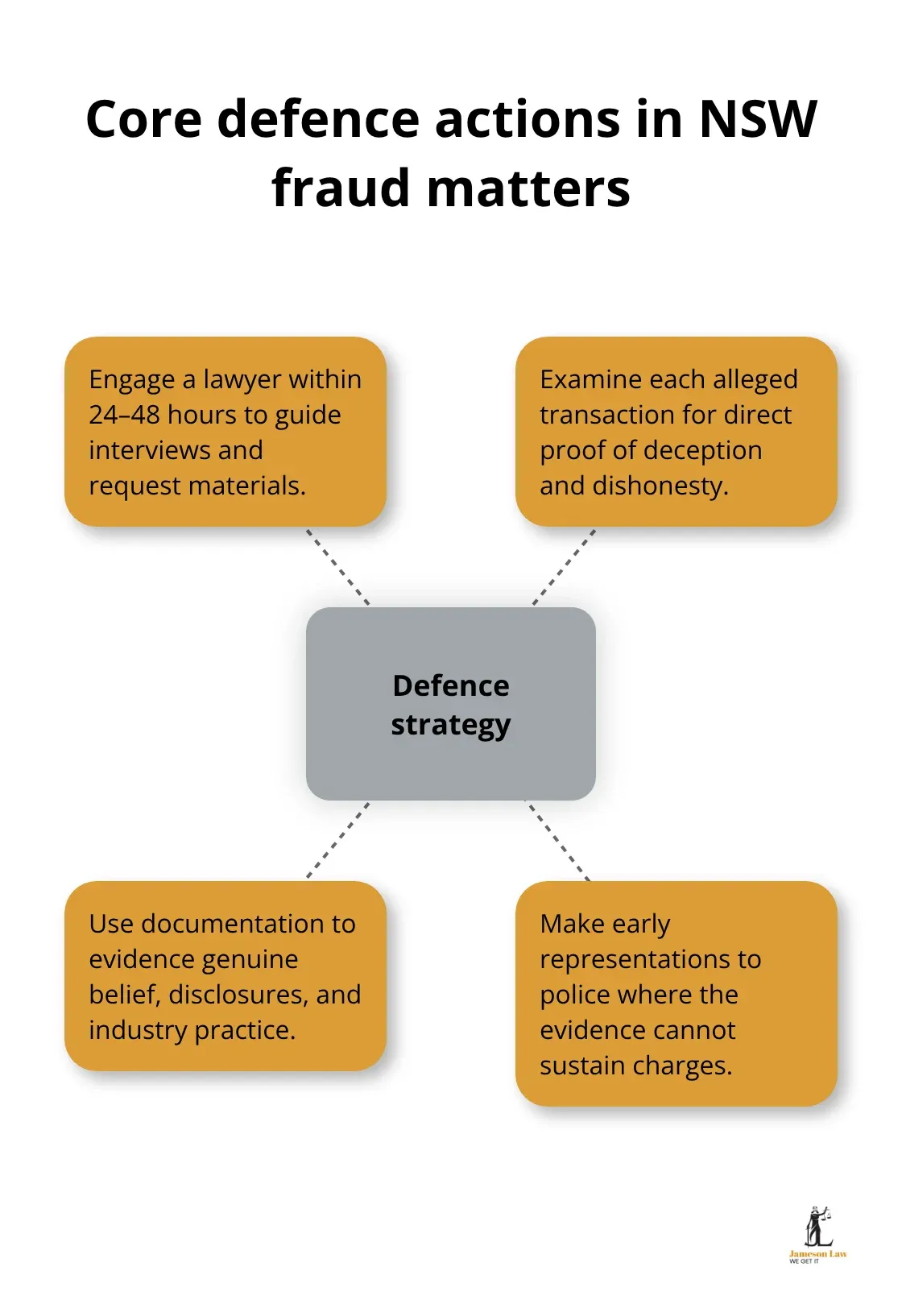
Documentation creates an objective record the Crown cannot reinterpret. You should gather financial records, emails, invoices, payment records, and any communications showing your state of mind at the time of the alleged conduct immediately after police contact. If the Crown alleges you concealed information, contemporaneous records showing you disclosed it to relevant parties demolish that allegation. If they claim you acted with dishonest intent, evidence showing you consulted with accountants, sought advice, or acted consistently with industry practice demonstrates you believed your conduct was lawful.
Your lawyer uses this material to challenge the Crown’s narrative transaction by transaction, potentially resulting in some counts being withdrawn before trial. In matters involving $5,000 or more that proceed to District Court, this strategic groundwork can mean the difference between facing twenty counts or five counts at trial.
Make Early Representations to Police
Early legal intervention allows your lawyer to make representations to police, sometimes preventing charges altogether if the evidence cannot sustain the allegations. This approach requires engaging a lawyer with specific experience in NSW fraud defence who understands how courts assess deception and dishonesty, not a generalist criminal lawyer handling your matter alongside traffic offences and minor assault cases.
Final Thoughts
Fraud charges NSW demand immediate action and strategic thinking. The elements the prosecution must prove-deception, dishonesty, and obtaining property or financial advantage-each represent opportunities to challenge their case. Your defence succeeds when you understand these elements, gather documentation that contradicts the Crown’s narrative, and engage legal representation before police interviews occur.
Early intervention within the first 24 to 48 hours of police contact allows your lawyer to request investigation materials, analyse whether the Crown can prove dishonesty by ordinary community standards, and sometimes prevent charges altogether. The evidence police gather during investigation forms the foundation of their entire case, and weaknesses identified early shape your defence strategy and can result in counts being withdrawn before trial. This timing transforms how your case proceeds through committal proceedings and potentially to District Court trial.
We at Jameson Law understand what’s at stake when you face fraud allegations. Our criminal law team has guided clients through these matters and knows how to challenge the Crown’s evidence effectively. Contact us immediately if police have contacted you or charged you with fraud, because the decisions you make in the first 48 hours determine your entire defence approach.