


Witness testimony can make or break a case, yet courts know that what a witness says isn’t always reliable. Memory fades, emotions cloud judgement, and even well-meaning witnesses can get details wrong.
At Jameson Law, we’ve seen firsthand how judges assess witness statement credibility using specific legal tests and frameworks. Understanding these standards helps you grasp why some evidence carries more weight than others in court.
What Makes a Witness Statement Reliable in Court
Judges do not accept every word a witness says at face value. They apply specific criteria to test whether testimony holds up under scrutiny. Consistency across statements matters enormously-when a witness tells the same story without contradicting themselves, it strengthens their credibility. Internal consistency means no self-contradictions within a single account, while external consistency means their story aligns with other credible evidence and witness testimony. Minor memory lapses after traumatic events receive different treatment from deliberate changes to key details. Corroboration from physical evidence, documents, or other witnesses substantially boosts reliability, though lack of corroboration does not automatically destroy credibility.
Motive and Bias Shape Credibility
Courts examine motive to lie closely. Bias, personal interests, financial incentives, or hostility toward the accused can undermine objectivity. A witness with something to gain from a particular outcome faces harder scrutiny than one with no stake in the result. Time since events occurred directly affects reliability-longer intervals naturally degrade memory, and judges account for this when weighing testimony. The National Academy of Sciences’ 2014 report on eyewitness identification found that the accuracy of suspect identifications was correlated with confidence in those identifications.
Demeanour Misleads Courts
Nervousness or visible stress in the witness box does not prove dishonesty, yet juries and sometimes judges incorrectly assume it does. A witness may feel anxious simply from testifying in an unfamiliar, formal environment. Courts must interpret demeanour within context rather than treating it as a reliable indicator of truthfulness. Prior dishonesty or criminal history can affect credibility assessments, but it is not automatically fatal to testimony. Expert testimony from psychologists or trauma specialists can help explain memory patterns or behaviour that might otherwise receive misinterpretation.
Cross-Examination Tests Credibility
Cross-examination credibility testing remains the most powerful tool for testing credibility-rigorous questioning reveals inconsistencies, bias, and gaps in knowledge that suggest unreliability. A well-conducted cross-examination exposes whether a witness truly observed what they claim or is reconstructing events from suggestion or assumption. The questioning process forces witnesses to clarify contradictions and account for details they may have overlooked or misremembered.
Opportunity and Perception Determine Reliability
What matters is not just what a witness claims to have seen but whether they actually had a fair chance to observe it. Lighting conditions, distance, duration of observation, and the witness’s attention level all determine whether their perception was reliable. A person glancing at an incident for two seconds from fifty metres away has far less reliable perception than someone present for the entire event at close range. Courts examine whether distractions or emotional reactions during the event compromised the witness’s ability to notice and remember details accurately. A witness in genuine fear during an incident may have tunnel vision, focusing only on threat-related information and missing peripheral details that could corroborate their account or reveal inconsistencies. These perceptual limitations shape how courts weigh eyewitness evidence against other forms of proof presented at trial.
Why Witness Memories Fail Under Pressure
Memory does not work like a video recorder that plays back exactly what happened. The National Academy of Sciences’ 2014 report on eyewitness identification established that memory is reconstructive-witnesses unconsciously fill gaps, reorder events, and incorporate information they learned after the incident occurred. This reconstruction happens most dramatically in the days and weeks following an event, meaning a witness statement taken months after a crime differs substantially from one recorded immediately.
How Time Degrades Witness Accuracy
Research found that the longer the delay between observation and identification, the weaker the reliability of the identification itself. Courts recognise this decay and apply greater scrutiny to evidence gathered long after events, yet many cases involve significant time gaps that fundamentally compromise accuracy. The passage of time allows witnesses to incorporate new information and reshape their original memories without realising it.
Leading Questions Contaminate Memory
Leading questions during police interviews or informal conversations with other witnesses actively reshape memory rather than simply retrieve it. When an interviewer asks “What colour was the car?” instead of “Tell me what you saw,” they plant a specific detail into the witness’s mind. The witness then incorporates this suggestion into their reconstructed memory, and by the time they testify weeks or months later, they genuinely believe they observed that detail themselves. This is not deliberate dishonesty-the witness has no awareness that their memory has been contaminated.
Cognitive Biases Distort Perception
Cognitive biases amplify these problems significantly. Confirmation bias leads witnesses to remember details that fit their initial impression and forget details that contradict it. The own-race bias causes witnesses to misidentify people from different racial backgrounds at substantially higher rates than people from their own race. Weapon focus bias narrows attention to a weapon during an assault, leaving the perpetrator’s face poorly encoded in memory. These biases operate unconsciously and affect even highly confident witnesses.
The Confidence Problem in Court
Courts must grapple with the uncomfortable truth that a witness who expresses absolute certainty in the witness box may have constructed a false memory with complete conviction. Confidence shown at trial can be artificially inflated relative to the confidence the witness expressed at the moment of identification. Without a record of what the witness said when they first identified a suspect, courts cannot detect whether confidence has grown over time through suggestion and reinforcement. The solution demands rigorous documentation at the moment of identification, not reliance on courtroom testimony months or years later. This is why the procedures police use to conduct identifications matter far more than the demeanour of a witness in the stand.
How Australian Courts Test Witness Credibility
Australian courts apply a structured framework to assess witness reliability, and this framework differs substantially from what many people assume happens in the courtroom. Under the common law test established through decades of case law, judges examine whether a witness had the capacity to observe events, whether they actually paid attention, and whether their account remains internally consistent. The Evidence Act 1995 (NSW) codifies these principles while adding practical requirements around how evidence is presented and challenged.
The Five-Factor Test for Identification Evidence
When judges encounter conflicting witness accounts, they do not simply choose the witness who appears more confident or composed. Instead, they systematically weigh factors including the opportunity each witness had to perceive events, the consistency of their statements over time, any corroborating physical evidence, and whether either witness demonstrated bias or motive to misrepresent facts. Courts in NSW increasingly recognise that eyewitness confidence bears little relationship to accuracy, a finding supported by research on visual perception and memory. This means judges now scrutinise how and when identifications occurred rather than accepting courtroom certainty as reliable proof.
The Manson v. Brathwaite test, adopted in Australian jurisprudence, requires courts to examine five specific factors: the witness’s opportunity to view the suspect, the level of attention they paid during observation, the accuracy of their prior description, their degree of certainty at the time of identification, and the time elapsed since the crime occurred. Critically, Australian courts distinguish between system variables and estimator variables. System variables are factors police control, such as lineup procedures and how questions are framed during interviews.
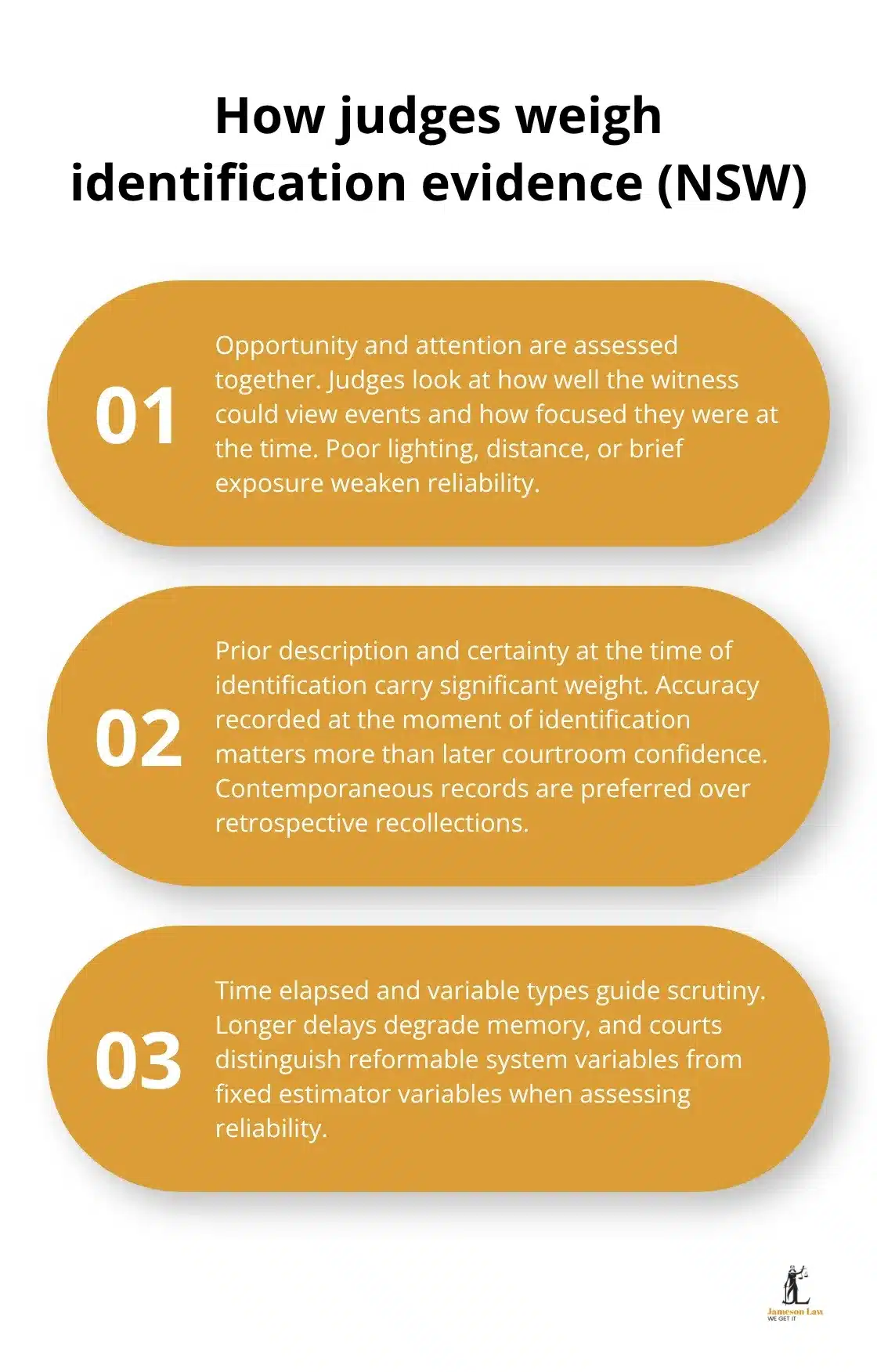
Estimator variables are crime-scene conditions beyond police control, such as lighting or distance. Courts now recognise they can address system variables through procedural reform but must treat estimator variables as fixed limitations on reliability.
System Variables and Police Procedures
This distinction has reshaped how NSW courts evaluate identification evidence, particularly regarding photo arrays, which now dominate police practice despite research showing live lineups produce more reliable identifications when properly administered. Documentation matters enormously in this assessment. A witness statement recorded immediately after an incident, ideally with video footage of the identification procedure, provides far stronger evidence than testimony months later about what the witness claims they said.
Courts have recognised that witness confidence can inflate artificially over time through repeated rehearsal and suggestion, making contemporaneous records essential for detecting whether confidence has genuinely increased or simply been reconstructed through later discussion. Australian courts have begun adopting reason-based jury instructions that explicitly explain why in-court confidence should be discounted when it conflicts with earlier identification procedures.
How Jurors Weigh Conflicting Evidence
Research on mock juries demonstrated that jurors who received explanations for why confidence is unreliable convicted at substantially lower rates than those receiving standard instructions, particularly when the instructions clarified the difference between police lineup identifications and courtroom identifications. This evidence has influenced judicial practice across NSW, though inconsistently. The practical consequence is that your testimony’s weight depends far less on how you appear in the witness box than on the quality of evidence surrounding how and when you made statements to police or other investigators.
Final Thoughts
Courts assess witness statement credibility through a rigorous, multi-layered process that extends far beyond accepting what someone says in the witness box. Consistency across accounts, opportunity to observe, corroboration with physical evidence, and scrutiny of motive and bias form the backbone of how Australian judges evaluate testimony. Yet the most critical insight remains this: confidence in court bears little relationship to accuracy, and a witness who appears certain may have constructed a false memory through suggestion and time.
The procedures police use to gather identification evidence, the timing of witness statements, and the quality of corroborating proof all carry far more weight than demeanour or courtroom composure. System variables-the factors police control-can be challenged and reformed, while estimator variables like lighting or distance remain fixed limitations on what any witness could have perceived. Documentation at the earliest opportunity and contemporaneous records of what witnesses actually said can fundamentally shape outcomes in your matter.
We at Jameson Law have extensive experience navigating witness evidence in criminal, personal injury, and civil matters across NSW. Whether you need advice on preparing your own testimony or challenging the reliability of evidence against you, our team can guide you through the legal process and explain how courts will weigh the evidence presented.