


A severe injury disrupts your health, finances, and daily life. Navigating personal injury NSW claims requires understanding that not all accidents follow the same legal pathway. Whether you are dealing with a workplace incident, a motor vehicle crash, or medical negligence, identifying the correct legal framework is your crucial first step.
At Jameson Law, we guide clients through the entire claims process. This comprehensive guide clarifies the differences between fault-based negligence claims and no-fault statutory schemes, outlines strict legal deadlines, and details what to expect from your first consultation through to settlement.
Negligence Claims vs. Statutory Schemes
A common misconception is that all personal injury claims require you to prove another person’s negligence (that they owed a duty of care, breached it, and caused your injury). In NSW, this is only true for specific types of claims.
Fault-Based Negligence Law
Claims for public liability (such as a slip and fall in a supermarket) and medical negligence operate under the Civil Liability Act 2002 (NSW). For these claims, you bear the legal burden of proving the four elements of negligence: duty of care, breach of that duty, causation, and measurable damage. If you cannot establish fault, your claim will fail.
Statutory “No-Fault” Schemes
Conversely, the Workers Compensation and Compulsory Third Party (CTP) motor accident schemes operate largely as statutory safety nets. Administered by the State Insurance Regulatory Authority (SIRA), these schemes provide early statutory benefits—such as medical expenses and weekly income support—often without the need to prove that an employer or another driver was negligent.
However, if your injuries are severe and you wish to pursue a lump-sum common law damages claim under these schemes (like Work Injury Damages or a CTP damages claim), you will generally need to prove fault and meet strict whole-person impairment thresholds.
| Claim Type | Legal Framework | General Claim Deadline |
|---|---|---|
| Public Liability & Medical Negligence | Negligence / Common Law | Generally 3 years from the date of discoverability. |
| Workers Compensation | Statutory Benefits & Work Injury Damages | Generally 6 months (subject to specific exceptions). |
| Motor Vehicle Accidents (CTP) | Statutory Benefits & CTP Damages | 28 days for backdated weekly benefits; 3 months for stat benefits; generally 3 years for damages. |
Strict Time Limits for Personal Injury NSW Claims
Failing to adhere to statutory deadlines can permanently extinguish your right to compensation. The deadlines vary drastically based on the type of claim.
The 3-Year Discoverability Rule and 12-Year Long-Stop
For common law damages claims, Section 50C of the Limitation Act 1969 (NSW) sets a strict deadline. You must commence court proceedings within three years from the date the cause of action was “discoverable” by you.
Under Section 50D, an injury is generally discoverable when you know, or ought reasonably to have known, that the injury occurred, was caused by the fault of the defendant, and was sufficiently serious to justify bringing an action. Additionally, there is an absolute 12-year long-stop period running from the date of the act or omission that caused the injury.
While missing these deadlines is catastrophic, it does not always automatically bar a claim. Courts possess limited statutory extension mechanisms in exceptional circumstances, but obtaining an extension is difficult. Minor claimants and individuals with certain legal incapacities also have distinct rules.
Statutory Scheme Administrative Deadlines
If you are claiming through SIRA-regulated schemes, you face much earlier administrative deadlines:
- CTP Claims: To ensure your weekly income support is backdated to the date of the crash, you must lodge your claim within 28 days. The final deadline for statutory benefits is generally 3 months.
- Workers Compensation: You must generally lodge a formal claim within 6 months of the injury, though exceptions apply for ignorance, mistake, or absence from the state.
The Claims Process: From Consultation to Settlement
Every claim requires structured, methodical preparation to establish liability, quantify damages, and negotiate with insurers.
1. Initial Consultation and Claim Assessment
Your first meeting with a personal injury lawyer sets the foundation. We will assess the facts, identify the correct legal framework (negligence vs. statutory), and determine if the claim is legally and financially viable to pursue. We will also advise you of the specific time limits applying to your matter.
2. Evidence Gathering and Medico-Legal Examinations
Insurers base their decisions on objective evidence. This phase involves obtaining complete clinical notes from treating doctors, securing CCTV or incident reports, and taking witness statements. Crucially, your lawyer will arrange an independent medico-legal examination. This expert assesses the stability of your injury, evaluates your Whole Person Impairment (WPI), and outlines your future treatment needs.
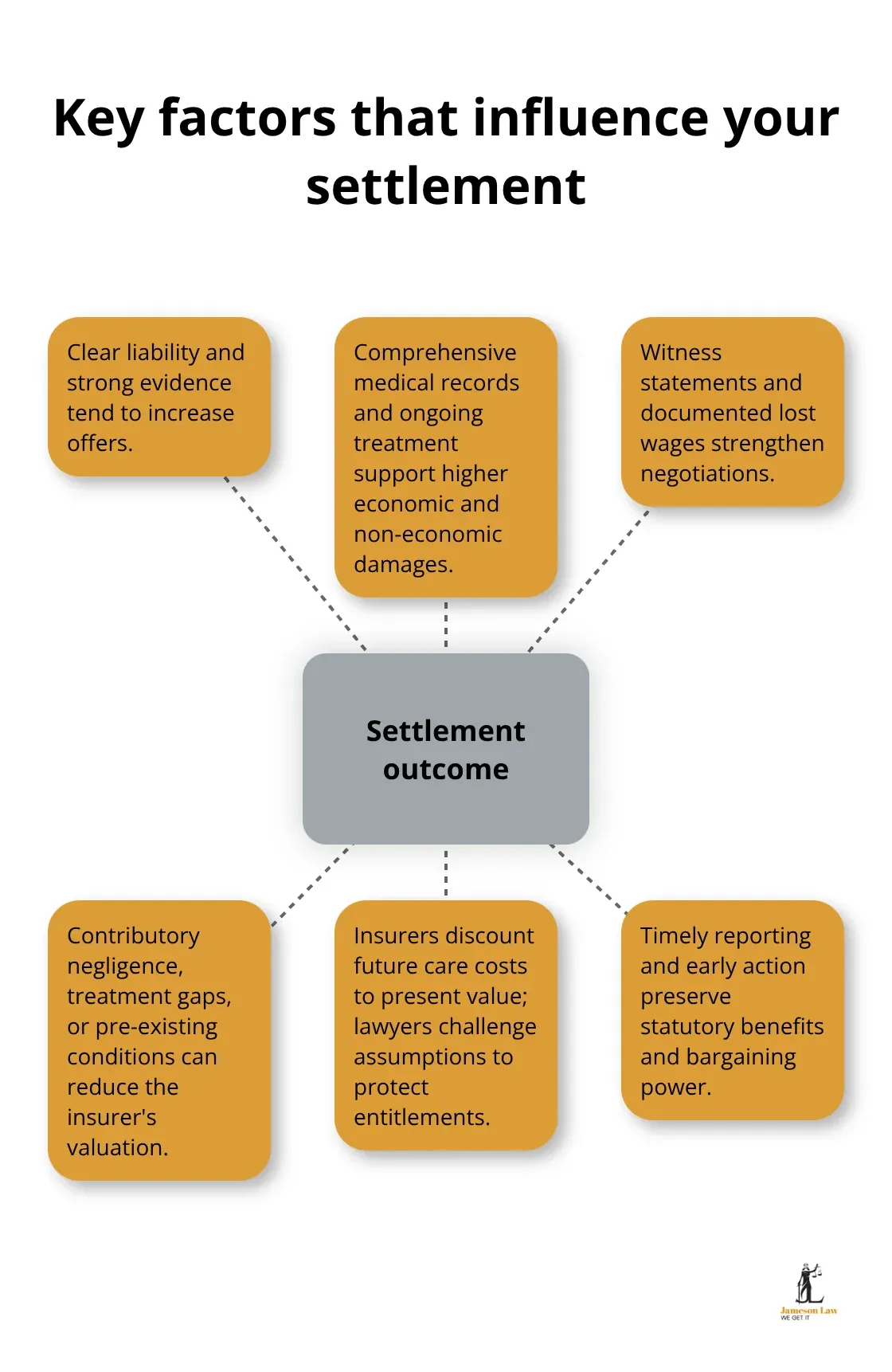
3. Assessing Heads of Damage
Your compensation is dictated by the specific regime governing your claim. Generally, damages are divided into:
- Economic Loss: Proven past and future lost earnings, out-of-pocket medical expenses, and care costs.
- Non-Economic Loss: Compensation for pain and suffering. Access to this head of damage is heavily restricted and usually requires surpassing a strict WPI threshold (e.g., greater than 10% for CTP claims, or 15% for Workers Compensation WID claims).
No lawyer can promise “full compensation,” as statutory caps and thresholds strictly limit the amounts recoverable in NSW.
4. Settlement Negotiations and Litigation
Once evidence is compiled, a formal demand or settlement offer is made to the insurer. Many personal injury matters resolve through alternative dispute resolution, such as informal settlement conferences or mediation, avoiding the need for a contested court hearing. However, if an insurer denies liability or undervalues the claim, commencing court proceedings or lodging a dispute with the Personal Injury Commission may be necessary.
Frequently Asked Questions
Do all personal injury claims in NSW require proving negligence?
No. While public liability and medical negligence claims do, statutory schemes like workers compensation and CTP motor accidents provide initial statutory benefits regardless of who was at fault.
What is the time limit for a personal injury damages claim in NSW?
Under the Limitation Act 1969, a personal injury damages claim must generally be commenced within 3 years from the date the injury became ‘discoverable’, subject to a 12-year long-stop and limited court extension mechanisms.
Are the time limits different for workers compensation and CTP claims?
Yes. You generally must lodge a workers compensation claim within 6 months. For CTP statutory benefits, you generally have 3 months to claim, but must lodge within 28 days to receive backdated weekly income payments.
Final Thoughts
Managing personal injury NSW claims requires meticulous attention to statutory deadlines and a clear understanding of the evidentiary thresholds dictated by your specific legal pathway. Whether relying on a no-fault statutory scheme for immediate medical support or building a complex negligence claim for common law damages, early action is vital to preserve evidence and protect your rights.
Because each scheme has different evidence and deadline rules, relying on informal advice or delaying action can prejudice a claim. If you have been injured, you can access free initial legal information through LawAccess NSW or consult a private practitioner.
To ensure your claim is categorized correctly and lodged within the strict NSW time limits, contact the experienced personal injury team at Jameson Law today.