

Dog Attack Injury NSW: Proving Liability and Seeking Compensation
A dog attack can leave you with serious physical injuries, psychological trauma, mounting medical bills, and deep uncertainty about your legal rights. In New South Wales, dog owners are held legally responsible for the injuries and losses their animals cause, but understanding how to properly build a public liability case requires clear, authoritative guidance.
We at Jameson Law help injured people navigate dog attack injury NSW claims every day. This guide walks you through your legal options under state legislation, what evidence matters most, and how compensation payouts are calculated in 2026.
Understanding Dog Attack Liability in NSW
Strict Liability for Companion Animals
Under NSW law, dog owners face strict liability for injuries their animals inflict. This means you do not need to prove the owner acted carelessly or knew the dog was aggressive—liability exists simply because the animal caused harm.
The Companion Animals Act 1998 (NSW) establishes this principle clearly: owners must take all reasonable precautions to prevent their dog from escaping a property, and they must answer for the consequences if it attacks.
If a dog rushes at, attacks, bites, or harasses a person, the owner faces statutory fines of up to $11,000. If gross recklessness caused the attack, penalties can soar to $22,000 and two years’ imprisonment, while incidents involving restricted or declared dangerous dogs carry penalties of up to $77,000.
How Negligence Strengthens Your Civil Claim
While strict liability applies automatically, establishing additional negligence adds significant weight to your personal injury claim. You can demonstrate negligence by showing the owner failed to take reasonable steps to prevent a known risk—such as leaving a historically aggressive dog unmuzzled or failing to secure front gates despite council warnings. If the attack stemmed from a reckless omission, you have grounds for a comprehensive negligence claim with robust backing for damages.
When Local Councils Bear Responsibility
Local government authorities hold statutory obligations to protect the public from menacing or dangerous dogs. If your local council received repeated notifications about an aggressive animal but failed to issue control orders, execute property inspections, or seize the dog, the council itself may face liability for negligence.
The Office of Local Government (OLG) publishes quarterly dog attack incident reports tracking data submitted by councils across NSW. These public records prove valuable because they document whether an authority had prior knowledge of an animal’s violent history. To hold a council liable, you must prove they held actual knowledge of the ongoing risk and breached their statutory duty of care.
Filing a Personal Injury Claim After an Attack
The actions you take immediately following a dog bite directly dictate the success of your insurance or civil litigation outcome. Witnesses move away, memories fade, and physical evidence degrades rapidly, making early action essential.
Critical Immediate Steps
- Report to Authorities: Contact your local council or NSW Police immediately. An official incident report creates an unassailable timeline and permanent record. Request the reference number.
- Secure Medical Documentation: Seek immediate medical evaluation at a hospital or GP clinic. Detailed medical records provide the primary evidentiary link connecting the trauma to your physical wounds.
- Capture Visual Evidence: Take clear, high-resolution photographs of your injuries before treatment, the clothing worn during the attack, and the exact scene (including unsecured gates or a lack of warning signs).
- Gather Party & Witness Details: Request the owner’s full name, residential address, and home and contents insurance details (which usually cover public liability claims). Secure contact parameters for any eyewitnesses.
Under the Limitation Act 1969 (NSW), you have a strict window of three years from the date of the attack to commence court proceedings. Initiating the claim within the first six months ensures evidence remains decision-ready.
Compensation and Damages in Dog Attack Cases
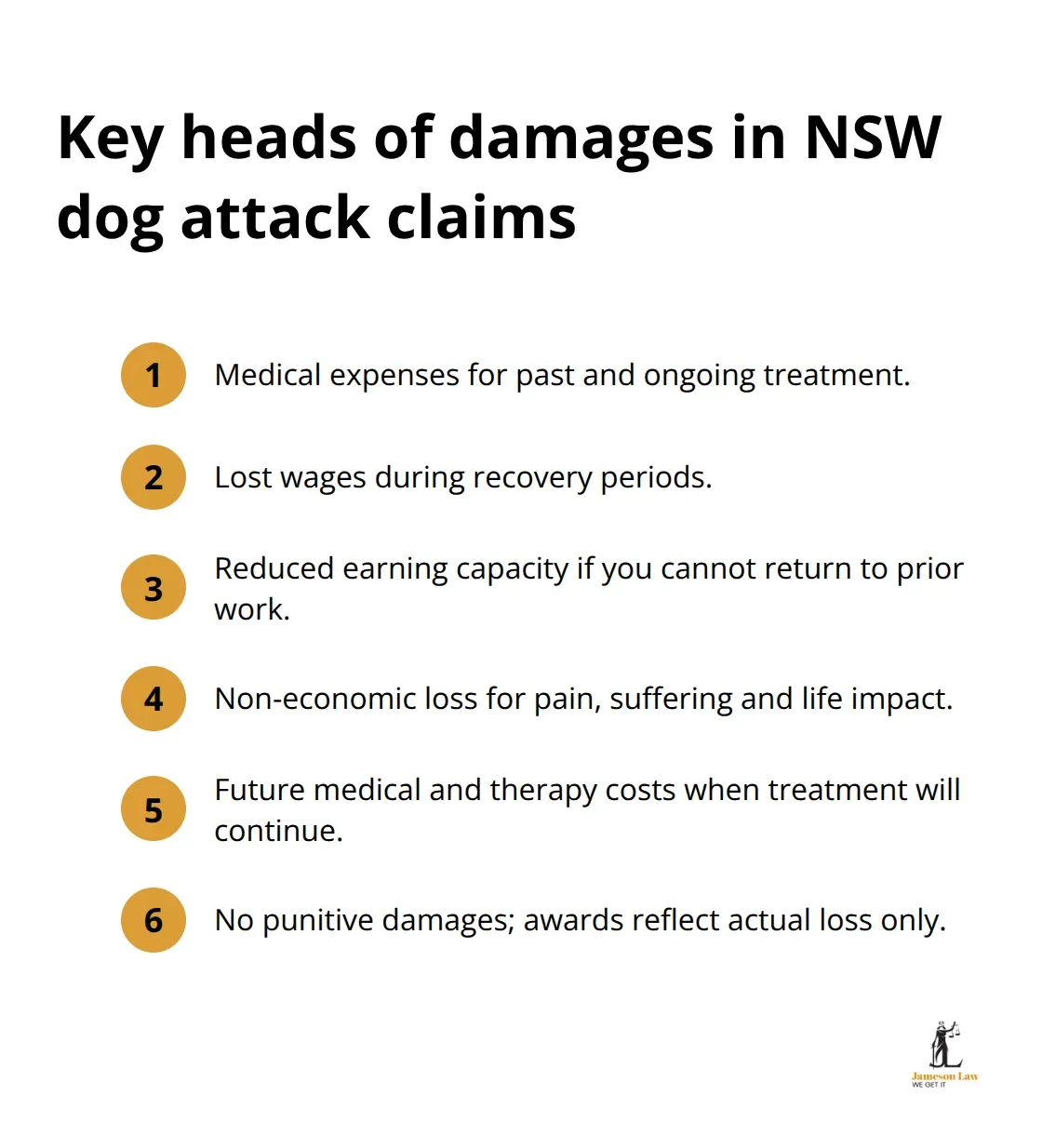
NSW courts divide public liability compensation into two clear categories under the Civil Liability Act 2002 (NSW). Payouts are calculated strictly on verifiable losses and injury severity scores:
| Damage Category | What it Covers | Required Evidence |
|---|---|---|
| Economic Loss | Quantifiable financial harm flowing directly from the attack, including past and future expenses. | Hospital bills, specialist fees, rehabilitation invoices, payslips, and tax returns. |
| Non-Economic Loss | Intangible harm including physical pain, emotional trauma, permanent scarring, or loss of enjoyment of life. | Medico-legal reports, psychological assessments, and photographic injury tracking. |
Quantifying Financial Harm
Medical expenses form the baseline of your claim. This encompasses emergency room procedures, ambulance fees, general practitioner consults, physical rehabilitation, and psychological care for post-traumatic stress. If a severe bite resulted in permanent nerve damage or complex lacerations, future economic losses—such as plastic surgery for scar revision—are factored in via expert medical prognoses.
Furthermore, past and future lost wages are heavily weighted. If your injuries or ongoing medical reviews prevent you from returning to work or alter your long-term earning capacity, financial analysts calculate your projected career loss across your working lifetime, protecting your stability.
Final Thoughts
A successful dog attack injury NSW claim depends entirely on rapid evidence compilation and a thorough understanding of state liability rules. Because dog owners are bound by strict liability standards, proving the occurrence and the resulting damage is your primary legal objective, alongside addressing potential council oversights.
Navigating insurance company adjusters or council legal panels independently exposes you to inadequate, early settlement offers that fail to account for long-term recovery costs. Partnering with a highly experienced personal injury team ensures your civil rights remain protected under the laws of New South Wales.
At Jameson Law, we handle public liability and animal injury matters on a strict No Win, No Fee basis, ensuring you face no upfront financial barriers during recovery. Contact our expert Sydney lawyers today for a comprehensive, transparent assessment of your case parameters.