

A slip and fall accident can happen in seconds, but the physical and financial consequences often last much longer. If you have been injured due to someone else’s negligence on a commercial, public, or private premises in New South Wales, you hold a statutory right to pursue comprehensive compensation.
At Jameson Law, our expert personal injury team helps injured Australians understand their slip fall NSW claim options and systematically navigate the legal landscape. This authoritative guide walks you through what is required to build an unassailable public liability case in 2026.
What Counts as a Slip and Fall in NSW
Definition and Legal Framework
A slip and fall injury occurs when you suffer physical or psychological harm on another party’s property because of a distinct hazard they failed to manage. The critical legal parameter is that the injury must stem directly from a breach of duty—meaning the property owner, occupier, or manager knew about the hazard (or reasonably should have known) and failed to rectify it or provide adequate warnings.
Under the Civil Liability Act 2002 (NSW), occupiers owe a strict duty of care to ensure their premises are safe for visitors. When they fail to maintain this standard, it constitutes actionable negligence.
Common Locations and Chain of Responsibility
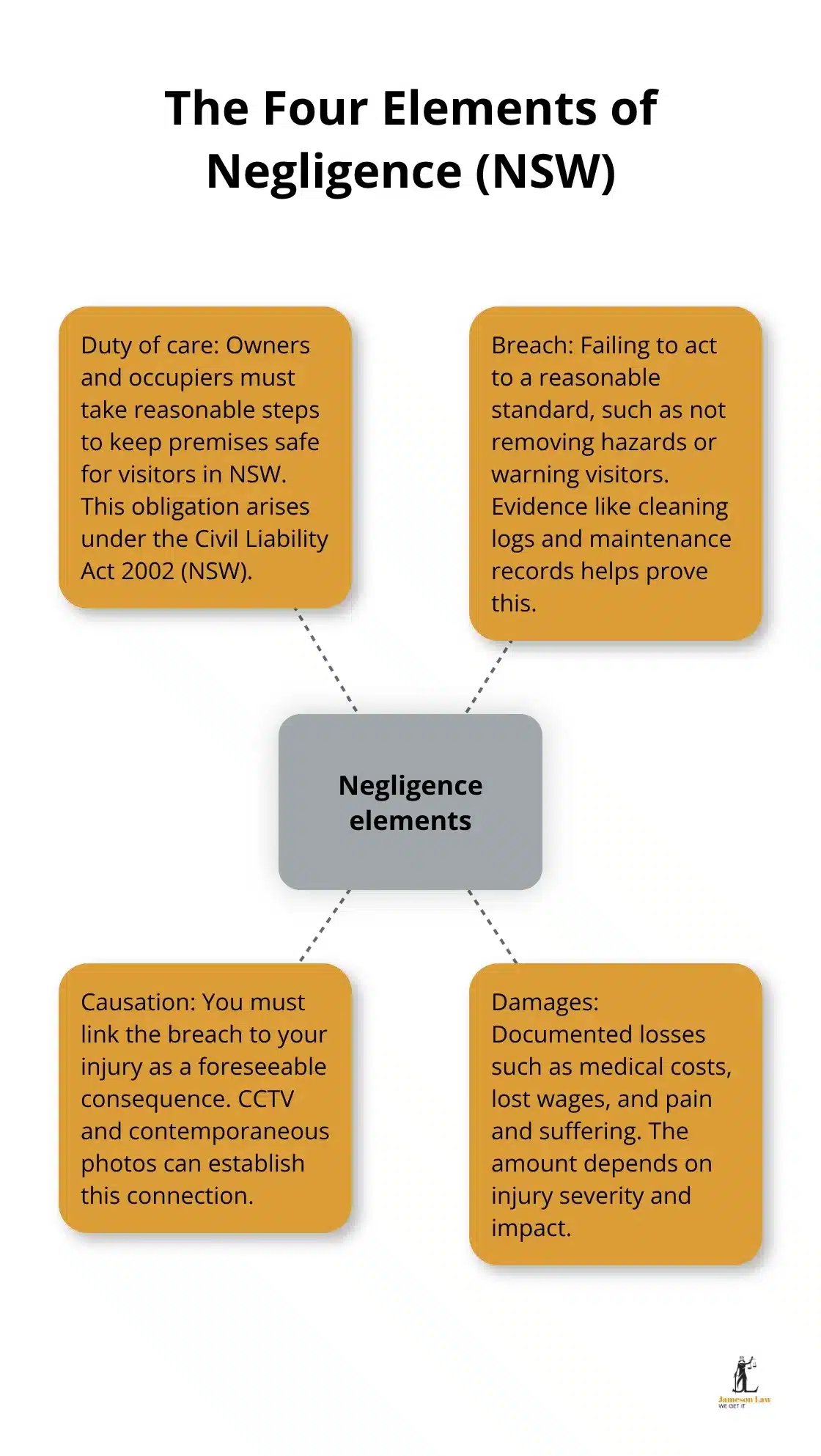
Workplace, commercial, and council environments carry distinct liability rules under public liability protocols. Responsibility is determined strictly by who commands operational control over the specific hazard area:
| Accident Scene | Typical Hazard Types | Liable Controlling Party |
|---|---|---|
| Supermarkets & Shopping Centres | Liquid spills, loose packaging, wet floors from cleaning without signage. | Retail Occupier / Centre Management |
| Restaurants, Cafés & Pubs | Leaking drink stations, grease build-up, dropped food items. | Venue Owner / Business Operator |
| Public Footpaths & Plazas | Severely cracked concrete, raised tree roots, broken drainage grates. | Local Municipal Council |
While retail managers must execute regular floor inspection cycles, claims involving public walkways run by a local council require satisfying additional, more stringent knowledge thresholds under roads authority protection provisions. Understanding who holds the underlying responsibility for the structural defect or temporary spill forms the baseline of your entire civil litigation file.
Establishing Negligence in Your Slip and Fall Claim
The Four Essential Legal Pillars
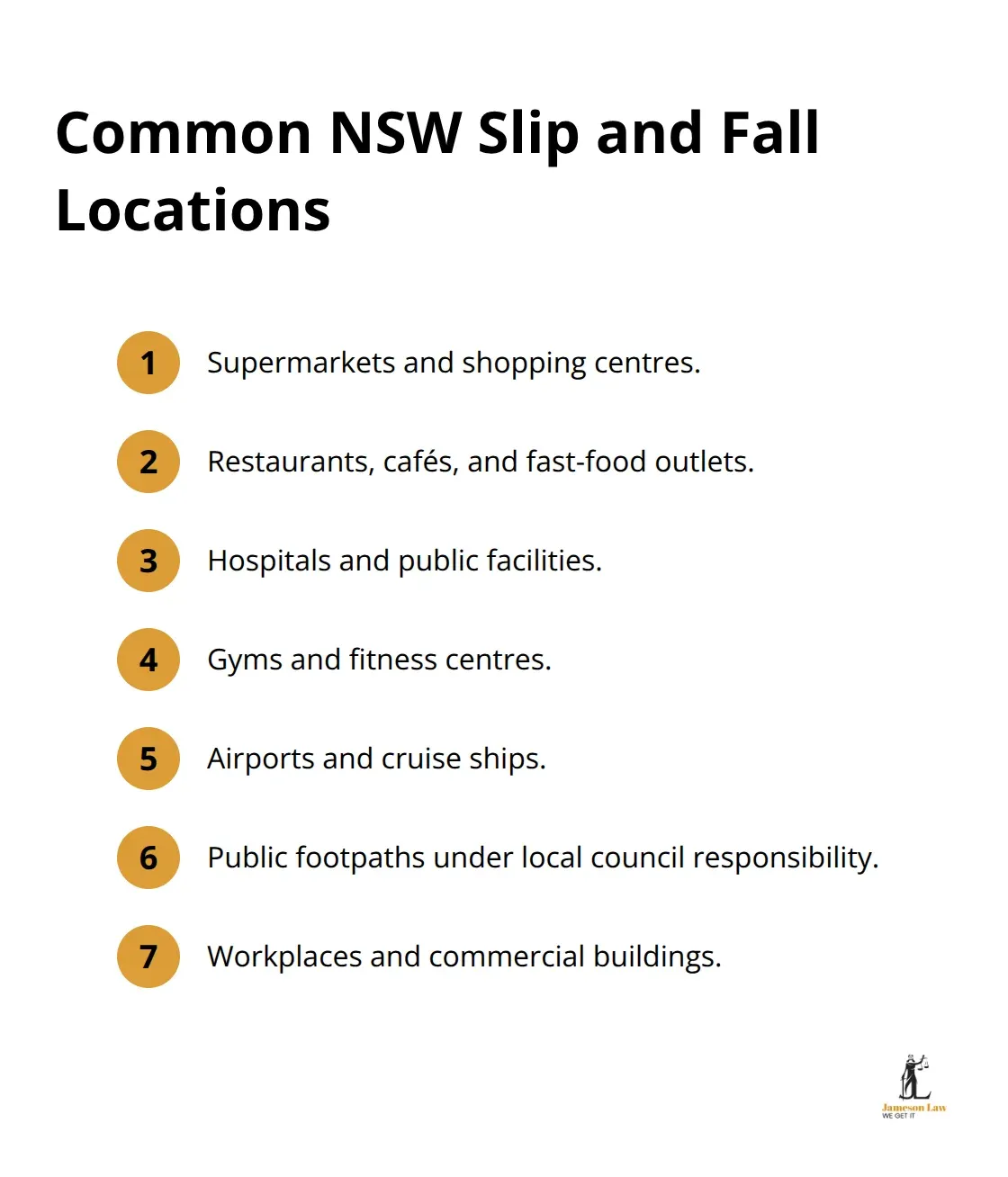
To secure a positive compensation outcome under New South Wales common law, your case must comprehensively prove four distinct legal elements:
- 1. Duty of Care: Proving the defendant held a lawful obligation to ensure your safety while entering their commercial or public premises.
- 2. Breach of Duty: Demonstrating the occupier failed to act as a “reasonable person” would—such as ignoring a known roof leak or skipping scheduled floor sweeps.
- 3. Causation: Establishing a direct link proving that the hazard itself was the proximate cause of your physical injury, rather than an unrelated pre-existing condition.
- 4. Measurable Damages: Presenting verified economic or non-economic losses flowing directly from the accident.
Statutory Caps and Time Parameters
For individuals suffering catastrophic, life-altering trauma, the maximum statutory payout for non-economic loss (pain and suffering) under Civil Liability indexing sits at approximately $804,000 for the 2025/2026 period, with minor to moderate injuries scaled proportionally according to injury severity scores.
Under the strict guidelines of the Limitation Act 1969 (NSW), you have a rigid window of three years from the date of the injury to formally launch court proceedings. Missing this statutory parameter permanently bars your claim.
Steps to Take After a Slip and Fall Accident
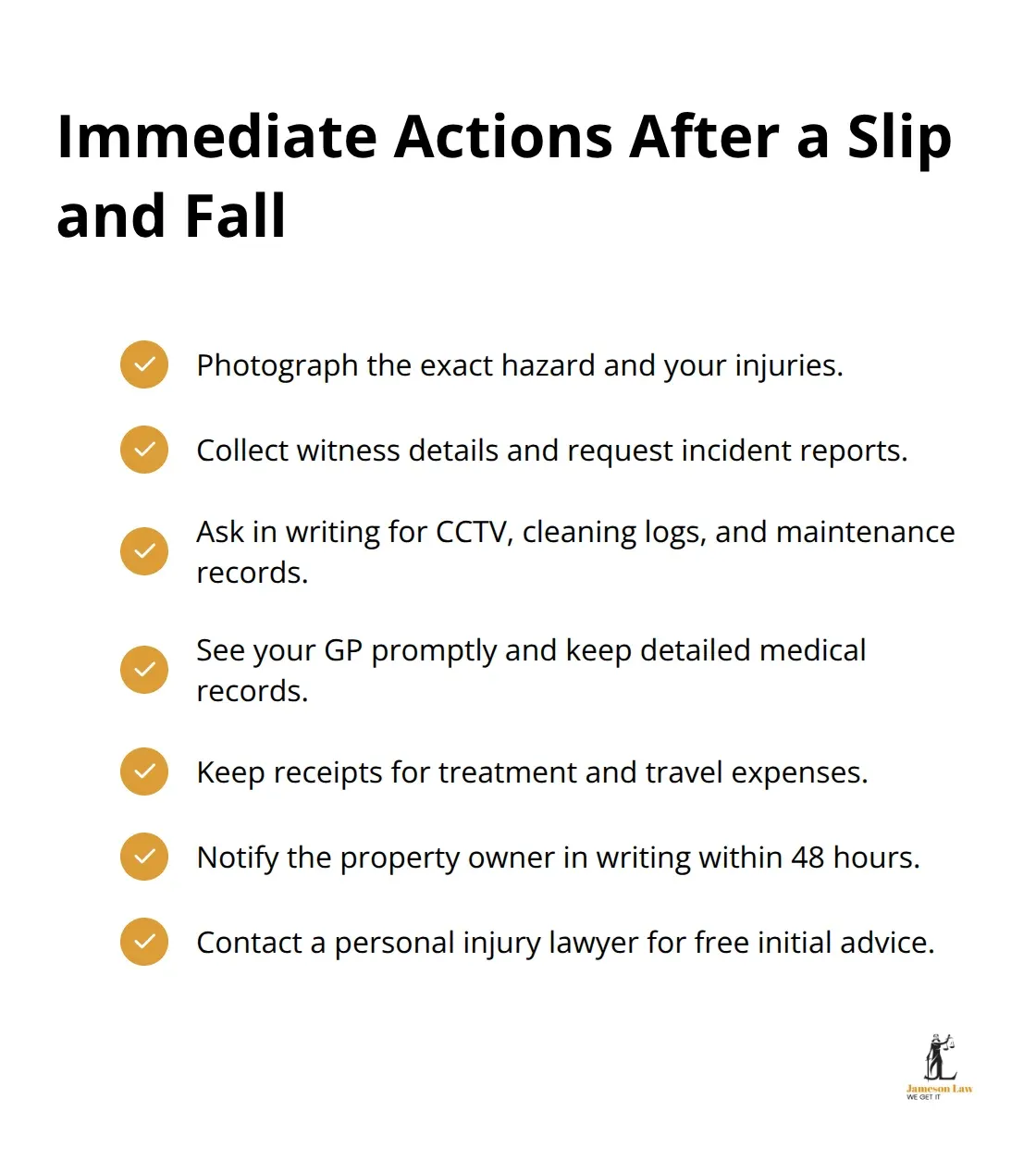
The first hour following an injury is the most critical window for evidence compilation. Insurers frequently dispute the presence or duration of transient hazards like spills, making early, decisive action vital:
- Capture Immediate Photographic Evidence: Photograph the exact hazard from multiple distances and angles before staff clean it. Capture the fluid, ice, structural defect, and the absolute lack of wet-floor warning pylons.
- Secure Independent Witness Data: Gather names, phone numbers, and email parameters from fellow customers or bystanders who observed your fall or commented on the hazard.
- Lodge a Written Incident Report: Demand the manager record the event in their official register. Secure a signed photocopy or take a photo of the completed accident report sheet before leaving.
- Formally Request CCTV Preservation: Instruct your lawyer to issue an immediate, binding evidence-preservation notice to management. Most commercial retail surveillance loops automatically overwrite their digital drives within 14 to 30 days.
- Obtain Timely Medico-Legal Records: Visit an emergency department or your local general practitioner without delay. Gaps between the accident date and your first medical consult allow insurance adjusters to argue the injury occurred elsewhere.
Final Thoughts
A successful slip fall NSW claim depends entirely on the empirical evidence secured during the opening stages of your matter. Detailed scene photographs, medical certificates, independent statements, and cleaning logs transform an unverified claim into ironclad proof of an occupier’s negligence.
Strategic Litigation Note: Attempting to negotiate directly with corporate insurance panels independently exposes unrepresented claimants to low-ball settlement offers that fail to account for long-term rehabilitation or permanent loss of earning capacity. Insurers are commercially trained to protect their bottom line by minimizng your trauma.
At Jameson Law, our highly experienced personal injury team operates on a strict, transparent No Win, No Fee framework, ensuring you face absolutely no financial risk or upfront legal costs during your recovery. Contact our Sydney and Parramatta offices today for a free, no-obligation evaluation of your claim’s parameters, and let us secure the maximum compensation you are entitled to under New South Wales law.