

Personal injury claims in NSW come with strict financial limits that many people do not fully understand until it is too late. These NSW personal injury limits can significantly affect how much compensation you receive, regardless of how serious your injury feels to you.
At Jameson Law, our highly experienced legal team has seen countless claimants surprised by legislative caps on weekly payments, medical expenses, and lump sum amounts. Knowing these limits upfront helps you proactively plan your claim strategy and understand exactly what to expect in 2026.
Why NSW Personal Injury Claims Have Different Caps
Statutory caps exist because NSW law deliberately limits compensation to manage state insurance premiums and provide predictable legal outcomes. The Civil Liability Act 2002 (NSW) and other pivotal legislation set these boundaries across different claim types.
These caps vary significantly depending entirely on how your injury occurred. Understanding which legislative regime applies to your situation is the critical first step to knowing what you can realistically recover.
| Legislative Regime | Applies To | Key Severity Threshold |
|---|---|---|
| Workers Compensation Act 1987 | Workplace injuries and occupational illnesses. | Thresholds apply for lump sum impairment payouts; weekly wage caps apply. |
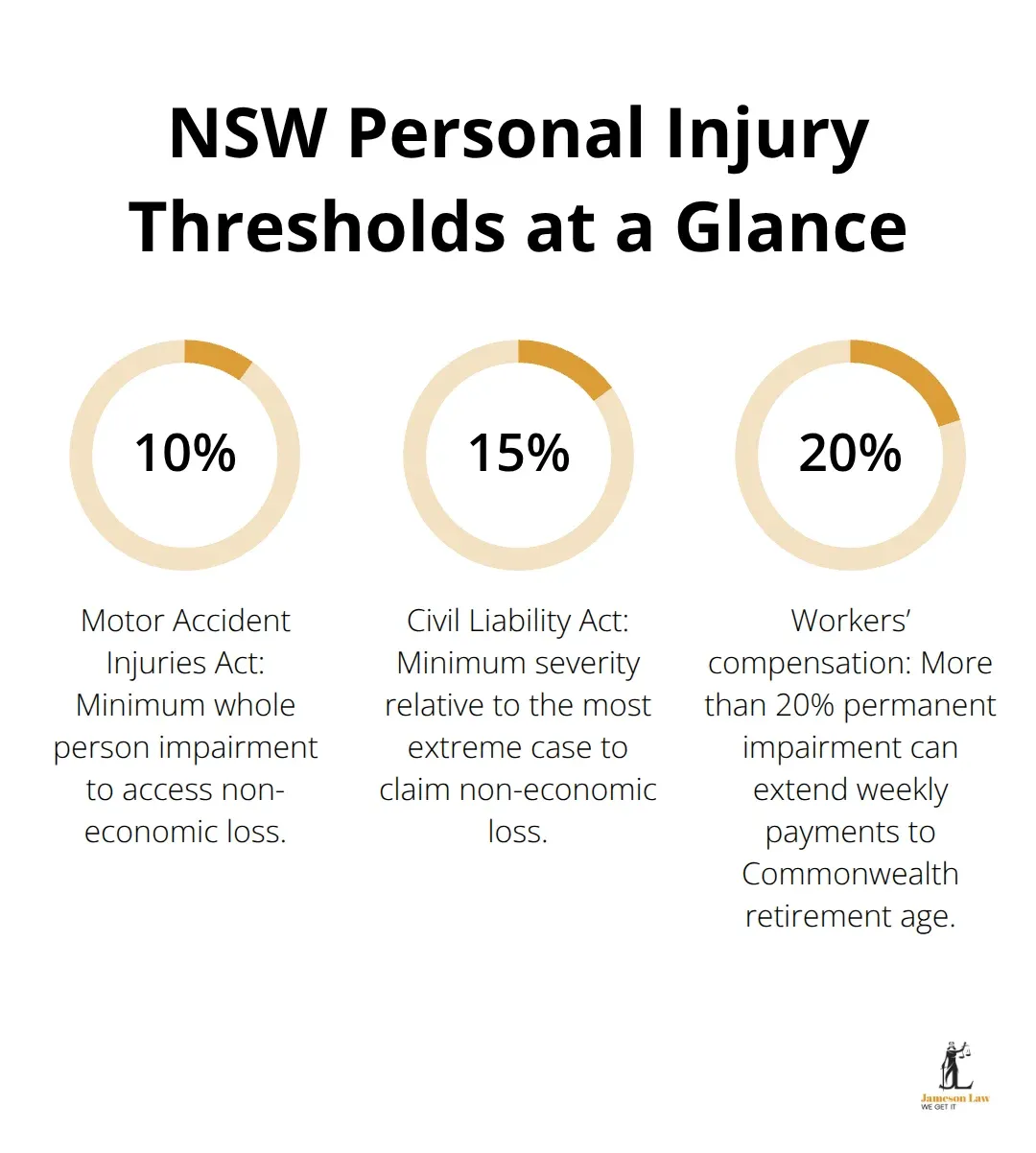
| Motor Accident Injuries Act 2017 | Car, motorcycle, and pedestrian accidents (CTP). | Requires >10% Whole Person Impairment (WPI) for pain & suffering. |
| Civil Liability Act 2002 | Public liability, medical negligence, slip and falls. | Requires at least 15% severity of a most extreme case. |
Economic Loss Caps Differ Dramatically Between Regimes
The calculation of past and future wage loss depends completely on your claim category:
- Civil Liability Claims: Past economic loss for wages is strictly capped at three times the NSW average weekly earnings. For example, based on an average of $2,010 per week, the absolute maximum you can recover is approximately $6,030 per week, regardless of whether your actual corporate salary was higher.
- Motor Vehicle Claims: Damages for economic loss are capped by legally disregarding any net weekly earnings above $6,334 per week.
- Workers’ Compensation: Pays a percentage of your Pre-Injury Average Weekly Earnings (PIAWE), capped by a firm statutory maximum that is indexed bi-annually by SIRA.
Non-Economic Loss Thresholds Lock Most Claimants Out
Non-economic loss covers intangible damages like pain, suffering, and loss of amenity. The Civil Liability Act 2002 requires your injury to reach at least 15% severity relative to a most extreme case before you can recover a single dollar for pain and suffering.
This is a substantial legal hurdle designed to exclude minor-to-moderate injuries entirely. Once you meet that threshold, the maximum you can recover is capped at $804,000 (indexed for the 2025/2026 period). In contrast, workers’ compensation does not directly compensate for generic “pain and suffering”; instead, it provides structured lump sum payouts based purely on permanent medical impairment percentages.
Current Cap Amounts and How They Apply
Workers’ Compensation Payment Structures
Workers’ compensation operates on a fundamentally different basis than civil litigation. Weekly payments for general workers start at up to 95% of your pre-injury average weekly earnings for the first 13 weeks, then safely drop to 80% from weeks 14 to 130.
Most benefits cap entirely at five years. However, if your permanent impairment exceeds 20%, you may receive payments until Commonwealth retirement age. Workers with the highest clinical needs can receive weekly payments up to the absolute statutory cap, which reached $2,662.10 per week as of April 2026.
Gratuitous Care Thresholds
Gratuitous care damages—compensation for unpaid domestic assistance provided by family or friends—have rigid requirements that unrepresented claimants frequently miss. You must unequivocally prove that the care was provided for at least six hours per week for six consecutive months.
Once you meet that threshold, the maximum rate is calculated at one-fortieth of the NSW average weekly earnings per hour (roughly $50.25/hour as of recent metrics). Commercial care costs (paid professional services) are recoverable separately and must be deemed reasonable and necessary for your rehabilitation.
Breaking Through Standard Caps
The caps outlined above represent the default limits, but they are not absolute ceilings for every single claim. NSW law recognises specific operational exceptions where claimants can access compensation beyond these standard thresholds.
Exempt Worker Classifications
Workers classified as “exempt” under the workers’ compensation scheme—such as police officers, paramedics, firefighters, and coal miners—operate under the pre-2012 legislative scheme. This creates a highly distinct payment structure that routinely yields broader lifetime benefits than standard corporate workers receive.
Dust Diseases and Intentional Acts
Certain catastrophic claims fall outside the standard capping framework altogether. The Dust Diseases Act 1942 (NSW) permits common law damages through the Dust Diseases Tribunal for permanent impairment, allowing a dual compensation pathway. Additionally, injuries arising from intentional acts, sexual abuse claims, and criminal conduct are explicitly excluded from the standard Civil Liability Act 2002 caps, meaning financial compensation in these categories may significantly exceed standard limits.
Final Thoughts
NSW personal injury limits fundamentally dictate what you can realistically recover, and understanding these caps before you enter mediation prevents devastating financial mistakes. The specific legal regime that applies to your injury determines not just the dollar amounts available, but whether you can recover anything at all for intangible pain and suffering.
Your strategy must begin by identifying which legislation governs your circumstances and verifying whether your injury qualifies for high-tier exceptions. Because statutory indexation changes twice yearly in April and October, timing your claim resolution strategically with an expert lawyer can heavily influence your final payout.
Contact Jameson Law today to have your case assessed against the full range of applicable NSW caps and thresholds. We provide personal injury representation on a transparent No Win, No Fee basis, meaning you pay zero legal fees unless we successfully recover compensation for you. Let our expert Sydney team ensure your settlement adequately covers your long-term medical and financial needs.