

A workplace injury can turn your life upside down, leaving you uncertain about your financial future and recovery options. NSW workers compensation benefits exist to support you through this difficult time, securely covering lost wages, medical costs, and rehabilitation services.
At Jameson Law, we have helped countless injured workers across Sydney understand their statutory entitlements and navigate the complex claims process. This definitive guide breaks down exactly what you may be entitled to and how to aggressively protect your rights in 2026.
Understanding the NSW Workers Compensation System
NSW workers compensation operates as a state-based insurance scheme regulated by the State Insurance Regulatory Authority (SIRA). When you suffer an injury at work or develop a work-related illness, this scheme provides financial support and medical coverage while you recover.
The system functions differently from standard public liability claims because it operates on a strict no-fault basis—you do not need to prove your employer acted negligently to receive benefits. As long as your injury or illness resulted from your employment, you typically qualify. This fundamental difference streamlines the initial support framework for injured workers.
Who Qualifies for NSW Workers Compensation?
Most employees working in NSW receive coverage under the scheme. If an NSW employer employs you, you almost certainly qualify regardless of whether your employer has formally obtained workers compensation insurance (although the law mandates they do so).
However, independent contractors and self-employed individuals typically do not receive coverage under the standard scheme. Workers in federal employment fall under Comcare rather than SIRA. Your employment status determines your eligibility far more than your job title, making proper classification vital.
What You’ll Receive Under NSW Workers Compensation
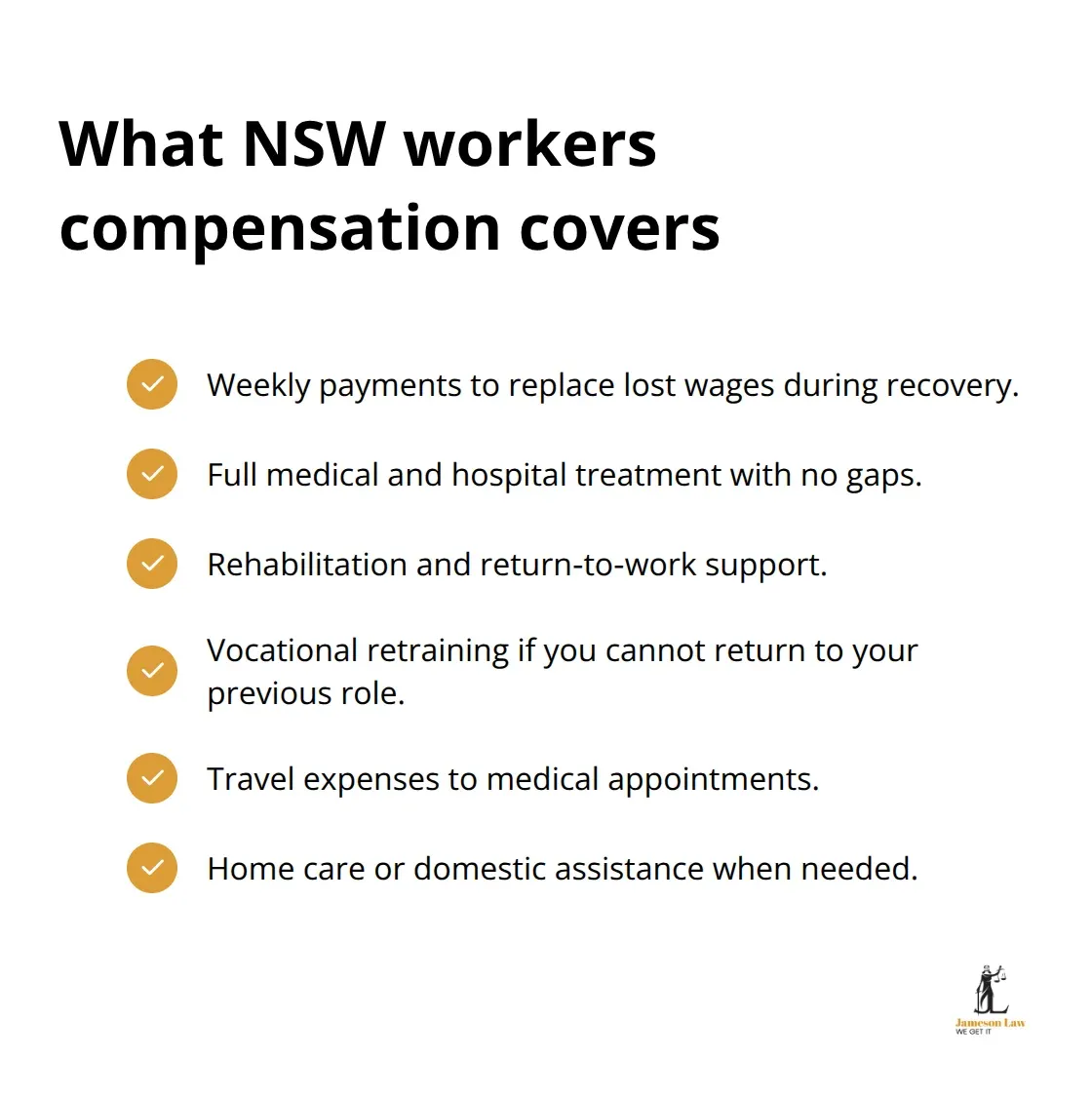
NSW workers compensation provides three primary forms of financial and practical support. The scheme prioritises replacing your lost income first, covering your medical expenses directly, and eventually supporting your safe return to work.
1. Weekly Compensation Payments
Weekly compensation payments form the backbone of the scheme’s support. If you are entirely unable to work due to your injury, your income replacement is scaled based on your Pre-Injury Average Weekly Earnings (PIAWE).
| Entitlement Period | Payment Calculation (No Work Capacity) | 2026 Statutory Cap |
|---|---|---|
| Weeks 0 to 13 | Up to 95% of your Pre-Injury Average Weekly Earnings (PIAWE). | $2,662.10 per week |
| Weeks 14 to 130 | Scales down to 80% of your PIAWE. | $2,662.10 per week |
| Beyond 130 Weeks | Requires rigorous Whole Person Impairment (WPI) assessments to continue. | $2,662.10 per week |
Important 2026 Update: The absolute maximum statutory cap set by SIRA for weekly payments currently stands at $2,662.10 per week.
2. Medical and Hospital Treatment
Medical and hospital treatment covers all reasonable and necessary expenses related to your injury from the moment it occurs. This includes initial doctor visits, specialist consultations, surgical procedures, and ongoing allied health support (like physiotherapy). Unlike private health insurance, there are no “gap” payments—the scheme pays the full approved cost directly to the providers.
3. Rehabilitation and Return-to-Work Support
Rather than simply paying you to stay home, SIRA actively invests in getting you back to productive work. This includes vocational retraining if your injury prevents you from returning to your previous role, and funding workplace modifications. For permanent disabilities, you may receive a substantial lump sum compensation payment alongside ongoing support, recognising that some physical or psychological injuries create lasting limitations.
How to Claim Your NSW Workers Compensation Benefits
Report Your Injury to Your Employer Immediately
The moment you suffer a work injury, your absolute priority shifts to reporting it formally. SIRA data indicates that claims officially lodged within 30 days of injury process significantly faster. You must notify your employer as soon as reasonably practicable, ideally within 24 hours.
Written notification works far better than verbal reporting because it creates an empirical record that protects you if disputes arise later. Your employer cannot legally penalise you for reporting a legitimate work injury.
Lodge Your Formal Claim With the Insurer
After notifying your employer, you must lodge a formal claim with the workers compensation insurer (such as iCare). You must include robust medical evidence—specifically a formal Certificate of Capacity from your treating GP. Insurers will not approve income replacement without this specific documentation.
Understand the Assessment and Dispute Process
The insurer must assess your claim within 14 days and issue a liability decision. If approved, benefits commence rapidly. However, if your claim is rejected, you must act decisively. You can request an internal review or escalate the matter to the Independent Review Office (IRO) and the Personal Injury Commission (PIC). Navigating these legal pathways alone often leads to critical missed deadlines.
Final Thoughts
NSW workers compensation benefits provide essential financial stability and medical coverage when a workplace injury derails your life. However, understanding your statutory entitlements represents only half the battle. The true challenge lies in navigating the procedural claims process correctly to ensure you are not underpaid.
From formally reporting your injury within 24 hours to maintaining an uninterrupted string of Certificates of Capacity, every step matters. Missing key deadlines or submitting inadequate medical evidence can cost you thousands of dollars in lost weekly payments.
If your claim faces rejection or if the insurer attempts to prematurely cut off your benefits at the 130-week mark, highly experienced legal intervention is crucial. Contact Jameson Law today for practical, authoritative legal advice tailored to your specific workplace injury. Our expert Sydney team will ensure you secure the absolute maximum compensation available under the law.